 2024, Vol. 56


2. 中国科学院、水利部成都山地灾害与环境研究所, 成都 610299;
3. 中国科学院大学, 北京 100049
塑料以其性质稳定、实用性强、成本低廉等特点在日常生活、工业生产等众多领域被广泛使用[1]。据统计,1950—2015年全球生产的塑料总量高达78亿吨,其中仅约7.02亿吨被回收利用[2],大量塑料进入环境所导致全球性污染问题不容小觑。其中,微塑料,目前被定义为直径小于5 mm的塑料碎片或颗粒,由于其具有持久性和生物积累特性,受到了广泛的关注[3-4]。研究估算,通过高温消毒的奶瓶喂养,一年进入婴儿体内的微塑料总量可高达66万颗[5]。随着新冠病毒的传播,医护用品的高频使用也导致了微塑料污染的加剧[6]。微塑料已被认定为影响人类和土壤生态系统新兴污染物[7]。
微塑料,依据来源不同可分为原生微塑料和次生微塑料[8]。在生产时为了达到设计目的制造的直径小于5 mm的微塑料为原生微塑料[9],多见于洗涤、化妆用品以及部分医疗辅助品[10-12]。由于光解、风化、物理破碎、生物降解等作用分解或降解为较小塑料碎片的微塑料为次生微塑料[13-15],多见于塑料大棚薄膜残留物、工业垃圾、生活垃圾的塑料次生物。目前微塑料的种类多样,其中常见的主要有聚乙烯(PE)、聚丙烯(PP)、聚苯乙烯(PS)、聚氯乙烯(PVC),聚对苯二甲酸乙二醇酯(PET)等[16]。目前,针对环境微塑料的研究主要集中在海洋等水生生态系统[17-19],重点针对微塑料的潜在来源、分布和生态毒理等[20-22]。然而,越来越多的研究发现陆地是微塑料最大的汇集地,土壤中的微塑料总量可能是海洋微塑料的4倍~ 23倍[23],污染形势更加严峻。以农田土壤为例,据估算,欧洲和北美洲每年约(4.4 ~ 30)万吨微塑料被释放至农田环境。我国农田土壤微塑料也因农业活动的特征存在区域性污染差异,目前报道的微塑料丰度最高可达每千克土壤105个[24]。微塑料体积小、疏水性强,易在土壤环境中发生迁移,最终汇入海洋、湖泊等生态系统,因此探明微塑料在陆地系统中的环境行为是微塑料污染控制的关键。微塑料产生和进入环境的过程中不可避免地会与污染物共存,在葡萄牙沿岸和北太平洋环流系统的微塑料颗粒中均发现有机物的存在[25-26],Heskett等[27]针对不同区域孤岛微塑料研究中也发现这一现象。微塑料具有比表面积大、疏水性强以及氧化后具有含氧官能团等特征,易与有机污染物通过疏水效应、极性效应、静电效应等方式产生吸附作用,从而成为土壤中常见有机污染物(如农药、抗生素、塑化剂、持久性有机污染物等)的载体,进而影响彼此在微观尺度的界面行为,最终影响污染物的环境归趋及环境毒性[28-32]。本文针对微塑料在土壤中的分布和迁移特征、微塑料与有机污染物的相互作用及微塑料对有机污染物迁移的影响进行系统总结与论述,旨在为土壤环境长效有机污染风险防控提供理论支撑。
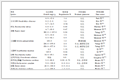
1 土壤系统中微塑料研究现状 1.1 土壤中微塑料的来源与分布土壤中的微塑料来源广泛,是微塑料的重要汇集地,常见微塑料类型、性质及用途如表 1所示,其中聚丙烯、聚乙烯以及聚氯乙烯,分别占据全球塑料产量24%、21% 及19%[33]。由于微塑料不同种类间物理化学性质差异较大和用途的多样性,对其在土壤环境中分布及转化行为具有显著影响。土壤中微塑料的来源包括农用塑料薄膜的分解[34]、有机肥料的使用、工业及污水处理厂的污水灌溉及污泥再利用[35-37]、生活垃圾的随意丢弃、汽车轮胎等机械磨损、大气中微塑料的沉降等[9, 36]。微塑料的来源不同导致其物理性状的差异较大,来源于农膜、塑料袋、较厚的塑料制品分解破碎的微塑料多数为塑料碎片;来源于服装、纺织品、绳索等的微塑料多数为纤维状微塑料;来源于发泡聚类用品等的微塑料多数为颗粒状微塑料。另外,被不同来源微塑料所污染的土壤包含的残留微塑料类型和总量也有所差异,来源于农膜等塑料制品微塑料成分主要包括聚乙烯、聚氯乙烯、聚苯乙烯等[34],而大气沉降微塑料种类包括聚酯、聚氯乙烯、聚乙烯、聚苯乙烯等,沉降通量每年可达到每平米146 000个[38]。Weithmann等[39]在调查有机肥中微塑料含量发现,微塑料种类主要为片状苯乙烯基聚合物,且其含量范围在每千克有机肥14 ~ 895个微塑料。
|
表 1 微塑料的常见类型、基本性质及用途 Table 1 Common types, basic properties and uses of microplastics |


由于污染来源、地理因素和土壤理化性质差异会影响土壤中微塑料的污染输入量与迁移特征,最终导致微塑料在不同地区土壤中的丰度呈现出各自的分布特征[40]。以我国土壤为例,针对流域土壤微塑料赋存特征的研究中发现,长江流域的土壤及沉积物中,微塑料以小于1.0 mm粒径占主导,土壤上层的微塑料丰度高于下层,且土壤中微塑料丰度呈现由上游至下游逐渐增加的趋势[41]。而环渤海北部河流入海口区域土壤中微塑料均以小于1 mm小粒径微塑料为主,上游地区微塑料的含量高于下游,与长江流域微塑料分布特征相异。在相同地域内,土壤深度对微塑料的分布也有一定影响。诸多研究表明[42-43]土壤中微塑料的丰度随着土壤深度增加而降低,但由于各地土壤中的径流特征不同,微塑料丰度也会出现随着土壤深度加深而增大的现象[44]。同时,土壤理化性质的差异对土壤中微塑料分布也有影响。土壤的pH和有机质含量影响微塑料与土壤颗粒之间的相互作用,对微塑料的分布起较为重要的作用[45]。针对青藏高原东部典型农业区微塑料分布因素的分析中指出,由于静电斥力使得带有负电荷的微塑料与高pH土壤之间吸附作用受到抑制,导致粒径小于100 μm的微塑料丰度与土壤pH呈现负相关;由于高有机碳土壤改善土壤孔隙条件的同时促进微生物活性而加速降解塑料,导致微塑料的丰度与土壤有机碳含量呈现正相关[46]。另外,土壤中植被与水动力特征可影响微塑料的空间分布[47],与水分入渗和土壤动物活动导致的微塑料向下迁移不同,植物根系对微塑料有一定的富集作用,主要原因是根系的生长导致土壤中形成更多的孔隙与裂隙,在水分的浮力作用下,作物根系周边的微塑料倾向于向上移动或维持在原土层位置[48]。土壤中的生物,如蚯蚓可通过摄食、表面携带等方式使微塑料迁移到土壤的各个区域[49]。对比土壤环境中微塑料的赋存特征(表 2),全球土壤存在不同程度的微塑料污染,我国农田土壤由于地膜覆盖、有机肥施用、淤泥还田等农艺的应用,存在区域性微塑料污染严重的现象。
|
|
表 2 土壤环境中微塑料的赋存特征 Table 2 Occurrence characteristics of microplastics in soil environment |
土壤中的微塑料可与土壤中的有机或无机组分相互作用进而一定程度上改变土壤的理化性质、结构、功能以及微生物群落[67],微塑料成分差异对土壤的影响作用不同。微塑料可以在土壤中为水的流动创造通道,加速土壤水分蒸发,加剧土壤水分短缺[68]。而de Souza Machado等[69]的研究发现,聚酯纤维的纤维状结构更易滞留于土壤颗粒表面,能显著提高土壤保水性,从而具有更高改变土壤理化性质的潜质外,微塑料的添加可促进土壤中腐殖酸类物质的积累,即在改善土壤肥力方面发挥作用。Liu等[70]研究发现,经过30 d培养后高浓度的聚丙烯微塑料显著增加了土壤中可溶性有机质含量,促进了土壤养分的释放,其中包括可溶性有机碳、有机氮、有机磷等。微塑料对土壤养分的影响受微塑料的浓度以及暴露时间的影响较大,研究表明,微塑料赋存对土壤养分的影响作用在第0 ~ 7天期间并不显著,而在第14 ~ 30天中可溶性有机质发生了显著的增加,是由于微塑料的添加缓慢增加了土壤中氧化酶活性,使土壤中较难溶解的高分子量化合物更多分解为易溶解的低分子化合物,导致溶解性有机质不同速度增加。且受土壤自身物理化学性质,如矿物和腐殖质、土壤孔隙大小分布等的影响,微塑料对土壤环境的影响作用存在差异。
1.2.2 微塑料对土壤微生物的影响土壤微生物活性与土壤理化特征密切相关,因此,微塑料在影响土壤自身特性的同时也对土壤环境中的微生物产生影响[71]。土壤孔隙度和土壤湿度的变化可能会改变土壤中的氧气流动,从而改变厌氧和好氧微生物的相对分布,也可能会导致微栖息地内本土微生物物种的改变或丧失[72]。针对微塑料环境行为的研究中发现,酯类微塑料聚3-羟基丁酸酯-co-3-羟基戊酸(PHBV)易于降解并被微生物群落用作碳源,导致特定微生物生长增加,并且与未经处理的土壤相比,PHBV的添加改变了土壤细菌群落在不同分类水平上的分布,并增加了α多样性以及酸杆菌和疣状杆菌门的相对丰度[73]。微塑料还可以诱导土壤微生物功能的变化,Judy等[74]的研究中发现,添加0.1% 和1% 聚对苯二甲酸乙二醇酯微塑料的土壤中基质诱导呼吸(SIR)速率显著降低。综上,微塑料与土壤之间的相互作用可能会导致土壤自身特性及地下生态系统如微生物群落等的改变,而微塑料由于其结构和性质的差异,对土壤的影响仍需进行综合评估。
2 微塑料与有机污染物相互作用机制当下,伴随农药施用、污水灌溉、污泥和废物填埋、污染物的泄漏等[11]导致的有机污染物(如农药、多环芳烃、多氯联苯、二
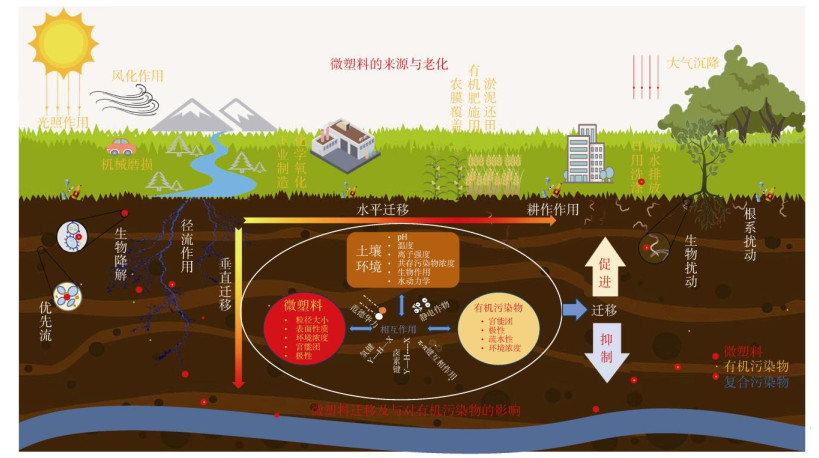
有机污染物与微塑料在环境介质中发生相互作用(图 1),包含:①有机化合物在水相和微塑料之间的分配过程中发生的疏水相互作用[75-76]。疏水性作用力会增强微塑料与污染物的吸附[77-78],该吸附作用通常表现为线性吸附,并且微塑料粒径越小、表面积越大,对疏水性有机污染物的吸附作用越大。②当微塑料与有机污染物均带电荷时,两者通过静电吸引或静电排斥可产生静电相互作用[79-80];由于pH等环境条件与污染物自身电荷的异质性,当微塑料表面的电荷与有机污染物解离产生的电荷相反,便会发生相互作用。③当微塑料具有羧基、酯羰基等含氧官能团时,其可作为质子供/受体与有机物发生的氢键相互作用[81-83]。④对于含有苯环结构的微塑料,可结合含有双键或苯环结构的有机分子发生π-π相互作用[75, 84]。⑤微塑料与有机污染物分子之间亦可通过范德华力[85]发生相互作用。由于微塑料与有机污染物以及环境介质的复杂性,以上作用力的主导作用不同,等温吸附曲线也不尽相同。针对聚乙烯为主要成分的塑料微球对四溴双酚吸附的研究中发现:100 ~ 500 μg/L四溴双酚与聚乙烯微塑料的等温吸附曲线较符合Langmuir模型曲线,即其吸附是由静电力作用主导的吸附[86],而老化后的聚丙烯与三氯生进行等温吸附试验的结果则更符合Freundlich模型,研究推测是由于老化微塑料表面产生裂纹和气孔,导致三氯生与微塑料之间发生多层吸附。针对微塑料对有机物的解吸研究中[25],大多数解吸过程观察到了轻微的解吸迟滞现象[87]。
|
图 1 微塑料的来源、土壤中的迁移及对有机污染物的影响 Fig. 1 Sources, migration in soil and their effects on organic pollutants of microplastics |
微塑料与有机污染物的相互作用研究中指出,微塑料可作为有机污染物积累和释放的载体,从而会产生协同毒性效应并影响其污染物的污染潜力[88]。在土壤环境中,由于微塑料的疏水性使其可以作为疏水性有机物的强吸附剂,从而降低疏水性有机污染物在土壤中的生物有效性[89]。Liu等[90]在探究聚乙烯微塑料和菲对小麦幼苗的联合毒性试验中发现微塑料会降低小麦幼苗根系和叶片中菲的浓度,原因可能是微塑料优先吸附土壤中的菲,从而减少了植物对菲的吸收。Yilimulati等[85]在研究微塑料与抗生素环丙沙星的吸附对秀丽隐杆线虫的毒性作用试验中发现,相比于单一微塑料或单一环丙沙星,微塑料与环丙沙星同时存在条件下对秀丽隐杆线虫的致死率更高,且200 nm微塑料比500 nm微塑料毒性更大,主要是由于尺寸较小的微塑料能吸附更多的污染物,进而促进了污染物在线虫体内的积累、对线虫存活率产生更严重的毒性作用。针对四溴双酚在聚乙烯微塑料上的吸附作用的研究[86]中发现,微塑料与有机污染物的相互作用主要是由疏水性和静电作用共同决定的,两者协同作用对斑马鱼的毒性远大于单一污染物。
2.2 微塑料与有机污染物相互作用的影响因素微塑料与有机污染物的相互作用主要受环境因素、微塑料特征以及污染物特性的影响。
环境因素包含环境介质中的pH、温度、离子强度等水化学条件以及共存污染物浓度等。在酸性条件下,有机污染物更易与微塑料发生吸附作用,这是由于有机污染物在酸性条件下以阳离子形式存在,通常情况下,由于环境pH大于微塑料表面的零电荷点(即pHpzc)而带有负电,因此常与带有正电荷的有机污染物产生静电作用,从而更易吸附于其表面[85]。离子强度的增加会增强微塑料对有机污染物的吸附。随环境温度的降低,微塑料对有机污染物如多氯联苯的吸附能力也随之增大[91]。
微塑料的物理化学特征,如种类、粒径、表面特征、自身的官能团结构(如苯环、酰胺、卤素键等)、极性、玻璃转化温度(微塑料聚合物分子从冻结玻璃态转化为运动橡胶态的转变温度)等也会影响其与有机污染物的吸附作用。除此之外,由于物理、生物和化学作用导致的微塑料老化也会不同程度地影响微塑料自身的物理化学特性,进一步影响土壤中微塑料与有机污染物的相互作用。微塑料粒径越小,比表面积越大,对有机污染物吸附效果越好。Li等[92]对四溴双酚与微塑料进行吸附行为中发现,在中性条件下,聚氯乙烯微塑料对四溴双酚的效果比聚苯乙烯、聚丙烯和聚乙烯效果明显,其原因是聚氯乙烯较其他种类微塑料极性更强,可通过极性相互作用对四溴双酚产生更强的亲和力。Tan等[93]在研究微塑料和多环芳烃作用时发现,微塑料形状与比表面积的差异会导致其对有机物的吸附容量不同,并且微塑料老化后,具有更疏松的结构和表面粗糙度,老化产生的裂纹或碎片同时也为疏水性有机污染物提供了更多的吸附位点,Wu等[94]研究老化聚丙烯微塑料对三氯生吸附的影响[25]也获得了一致的结论。微塑料的玻璃化转变温度影响微塑料常温下的状态,进而可以影响微塑料的吸附容量。杨杰等[95]在不同土壤环境对微塑料吸附四环素影响的研究中发现,在常温下,聚乙烯属于橡胶态聚合物,而聚苯乙烯、聚酰胺则由于玻璃转化温度较高属于玻璃态聚合物,有机污染物易通过分配作用吸附于橡胶态的聚乙烯微塑料表面。同样,徐鹏程等[96]研究微塑料对多溴联苯醚的吸附研究中也得到相似的研究结论。
有机污染物的种类、官能团、极性、疏水性以及环境浓度也会影响其与微塑料的相互作用[97]。研究表明,有机物浓度越高,吸附越易发生[98]。多种有机污染物同时存在或对污染物吸附作用产生抑制的效果[99]。微塑料对不同疏水性的有机污染物吸附作用也有所差异,这可能是由于吸附机理的不同导致的。
目前对于微塑料与有机污染物的相互作用机理及影响因素的研究大多在水环境条件下进行,在土壤中的研究仍在起步阶段。当下,伴随陆地生态系统污染物的赋存与累计,土壤环境中污染物、微塑料共存条件下势必会导致污染物在微塑料上的竞争吸附、分配差异,最终导致协同环境效应,因此土壤环境中的微塑料与有机物的相互作用及影响仍需进一步探讨。
3 微塑料在土壤环境中的迁移机理土壤是微塑料重要的汇集地,且伴随微塑料在土壤中的迁移,导致其在更多陆生动植物体的生物积累和毒性,最终危害人类健康。在土壤环境中,微塑料可通过淋滤、动物活动、根系生长等作用进行迁移,其中,淋滤对微塑料在土壤中的垂向迁移具有更明显的促进作用。目前,由于检测手段限制等原因,微塑料在土壤中迁移的研究在起步阶段,较多研究关注微塑料在多孔介质中的迁移机理、内滞留特征以及化学条件对迁移的影响等。
微塑料在土壤中的迁移影响因素主要包括土壤环境因素、土壤自身理化特征、微塑料特性以及生物作用等。地表微塑料的迁移受风蚀及地表径流作用明显[100];而地下环境中,微塑料随地下径流迁移过程中,土壤环境的pH、离子强度、有机质含量、土壤颗粒大小以及水动力因素等对迁移影响较大[101]。研究发现,聚酯微塑料的迁移能力随环境介质中电解质浓度及阳离子价态的升高而降低,随pH的升高而增强。前者是由于微塑料颗粒与介质表面之间的双电层压缩、静电斥力减小,导致微塑料更易沉积;后者是微塑料表面官能团去质子化增强、负电性增大而导致的迁移能力提高[102]。Wu等[103]研究离子强度及土壤性质对聚苯乙烯纳米塑料迁移影响中发现,土壤pH越高,土壤与表面带负电荷的微塑料颗粒静电斥力就越强,从而加快了微塑料的迁移。除此之外,该研究还指出土壤水环境的离子价态越高,对微塑料迁移的抑制作用越强。Hou等[104]针对聚乙烯在饱和石英砂中的迁移行为研究发现,离子强度越高,微塑料与固相介质的排斥作用越低,微塑料的迁移行为越受抑制。另外,随着环境中富里酸浓度的增加,微塑料迁移能力先增加后达到稳定,其原因是微塑料与富里酸通过π-π键、氢键作用力发生吸附作用从而增加了微塑料的表面负电荷、改变了微塑料的ζ电位,导致微塑料与介质的静电斥力增强,更易发生迁移。Rong等[105]的研究同样指出腐殖酸在一定浓度范围内可显著促进微塑料在多孔介质中的迁移。除此之外,该试验还研究了氮肥对微塑料迁移的影响,试验结果显示有机氮肥、无机氮肥添加都会导致微塑料的迁移率降低,是由于氮肥通过吸附于微塑料表面,导致微塑料的ζ电位降低,从而减小了微塑料和多孔介质之间的斥力作用,抑制了微塑料的迁移。微塑料在沙土柱中的渗透迁移模拟试验研究中指出不同微塑料迁移深度差异较大,迁移深度与干–湿循环次数呈正相关[106],在此基础上估算微塑料在100年的平均渗透深度可达1.48 ~ 7.42 m。
除以上环境介质的理化性质的影响外,土壤环境中的生物扰动、耕作等因素对微塑料在土壤环境中的迁移产生影响。土壤中的生物作用,如蚯蚓表皮的黏附作用、蚯蚓的摄入与排泄作用都会不同程度地促进微塑料的迁移[49]。其他土壤生物群,例如,土壤跳虫和捕食性螨等也会通过表皮黏附作用促进微塑料的迁移。据报道,尺寸小于0.2 cm的土壤微小节肢动物甚至可以移动尺寸高达9 cm的塑料[107]。土壤中植物的根系生长也可以为微塑料的迁移提供条件,其中,通过作物根系产生的孔道以及气候干旱引起的土壤龟裂可为水分优先携带微塑料向土壤深层移动提供条件,并且,植物也可通过吸收等作用促进微塑料在土壤上层的富集。Li等[48]针对不同作物根系下微塑料沿土壤剖面的垂直迁移的研究中发现,当微塑料最初分布在表层时,作物根系对微塑料的垂直迁移几乎没有影响;但对于沿土壤剖面均匀分布的微塑料,玉米根系可促进中间层(7 ~ 12 cm)的微塑料向上运动。传统耕作方式也可以促进微塑料能迁移至20 ~ 30 cm土层。
微塑料的种类、粒径、浓度、官能团及其老化程度等理化性质会影响微塑料在土壤中的迁移特征。微塑料浓度越高,粒径越小,越易发生迁移[107]。Liu等[108]的研究证明老化后的聚苯乙烯微塑料迁移率高于非老化微塑料,可能是由于微塑料表面氧化产生的含氧官能团增加了微塑料的电负性和亲水性。Ren等[109]针对不同老化方式下微塑料的迁移特性研究中指出,硫酸盐老化、紫外老化以及紫外过硫酸盐联合老化后的微塑料在砂土和黏土均较原始微塑料表现出更大的迁移能力,主要原因是老化产生含氧官能团增加微塑料负电荷,增加微塑料和土壤颗粒之间的静电斥力。老化微塑料在不同化学条件下的迁移研究中发现,微塑料在NaCl、CaCl2和MgCl2溶质中的迁移率均高于原始微塑料[110]。但老化微塑料在迁移过程中也有团聚现象的发生,Shaniv等[111]发现羧基化的聚苯乙烯模型颗粒迁移时会出现团聚现象,其原因可能是土壤溶液中带正电的组分通过吸附带负电的微塑料颗粒进而导致微塑料之间发生桥联作用而团聚并影响迁移。
目前,对微塑料在复杂土壤介质中的迁移及归趋研究在起步阶段,机理认知有限,且研究中大多使用的是模型微塑料,无法准确预估不同性状的微塑料在复杂土壤中体现的归趋特征。
4 微塑料对有机污染物迁移的影响 4.1 有机污染物在土壤环境中迁移的影响因素有机污染物在环境中的迁移转化过程中吸附和解吸作用是决定其环境归趋的关键[14]。有机污染物进入土壤后,除表层中小部分挥发到大气中,其余部分污染物可被土壤有机质和土壤胶体吸附,胶体结合态的污染物伴随胶体迁移至深层,最终导致深层土壤或地下径流污染。在土壤介质中,有机污染物的吸附机制主要为表面吸附和分配作用,该作用是有机物与吸附质之间静电作用、范德华力及氢键等分子间作用力以及疏水性作用[112]等综合作用的结果。除此之外,生物作用导致的迁移转化也较为普遍[113]。
有机污染物在土壤中迁移受土壤环境特征、有机污染物特性、生物作用等的影响。土壤环境的pH、温度、有机质含量、离子强度等物理化学性质对迁移的影响较大,且由于吸附机理的不同而导致对污染物迁移的促进或抑制作用不同[114-116]。针对环丙沙星在土壤中的吸附研究[117]中发现,在pH较低的情况下,带正电荷的有机污染物与土壤胶体表面产生的静电引力占主导,但随着pH的增加,静电排斥作用增加,最终导致了环丙沙星在土壤中的吸附量减少、迁移量增加。环境温度对有机污染物迁移的影响主要基于污染物与吸附质的反应为放热或吸热反应。对于吸热反应,温度升高则有利于有机污染物的吸附,且高温提高了有机分子的扩散速率,进一步促进吸附。而Mutavdžić Pavlović等[118]在研究环丙沙星与河流沉积物之间的吸附研究中估算了沉积物对环丙沙星的吸附热力学参数,ΔH的值为负,即吸附作用为放热,环丙沙星的吸附量随着温度的升高而减小。Hu等[119]发现磺胺嘧啶在土壤中的吸附作用随离子浓度的增加而呈现先增加后降低的趋势,这是由于有机污染物与金属阳离子发生阳离子架桥作用,但随溶液中离子浓度的增多,抗生素与阳离子之间存在竞争吸附关系,导致抗生素吸附量的减少。土壤类型及土壤中有机质含量的差异也会影响有机污染物在土壤环境中的行为,Yao等[120]研究土霉素在黑土和红壤中的吸附发现,有机质含量较高的黑土对土霉素的吸附量大于红壤。有机污染物的浓度、极性、官能团等特性也对自身在土壤环境中的迁移产生较大影响。低环多环芳烃较高环多环芳烃更易迁移[121]的主要原因是多环芳烃环数增加导致溶解度减小,从而容易分配到土壤中,难以迁移;高环多环芳烃主要以与土壤胶体结合发生迁移的方式,因此较低环多环芳烃主要以溶解态发生迁移方式更易迁移至土壤深处。Di Guardo等[122]针对自然土壤中多氯联苯分布特征研究中发现:多氯联苯的浓度随土壤深度迅速下降,且最大值一般在土壤表层以下30 cm内,产生这种现象的因素之一是多氯联苯的疏水性。Zhou等[123]针对青藏高原土壤中氟化物的空间分布调查中发现,短链氟化物具有更强的迁移能力和向土壤深处迁移的倾向,这可能是由于短链氟化物的疏水性和土壤分配常数相对较低导致的。另外,生物作用也会促进有机污染物在土壤中的迁移,其中包括植物根系生长和陆生动物携带等[124]。另外,在复杂土壤体系中,多种有机污染物之间的拮抗或协同作用对有机污染物的迁移也会产生不同的影响。
4.2 微塑料与有机污染物相互作用对迁移的影响伴随塑料的广泛使用,微塑料进入土壤环境后不可避免地会与有机污染物发生相互作用。微塑料粒径小、比表面积大,可在环境介质中为有机物的吸附提供额外的吸附位点,因此常作为有机污染物的载体。同时,有机物通过氢键、π-π键和范德华力等与微塑料发生相互作用[125],也改变了微塑料的表面特性并影响微塑料在环境介质中的迁移归趋。在微塑料的迁移过程中,微塑料与污染物之间如发生不可逆吸附,有机污染物将与微塑料形成共聚体,跟随微塑料发生共迁移[126]。与单一污染迁移相比,微塑料与有机污染物的共迁移行为则更为复杂,这与它们的浓度、物理化学特性及环境因素相关,由于相互作用的机理不同,对各自迁移的影响也有差异。
微塑料官能团的差异会导致自身极性的不同,如聚氯乙烯和聚苯乙烯分别带有氯原子和苯环结构,两者的极性会影响微塑料的吸附性能及迁移特征[127]。针对胶体态聚苯乙烯微塑料颗粒与四环素的相互作用及共迁移行为研究中指出,微塑料与抗生素共存条件下的迁移因溶液条件的不同而产生异质性,主要归因于在不同化学条件下有机物吸附、有机物分子之间的疏水相互作用、介质表面沉积位点的竞争、微塑料的亲水性/疏水性差异等综合作用的差异[128]。另外,具有胶体特征的微塑料其自身ζ电位会影响微塑料与有机物之间的静电作用进而影响两者共存条件下的吸附及迁移特征。Hu等[129]针对饱和多孔介质中萘与聚苯乙烯纳米塑料的共迁移研究中发现,10 ~ 100 mg/L聚苯乙烯纳米塑料在低离子强度下促进了萘的迁移,这是由于萘与微塑料之间的吸附作用大于萘与石英砂之间的吸附作用,从而导致有机物更多地伴随具有高流动性的纳米塑料共迁移。该研究还发现,由于电荷屏蔽效应,萘的存在降低了纳米塑料的流动性。Rong等[130]在对蛋白质和微塑料共迁移试验研究中发现,当蛋白质和微塑料带相同电荷时,静电作用导致蛋白质和微塑料产生排斥作用,促进了微塑料的迁移;而当微塑料与有机物带相反电荷时,带正电荷的胰蛋白酶与带负电荷的微塑料吸附,导致微塑料体积增加且静电斥力降低,抑制了微塑料的迁移。另一方面,不同种类的微塑料玻璃化转变温度的差异可能导致吸附机理有所改变。当温度大于玻璃转化温度时,分子链发生运动,微塑料从玻璃态转变为橡胶态,由于橡胶态物质具有更高的流动性,对疏水性有机污染物具有良好的亲和力[131]。有研究表明[96],聚乙烯的玻璃化转变温度为–125 ℃,远远小于自然温度,在常温下呈橡胶态,有机污染物易通过分配作用吸附在聚乙烯微塑料上[78]。环境介质中微塑料的粒径和浓度也会对有机污染物的迁移有影响,由于纳米塑料的比表面积较微米及毫米级微塑料更高,因此吸附能力更高,且微塑料粒径越小,在介质中会表现出更强的流动性,故对吸附在微塑料中的有机污染物的迁移更易产生促进作用[132]。微塑料与有机污染物的共迁移是基于二者的吸附解吸作用进行的,但有研究指出微塑料载体与有机污染物较强吸附作用的部分原因在于解吸过程发生滞后且过程缓慢[133],而解吸滞后过程的强度取决于有机污染物的极性强度[134]。针对解吸滞后性,玻璃态聚合物比橡胶态聚合物发生解吸滞后现象更明显[135]。除此之外,微塑料的老化作用导致微塑料表面物理化学性能发生改变,如表面积增大、含氧官能团增加[136],可为有机污染物的吸附提供更多附着点[136-138];老化作用也会改变微塑料的电负性和疏水分配作用,进而导致微塑料与极性有机污染物通过更强的氢键作用产生吸附[113];且由于老化后的微塑料亲水性增加,自身迁移率增高,可同时与极性和非极性有机污染物产生吸附作用,也在一定程度上促进了有机污染物的迁移[108]。Yan等[139]针对天然壤质砂土中老化微塑料迁移的研究中发现,迁移的微塑料表面有四环素、β-内酰胺和磺胺抗生素抗性基因的检出,说明微塑料不仅可以影响有机污染物的迁移,也可能是抗性基因向深层土壤传播的潜在途径。
目前针对单一微塑料与某一类有机污染物的相互作用及对迁移的影响研究多集中于饱和多孔介质中,实际的土壤环境会发生多种微塑料与不同污染物共存,且伴随复杂的土壤环境条件,也会引起微塑料不同程度的老化并进一步影响微塑料与共存有机污染物的环境归趋与毒理。
5 结论与展望伴随塑料的广泛使用,微塑料已在生态系统尤其是陆地生态系统中累积。由于微塑料来源、自身理化性质和环境特征的差异,导致不同类型的微塑料在土壤中的分布呈现区域异质性。微塑料在环境中的赋存也不可避免会与共存污染物发生相互作用,进而影响污染物的环境归趋。微塑料与有机污染物的相互作用是两者疏水特性、静电作用、氢键作用、π-π相互作用以及范德华力的综合结果,并且两者的相互作用也会产生协同毒性效应。微塑料与有机污染物相互作用受环境因素、微塑料和有机物自身理化特性的影响。在土壤环境中,微塑料可通过淋滤、动物活动、根系生长等作用发生迁移。土壤环境特征、生物作用、微塑料自身特性均会对微塑料在土壤环境中的迁移产生影响。环境中的微塑料可作为有机污染物的载体影响有机物在陆地生态系统中的归趋,反之,由于有机物与微塑料的相互作用也改变了微塑料表面特性并导致污染物迁移或共迁移特征的改变。目前,针对土壤环境中微塑料的迁移特征及与共存污染物相互作用的影响研究还在起步阶段,未来亟待解决以下问题:
1) 土壤中微塑料迁移机理与模型研究。目前,大多数微塑料的迁移及其影响因素的研究是在理想的饱和多孔介质中进行的,复杂土壤环境中微塑料的迁移研究仍然在起步阶段,目前迁移机理认知还存在不足,尚缺乏不同类型土壤中微塑料的迁移特征及模型模拟研究。
2) 微塑料老化对其环境行为的影响研究。微塑料在自然环境中的老化普遍存在,与普通微塑料相比,老化微塑料对土壤环境中微塑料自身赋存特征、与共存污染物相互作用及环境微生物的影响更大。目前针对微塑料老化以单一条件下控制试验为主,实际环境中微塑料的老化过程表征及模型化预测亟待加强,以便更准确地预估微塑料环境行为及影响。
3) 微塑料与共存污染物相互作用的影响研究。目前,针对微塑料与环境介质中共存污染物间相互作用、迁移过程和机理的研究较少,特别是农田生态系统,需深入探究实际环境条件下微塑料、污染物共存对作物–土壤系统的影响,为准确预测微塑料与污染物的环境行为及生态环境风险、污染控制提供更坚实的理论基础。
| [1] |
Rusli A, Othman M H, Marsilla K I. Plastics in high heat resistant applications[J]. Encyclopedia of materials: plastics and polymers, 2022, 4: 200-215 (  0) 0) |
| [2] |
Thompson R C, Moore C J, vom Saal F S, et al. Plastics, the environment and human health: Current consensus and future trends[J]. Philosophical Transactions of the Royal Society of London Series B, Biological Sciences, 2009, 364(1526): 2153-2166 DOI:10.1098/rstb.2009.0053 ( 0) |
| [3] |
Thompson R C, Olsen Y, Mitchell R P, et al. Lost at sea: Where is all the plastic?[J]. Science, 2004, 304(5672): 838 DOI:10.1126/science.1094559 ( 0) |
| [4] |
黄萌, 程思, 李嘉琪, 等. 聚苯乙烯微塑料对秀丽隐杆线虫取食偏好的影响[J]. 土壤, 2022, 54(1): 47-54 ( 0) |
| [5] |
Su Y, Hu X, Tang H J, et al. Steam disinfection releases micro(nano)plastics from silicone-rubber baby teats as examined by optical photothermal infrared microspectroscopy[J]. Nature Nanotechnology, 2022, 17: 76-85 DOI:10.1038/s41565-021-00998-x ( 0) |
| [6] |
Liu J L, Vethaak A D, An L H, et al. An environmental dilemma for China during the COVID-19 pandemic: The explosion of disposable plastic wastes[J]. Bulletin of Environmental Contamination and Toxicology, 2021, 106(2): 237-240 DOI:10.1007/s00128-021-03121-x ( 0) |
| [7] |
da Costa Araújo A P, da Luz T M, Rocha T L, et al. Toxicity evaluation of the combination of emerging pollutants with polyethylene microplastics in zebrafish: Perspective study of genotoxicity, mutagenicity, and redox unbalance[J]. Journal of Hazardous Materials, 2022, 432: 128691 DOI:10.1016/j.jhazmat.2022.128691 ( 0) |
| [8] |
刘沙沙, 付建平, 郭楚玲, 等. 微塑料的环境行为及其生态毒性研究进展[J]. 农业环境科学学报, 2019, 38(5): 957-969 ( 0) |
| [9] |
Carr S A, Liu J, Tesoro A G. Transport and fate of microplastic particles in wastewater treatment plants[J]. Water Research, 2016, 91: 174-182 DOI:10.1016/j.watres.2016.01.002 ( 0) |
| [10] |
Oßmann B E, Sarau G, Holtmannspötter H, et al. Small-sized microplastics and pigmented particles in bottled mineral water[J]. Water Research, 2018, 141: 307-316 DOI:10.1016/j.watres.2018.05.027 ( 0) |
| [11] |
Sun Q, Ren S Y, Ni H G. Incidence of microplastics in personal care products: An appreciable part of plastic pollution[J]. Science of the Total Environment, 2020, 742: 140218 DOI:10.1016/j.scitotenv.2020.140218 ( 0) |
| [12] |
Dissanayake P D, Kim S, Sarkar B, et al. Effects of microplastics on the terrestrial environment: A critical review[J]. Environmental Research, 2022, 209: 112734 DOI:10.1016/j.envres.2022.112734 ( 0) |
| [13] |
Mekaru H. Effect of agitation method on the nanosized degradation of polystyrene microplastics dispersed in water[J]. ACS Omega, 2020, 5(7): 3218-3227 DOI:10.1021/acsomega.9b03278 ( 0) |
| [14] |
Stolte A, Forster S, Gerdts G, et al. Microplastic concentrations in beach sediments along the German Baltic coast[J]. Marine Pollution Bulletin, 2015, 99(1/2): 216-229 ( 0) |
| [15] |
张晨捷, 涂晨, 周倩, 等. 低密度聚乙烯薄膜微塑料在黄河口海岸带环境中的风化特征[J]. 土壤学报, 2021, 58(2): 456-463 ( 0) |
| [16] |
Fok L, Cheung P K, Tang G D, et al. Size distribution of stranded small plastic debris on the coast of Guangdong, South China[J]. Environmental Pollution, 2017, 220: 407-412 DOI:10.1016/j.envpol.2016.09.079 ( 0) |
| [17] |
Abayomi O A, Range P, Al-Ghouti M A, et al. Microplastics in coastal environments of the Arabian Gulf[J]. Marine Pollution Bulletin, 2017, 124(1): 181-188 DOI:10.1016/j.marpolbul.2017.07.011 ( 0) |
| [18] |
Nie H Y, Wang J, Xu K H, et al. Microplastic pollution in water and fish samples around Nanxun Reef in Nansha Islands, South China Sea[J]. Science of the Total Environment, 2019, 696: 134022 DOI:10.1016/j.scitotenv.2019.134022 ( 0) |
| [19] |
周隆胤, 简敏菲, 余厚平, 等. 乐安河—鄱阳湖段底泥微塑料的分布特征及其来源[J]. 土壤学报, 2018, 55(5): 1222-1232 ( 0) |
| [20] |
Kabir A H M E, Sekine M, Imai T, et al. Microplastics pollution in the seto inland sea and sea of Japan surrounded yamaguchi prefecture areas, Japan: Abundance, characterization and distribution, and potential occurrences[J]. Journal of Water and Environment Technology, 2020, 18(3): 175-194 DOI:10.2965/jwet.19-127 ( 0) |
| [21] |
Mohsen M, Sun L N, Lin C G, et al. Mechanism underlying the toxicity of the microplastic fibre transfer in the sea cucumber Apostichopus japonicus[J]. Journal of Hazardous Materials, 2021, 416: 125858 DOI:10.1016/j.jhazmat.2021.125858 ( 0) |
| [22] |
刘强, 徐旭丹, 黄伟, 等. 海洋微塑料污染的生态效应研究进展[J]. 生态学报, 2017, 37(22): 7397-7409 ( 0) |
| [23] |
Kumar M, Xiong X N, He M J, et al. Microplastics as pollutants in agricultural soils[J]. Environmental Pollution, 2020, 265: 114980 DOI:10.1016/j.envpol.2020.114980 ( 0) |
| [24] |
Zhou Y F, Liu X N, Wang J. Characterization of microplastics and the association of heavy metals with microplastics in suburban soil of central China[J]. Science of the Total Environment, 2019, 694: 133798 DOI:10.1016/j.scitotenv.2019.133798 ( 0) |
| [25] |
Mizukawa K, Takada H, Ito M, et al. Monitoring of a wide range of organic micropollutants on the Portuguese coast using plastic resin pellets[J]. Marine Pollution Bulletin, 2013, 70(1/2): 296-302 ( 0) |
| [26] |
Rios Mendoza L M, Jones P R. Characterisation of microplastics and toxic chemicals extracted from microplastic samples from the North Pacific Gyre[J]. Environmental Chemistry, 2015, 12(5): 611 DOI:10.1071/EN14236 ( 0) |
| [27] |
Heskett M, Takada H, Yamashita R, et al. Measurement of persistent organic pollutants (POPs) in plastic resin pellets from remote islands: Toward establishment of background concentrations for International Pellet Watch[J]. Marine Pollution Bulletin, 2012, 64(2): 445-448 DOI:10.1016/j.marpolbul.2011.11.004 ( 0) |
| [28] |
薛向东, 王星源, 梅雨晨, 等. 微塑料对水中铜离子和四环素的吸附行为[J]. 环境科学, 2020, 41(8): 3675-3683 ( 0) |
| [29] |
Wu X W, Liu P, Huang H, et al. Adsorption of triclosan onto different aged polypropylene microplastics: Critical effect of cations[J]. Science of the Total Environment, 2020, 717: 137033 DOI:10.1016/j.scitotenv.2020.137033 ( 0) |
| [30] |
Fang S, Yu W S, Li C L, et al. Adsorption behavior of three triazole fungicides on polystyrene microplastics[J]. Science of the Total Environment, 2019, 691: 1119-1126 DOI:10.1016/j.scitotenv.2019.07.176 ( 0) |
| [31] |
Wang W F, Ge J, Yu X Y, et al. Environmental fate and impacts of microplastics in soil ecosystems: Progress and perspective[J]. Science of the Total Environment, 2020, 708: 134841 DOI:10.1016/j.scitotenv.2019.134841 ( 0) |
| [32] |
Zhao F, Ma Z H, Ping H, et al. Tissue distribution of phthalates in celery under different cultivation patterns and associated dietary exposure[J]. Environmental Pollution, 2022, 292: 118391 DOI:10.1016/j.envpol.2021.118391 ( 0) |
| [33] |
Andrady A L. Microplastics in the marine environment[J]. Marine Pollution Bulletin, 2011, 62(8): 1596-1605 DOI:10.1016/j.marpolbul.2011.05.030 ( 0) |
| [34] |
Ding L, Zhang S Y, Wang X Y, et al. The occurrence and distribution characteristics of microplastics in the agricultural soils of Shaanxi Province, in north-western China[J]. Science of the Total Environment, 2020, 720: 137525 DOI:10.1016/j.scitotenv.2020.137525 ( 0) |
| [35] |
Zhou B Y, Wang J Q, Zhang H B, et al. Microplastics in agricultural soils on the coastal plain of Hangzhou Bay, East China: Multiple sources other than plastic mulching film[J]. Journal of Hazardous Materials, 2020, 388: 121814 DOI:10.1016/j.jhazmat.2019.121814 ( 0) |
| [36] |
Steinmetz Z, Wollmann C, Schaefer M, et al. Plastic mulching in agriculture. Trading short-term agronomic benefits for longterm soil degradation?[J]. Science of the Total Environment, 2016, 550: 690-705 DOI:10.1016/j.scitotenv.2016.01.153 ( 0) |
| [37] |
Mahon A M, O'Connell B, Healy M G, et al. Microplastics in sewage sludge: Effects of treatment[J]. Environmental Science & Technology, 2017, 51(2): 810-818 ( 0) |
| [38] |
Mintenig S M, Int-Veen I, Löder M G J, et al. Identification of microplastic in effluents of waste water treatment plants using focal plane array-based micro-Fourier-transform infrared imaging[J]. Water Research, 2017, 108: 365-372 DOI:10.1016/j.watres.2016.11.015 ( 0) |
| [39] |
Weithmann N, Möller J N, Löder M G J, et al. Organic fertilizer as a vehicle for the entry of microplastic into the environment[J]. Science Advances, 2018, 4(4): eaap8060 DOI:10.1126/sciadv.aap8060 ( 0) |
| [40] |
Xu L, Han L H, Li J, et al. Missing relationship between meso- and microplastics in adjacent soils and sediments[J]. Journal of Hazardous Materials, 2022, 424(Pt A): 127234 ( 0) |
| [41] |
Yuan W K, Christie-Oleza J A, Xu E G, et al. Environmental fate of microplastics in the world's third-largest river: Basin-wide investigation and microplastic community analysis[J]. Water Research, 2022, 210: 118002 DOI:10.1016/j.watres.2021.118002 ( 0) |
| [42] |
Liu M T, Lu S B, Song Y, et al. Microplastic and mesoplastic pollution in farmland soils in suburbs of Shanghai, China[J]. Environmental Pollution, 2018, 242: 855-862 DOI:10.1016/j.envpol.2018.07.051 ( 0) |
| [43] |
Zhang S L, Yang X M, Gertsen H, et al. A simple method for the extraction and identification of light density microplastics from soil[J]. Science of the Total Environment, 2018, 616/617: 1056-1065 DOI:10.1016/j.scitotenv.2017.10.213 ( 0) |
| [44] |
Zhang S L, Liu X, Hao X H, et al. Distribution of low-density microplastics in the mollisol farmlands of Northeast China[J]. Science of the Total Environment, 2020, 708: 135091 DOI:10.1016/j.scitotenv.2019.135091 ( 0) |
| [45] |
Luo Y Y, Zhang Y Y, Xu Y B, et al. Distribution characteristics and mechanism of microplastics mediated by soil physicochemical properties[J]. Science of the Total Environment, 2020, 726: 138389 DOI:10.1016/j.scitotenv.2020.138389 ( 0) |
| [46] |
Zhang H X, Huang Y M, An S S, et al. Land-use patterns determine the distribution of soil microplastics in typical agricultural areas on the eastern Qinghai-Tibetan Plateau[J]. Journal of Hazardous Materials, 2022, 426: 127806 DOI:10.1016/j.jhazmat.2021.127806 ( 0) |
| [47] |
Helcoski R, Yonkos L T, Sanchez A, et al. Wetland soil microplastics are negatively related to vegetation cover and stem density[J]. Environmental Pollution, 2020, 256: 113391 DOI:10.1016/j.envpol.2019.113391 ( 0) |
| [48] |
Li H X, Lu X Q, Wang S Y, et al. Vertical migration of microplastics along soil profile under different crop root systems[J]. Environmental Pollution, 2021, 278: 116833 DOI:10.1016/j.envpol.2021.116833 ( 0) |
| [49] |
Rillig M C, Ziersch L, Hempel S. Microplastic transport in soil by earthworms[J]. Scientific Reports, 2017, 7(1): 1362 DOI:10.1038/s41598-017-01594-7 ( 0) |
| [50] |
韩丽花, 李巧玲, 徐笠, 等. 大辽河流域土壤中微塑料的丰度与分布研究[J]. 生态毒理学报, 2020, 15(1): 174-185 ( 0) |
| [51] |
岳俊杰, 赵爽, 程昊东, 等. 不同植物覆盖下黄河三角洲湿地土壤中微塑料的分布[J]. 环境科学, 2021, 42(1): 204-210 ( 0) |
| [52] |
Yang J, Li R J, Zhou Q, et al. Abundance and morphology of microplastics in an agricultural soil following long-term repeated application of pig manure[J]. Environmental Pollution, 2021, 272: 116028 DOI:10.1016/j.envpol.2020.116028 ( 0) |
| [53] |
Yang L, Kang S C, Wang Z Q, et al. Microplastic characteristic in the soil across the Tibetan Plateau[J]. The Science of the Total Environment, 2022, 828: 154518 DOI:10.1016/j.scitotenv.2022.154518 ( 0) |
| [54] |
Ding L, Wang X L, Ouyang Z Z, et al. The occurrence of microplastic in Mu Us Sand Land soils in Northwest China: Different soil types, vegetation cover and restoration years[J]. Journal of Hazardous Materials, 2021, 403: 123982 DOI:10.1016/j.jhazmat.2020.123982 ( 0) |
| [55] |
Liu X N, Tang N, Yang W G, et al. Microplastics pollution in the soils of various land-use types along Sheshui River Basin of Central China[J]. Science of the Total Environment, 2022, 806: 150620 DOI:10.1016/j.scitotenv.2021.150620 ( 0) |
| [56] |
Xu G R, Yang L, Xu L, et al. Soil microplastic pollution under different land uses in tropics, southwestern China[J]. Chemosphere, 2022, 289: 133176 DOI:10.1016/j.chemosphere.2021.133176 ( 0) |
| [57] |
Yu L, Zhang J D, Liu Y, et al. Distribution characteristics of microplastics in agricultural soils from the largest vegetable production base in China[J]. Science of the Total Environment, 2021, 756: 143860 DOI:10.1016/j.scitotenv.2020.143860 ( 0) |
| [58] |
Cao L, Wu D, Liu P, et al. Occurrence, distribution and affecting factors of microplastics in agricultural soils along the lower reaches of Yangtze River, China[J]. Science of the Total Environment, 2021, 794: 148694 DOI:10.1016/j.scitotenv.2021.148694 ( 0) |
| [59] |
Chen Y L, Leng Y F, Liu X N, et al. Microplastic pollution in vegetable farmlands of suburb Wuhan, central China[J]. Environmental Pollution, 2020, 257: 113449 DOI:10.1016/j.envpol.2019.113449 ( 0) |
| [60] |
Yang J, Song K F, Tu C, et al. Distribution and weathering characteristics of microplastics in paddy soils following long-term mulching: A field study in Southwest China[J]. Science of the Total Environment, 2023, 858: 159774 DOI:10.1016/j.scitotenv.2022.159774 ( 0) |
| [61] |
Nematollahi M J, Keshavarzi B, Mohit F, et al. Microplastic occurrence in urban and industrial soils of Ahvaz metropolis: A city with a sustained record of air pollution[J]. Science of the Total Environment, 2022, 819: 152051 DOI:10.1016/j.scitotenv.2021.152051 ( 0) |
| [62] |
Ragoobur D, Huerta-Lwanga E, Somaroo G D. Microplastics in agricultural soils, wastewater effluents and sewage sludge in Mauritius[J]. Science of the Total Environment, 2021, 798: 149326 DOI:10.1016/j.scitotenv.2021.149326 ( 0) |
| [63] |
Weber C J, Opp C. Spatial patterns of mesoplastics and coarse microplastics in floodplain soils as resulting from land use and fluvial processes[J]. Environmental Pollution, 2020, 267: 115390 DOI:10.1016/j.envpol.2020.115390 ( 0) |
| [64] |
Rolf M, Laermanns H, Kienzler L, et al. Flooding frequency and floodplain topography determine abundance of microplastics in an alluvial Rhine soil[J]. Science of the Total Environment, 2022, 836: 155141 DOI:10.1016/j.scitotenv.2022.155141 ( 0) |
| [65] |
Park S Y, Kim C G. A comparative study on the distribution behavior of microplastics through FT-IR analysis on different land uses in agricultural soils[J]. Environmental Research, 2022, 215: 114404 DOI:10.1016/j.envres.2022.114404 ( 0) |
| [66] |
Pérez-Reverón R, González-Sálamo J, Hernández-Sánchez C, et al. Recycled wastewater as a potential source of microplastics in irrigated soils from an arid-insular territory (Fuerteventura, Spain)[J]. Science of the Total Environment, 2022, 817: 152830 DOI:10.1016/j.scitotenv.2021.152830 ( 0) |
| [67] |
冯雪莹, 孙玉焕, 张书武, 等. 微塑料对土壤-植物系统的生态效应[J]. 土壤学报, 2021, 58(2): 299-313 ( 0) |
| [68] |
de Souza Machado A A, Lau C W, Kloas W, et al. Microplastics can change soil properties and affect plant performance[J]. Environmental Science & Technology, 2019, 53(10): 6044-6052 ( 0) |
| [69] |
de Souza Machado A A, Lau C W, Till J, et al. Impacts of microplastics on the soil biophysical environment[J]. Environmental Science & Technology, 2018, 52(17): 9656-9665 ( 0) |
| [70] |
Liu H F, Yang X M, Liu G B, et al. Response of soil dissolved organic matter to microplastic addition in Chinese loess soil[J]. Chemosphere, 2017, 185: 907-917 DOI:10.1016/j.chemosphere.2017.07.064 ( 0) |
| [71] |
胡志娥, 肖谋良, 丁济娜, 等. 长期覆膜条件下农田土壤微生物群落的响应特征[J]. 环境科学, 2022, 43(10): 4745-4754 ( 0) |
| [72] |
Rubol S, Manzoni S, Bellin A, et al. Modeling soil moisture and oxygen effects on soil biogeochemical cycles including dissimilatory nitrate reduction to ammonium (DNRA)[J]. Advances in Water Resources, 2013, 62: 106-124 DOI:10.1016/j.advwatres.2013.09.016 ( 0) |
| [73] |
Zhou J, Gui H, Banfield C C, et al. The microplastisphere: Biodegradable microplastics addition alters soil microbial community structure and function[J]. Soil Biology and Biochemistry, 2021, 156: 108211 DOI:10.1016/j.soilbio.2021.108211 ( 0) |
| [74] |
Judy J D, Williams M, Gregg A, et al. Microplastics in municipal mixed-waste organic outputs induce minimal short to long-term toxicity in key terrestrial biota[J]. Environmental Pollution, 2019, 252: 522-531 DOI:10.1016/j.envpol.2019.05.027 ( 0) |
| [75] |
Hu B Y, Li Y X, Jiang L S, et al. Influence of microplastics occurrence on the adsorption of 17β-estradiol in soil[J]. Journal of Hazardous Materials, 2020, 400: 123325 DOI:10.1016/j.jhazmat.2020.123325 ( 0) |
| [76] |
Puckowski A, Cwięk W, Mioduszewska K, et al. Sorption of pharmaceuticals on the surface of microplastics[J]. Chemosphere, 2021, 263: 127976 DOI:10.1016/j.chemosphere.2020.127976 ( 0) |
| [77] |
Lin W, Jiang R F, Wu J Y, et al. Sorption properties of hydrophobic organic chemicals to micro-sized polystyrene particles[J]. Science of the Total Environment, 2019, 690: 565-572 DOI:10.1016/j.scitotenv.2019.06.537 ( 0) |
| [78] |
Hüffer T, Hofmann T. Sorption of non-polar organic compounds by micro-sized plastic particles in aqueous solution[J]. Environmental Pollution, 2016, 214: 194-201 DOI:10.1016/j.envpol.2016.04.018 ( 0) |
| [79] |
Yu H D, Yang B, Waigi M G, et al. The effects of functional groups on the sorption of naphthalene on microplastics[J]. Chemosphere, 2020, 261: 127592 DOI:10.1016/j.chemosphere.2020.127592 ( 0) |
| [80] |
Zhang J H, Chen H B, He H, et al. Adsorption behavior and mechanism of 9-Nitroanthracene on typical microplastics in aqueous solutions[J]. Chemosphere, 2020, 245: 125628 DOI:10.1016/j.chemosphere.2019.125628 ( 0) |
| [81] |
Zhang P, Huang P, Sun H W, et al. The structure of agricultural microplastics (PT, PU and UF) and their sorption capacities for PAHs and PHE derivates under various salinity and oxidation treatments[J]. Environmental Pollution, 2020, 257: 113525 DOI:10.1016/j.envpol.2019.113525 ( 0) |
| [82] |
Zhao L F, Rong L L, Xu J P, et al. Sorption of five organic compounds by polar and nonpolar microplastics[J]. Chemosphere, 2020, 257: 127206 DOI:10.1016/j.chemosphere.2020.127206 ( 0) |
| [83] |
Li J Y, Liu H H, Chen J P. Microplastics in freshwater systems: A review on occurrence, environmental effects, and methods for microplastics detection[J]. Water Research, 2018, 137: 362-374 DOI:10.1016/j.watres.2017.12.056 ( 0) |
| [84] |
Liu P, Lu K, Li J L, et al. Effect of aging on adsorption behavior of polystyrene microplastics for pharmaceuticals: Adsorption mechanism and role of aging intermediates[J]. Journal of Hazardous Materials, 2020, 384: 121193 DOI:10.1016/j.jhazmat.2019.121193 ( 0) |
| [85] |
Yilimulati M, Wang L F, Ma X L, et al. Adsorption of ciprofloxacin to functionalized nano-sized polystyrene plastic: Kinetics, thermochemistry and toxicity[J]. Science of the Total Environment, 2021, 750: 142370 DOI:10.1016/j.scitotenv.2020.142370 ( 0) |
| [86] |
Yu Y J, Ma R X, Qu H, et al. Enhanced adsorption of tetrabromobisphenol a (TBBPA) on cosmetic-derived plastic microbeads and combined effects on zebrafish[J]. Chemosphere, 2020, 248: 126067 DOI:10.1016/j.chemosphere.2020.126067 ( 0) |
| [87] |
Xu J P, Zhang K, Wang L, et al. Strong but reversible sorption on polar microplastics enhanced earthworm bioaccumulation of associated organic compounds[J]. Journal of Hazardous Materials, 2022, 423: 127079 DOI:10.1016/j.jhazmat.2021.127079 ( 0) |
| [88] |
姬庆松, 孔祥程, 王信凯, 等. 环境微塑料与有机污染物的相互作用及联合毒性效应研究进展[J]. 环境化学, 2022, 41(1): 70-82 ( 0) |
| [89] |
李鹏飞, 侯德义, 王刘炜, 等. 农田中的(微)塑料污染: 来源、迁移、环境生态效应及防治措施[J]. 土壤学报, 2021, 58(2): 314-330 ( 0) |
| [90] |
Liu S Q, Wang J W, Zhu J H, et al. The joint toxicity of polyethylene microplastic and phenanthrene to wheat seedlings[J]. Chemosphere, 2021, 282: 130967 DOI:10.1016/j.chemosphere.2021.130967 ( 0) |
| [91] |
Zhan Z W, Wang J D, Peng J P, et al. Sorption of 3, 3', 4, 4'-tetrachlorobiphenyl by microplastics: A case study of polypropylene[J]. Marine Pollution Bulletin, 2016, 110(1): 559-563 DOI:10.1016/j.marpolbul.2016.05.036 ( 0) |
| [92] |
Li S S, Ma R X, Zhu X H, et al. Sorption of tetrabromobisphenol A onto microplastics: Behavior, mechanisms, and the effects of sorbent and environmental factors[J]. Ecotoxicology and Environmental Safety, 2021, 210: 111842 DOI:10.1016/j.ecoenv.2020.111842 ( 0) |
| [93] |
Tan X L, Yu X B, Cai L Q, et al. Microplastics and associated PAHs in surface water from the Feilaixia Reservoir in the Beijiang River, China[J]. Chemosphere, 2019, 221: 834-840 DOI:10.1016/j.chemosphere.2019.01.022 ( 0) |
| [94] |
Wu X W, Liu P, Shi H H, et al. Photo aging and fragmentation of polypropylene food packaging materials in artificial seawater[J]. Water Research, 2021, 188: 116456 DOI:10.1016/j.watres.2020.116456 ( 0) |
| [95] |
杨杰, 仓龙, 邱炜, 等. 不同土壤环境因素对微塑料吸附四环素的影响[J]. 农业环境科学学报, 2019, 38(11): 2503-2510 DOI:10.11654/jaes.2019-0490 ( 0) |
| [96] |
徐鹏程, 郭健, 马东, 等. 新制和老化微塑料对多溴联苯醚的吸附[J]. 环境科学, 2020, 41(3): 1329-1337 ( 0) |
| [97] |
Guo X T, Pang J W, Chen S Y, et al. Sorption properties of tylosin on four different microplastics[J]. Chemosphere, 2018, 209: 240-245 DOI:10.1016/j.chemosphere.2018.06.100 ( 0) |
| [98] |
Bakir A, Rowland S J, Thompson R C. Transport of persistent organic pollutants by microplastics in estuarine conditions[J]. Estuarine, Coastal and Shelf Science, 2014, 140: 14-21 DOI:10.1016/j.ecss.2014.01.004 ( 0) |
| [99] |
Bakir A, Rowland S J, Thompson R C. Competitive sorption of persistent organic pollutants onto microplastics in the marine environment[J]. Marine Pollution Bulletin, 2012, 64(12): 2782-2789 DOI:10.1016/j.marpolbul.2012.09.010 ( 0) |
| [100] |
de Jesus Piñon-Colin T, Rodriguez-Jimenez R, Rogel-Hernandez E, et al. Microplastics in stormwater runoff in a semiarid region, Tijuana, Mexico[J]. Science of the Total Environment, 2020, 704: 135411 DOI:10.1016/j.scitotenv.2019.135411 ( 0) |
| [101] |
Gui X Y, Ren Z F, Xu X Y, et al. Dispersion and transport of microplastics in three water-saturated coastal soils[J]. Journal of Hazardous Materials, 2022, 424: 127614 DOI:10.1016/j.jhazmat.2021.127614 ( 0) |
| [102] |
Dong S N, Xia J H, Sheng L T, et al. Transport characteristics of fragmental polyethylene glycol terephthalate (PET) microplastics in porous media under various chemical conditions[J]. Chemosphere, 2021, 276: 130214 DOI:10.1016/j.chemosphere.2021.130214 ( 0) |
| [103] |
Wu X L, Lyu X Y, Li Z Y, et al. Transport of polystyrene nanoplastics in natural soils: Effect of soil properties, ionic strength and cation type[J]. Science of the Total Environment, 2020, 707: 136065 DOI:10.1016/j.scitotenv.2019.136065 ( 0) |
| [104] |
Hou J, Xu X Y, Lan L, et al. Transport behavior of micro polyethylene particles in saturated quartz sand: Impacts of input concentration and physicochemical factors[J]. Environmental Pollution, 2020, 263: 114499 DOI:10.1016/j.envpol.2020.114499 ( 0) |
| [105] |
Rong H F, Li M, He L, et al. Transport and deposition behaviors of microplastics in porous media: Co-impacts of N fertilizers and humic acid[J]. Journal of Hazardous Materials, 2022, 426: 127787 DOI:10.1016/j.jhazmat.2021.127787 ( 0) |
| [106] |
O'Connor D, Pan S Z, Shen Z T, et al. Microplastics undergo accelerated vertical migration in sand soil due to small size and wet-dry cycles[J]. Environmental Pollution, 2019, 249: 527-534 DOI:10.1016/j.envpol.2019.03.092 ( 0) |
| [107] |
Zhu D, Bi Q F, Xiang Q, et al. Trophic predator-prey relationships promote transport of microplastics compared with the single Hypoaspis aculeifer and Folsomia candida[J]. Environmental Pollution, 2018, 235: 150-154 DOI:10.1016/j.envpol.2017.12.058 ( 0) |
| [108] |
Liu J, Zhang T, Tian L L, et al. Aging significantly affects mobility and contaminant-mobilizing ability of nanoplastics in saturated loamy sand[J]. Environmental Science & Technology, 2019, 53(10): 5805-5815 ( 0) |
| [109] |
Ren Z F, Gui X Y, Wei Y Q, et al. Chemical and photo-initiated aging enhances transport risk of microplastics in saturated soils: Key factors, mechanisms, and modeling[J]. Water Research, 2021, 202: 117407 DOI:10.1016/j.watres.2021.117407 ( 0) |
| [110] |
Xi X L, Wang L, Zhou T, et al. Effects of physicochemical factors on the transport of aged polystyrene nanoparticles in saturated porous media[J]. Chemosphere, 2022, 289: 133239 DOI:10.1016/j.chemosphere.2021.133239 ( 0) |
| [111] |
Shaniv D, Dror I, Berkowitz B. Effects of particle size and surface chemistry on plastic nanoparticle transport in saturated natural porous media[J]. Chemosphere, 2021, 262: 127854 DOI:10.1016/j.chemosphere.2020.127854 ( 0) |
| [112] |
Xu Y B, Yu X Q, Xu B L, et al. Sorption of pharmaceuticals and personal care products on soil and soil components: Influencing factors and mechanisms[J]. Science of the Total Environment, 2021, 753: 141891 DOI:10.1016/j.scitotenv.2020.141891 ( 0) |
| [113] |
Liu X, Wang S, Jiang Y S, et al. Polychlorinated biphenyls and polybrominated diphenylethers in soils from planted forests and adjacent natural forests on a tropical island[J]. Environmental Pollution, 2017, 227: 57-63 DOI:10.1016/j.envpol.2017.04.042 ( 0) |
| [114] |
Ma X Y, Yang C, Jiang Y, et al. Desorption of heavy metals and tetracycline from goethite-coated sands: The role of complexation[J]. Colloids and Surfaces A: Physicochemical and Engineering Aspects, 2019, 573: 88-94 ( 0) |
| [115] |
Call J J, Rakshit S, Essington M E. The adsorption of tylosin by montmorillonite and vermiculite: Exchange selectivity and intercalation[J]. Soil Science Society of America Journal, 2019, 83(3): 584-596 DOI:10.2136/sssaj2018.12.0475 ( 0) |
| [116] |
Yuan L, Yan M, Huang Z Z, et al. Influences of pH and metal ions on the interactions of oxytetracycline onto nano-hydroxyapatite and their co-adsorption behavior in aqueous solution[J]. Journal of Colloid and Interface Science, 2019, 541: 101-113 DOI:10.1016/j.jcis.2019.01.078 ( 0) |
| [117] |
Gouza A, Saoiabi S, El Karbane M, et al. Oil shale powders and their interactions with ciprofloxacin, ofloxacin, and oxytetracycline antibiotics[J]. Environmental Science and Pollution Research International, 2017, 24(33): 25977-25985 DOI:10.1007/s11356-017-0100-5 ( 0) |
| [118] |
Mutavdžić Pavlović D, Ćurković L, Grčić I, et al. Isotherm, kinetic, and thermodynamic study of ciprofloxacin sorption on sediments[J]. Environmental Science and Pollution Research International, 2017, 24(11): 10091-10106 DOI:10.1007/s11356-017-8461-3 ( 0) |
| [119] |
Hu S Q, Zhang Y, Shen G X, et al. Adsorption/desorption behavior and mechanisms of sulfadiazine and sulfamethoxazole in agricultural soil systems[J]. Soil and Tillage Research, 2019, 186: 233-241 DOI:10.1016/j.still.2018.10.026 ( 0) |
| [120] |
Yao F, Zhao J L, Xiao Q H. Impacts of soil organic matter, iron-aluminium oxides and pH on adsorption-desorption behaviors of oxytetracycline[J]. Research Journal of Biotechnology, 2016, 11: 1 ( 0) |
| [121] |
孙玉川, 沈立成, 袁道先. 多环芳烃在岩溶区上覆土壤中的垂直迁移及控制因素[J]. 土壤学报, 2014, 51(4): 795-805 ( 0) |
| [122] |
Di Guardo A, Raspa G, Terzaghi E, et al. PCB vertical and horizontal movement in agricultural soils of a highly contaminated site: Role of soil properties, cultivation history and PCB physico-chemical parameters[J]. The Science of the Total Environment, 2020, 747: 141477 DOI:10.1016/j.scitotenv.2020.141477 ( 0) |
| [123] |
Zhou J, Zhao G Q, Li M, et al. Three-dimensional spatial distribution of legacy and novel poly/perfluoroalkyl substances in the Tibetan Plateau soil: Implications for transport and sources[J]. Environment International, 2022, 158: 107007 DOI:10.1016/j.envint.2021.107007 ( 0) |
| [124] |
Terzaghi E, Vitale C M, Salina G, et al. Plants radically change the mobility of PCBs in soil: Role of different species and soil conditions[J]. Journal of Hazardous Materials, 2020, 388: 121786 DOI:10.1016/j.jhazmat.2019.121786 ( 0) |
| [125] |
Li S C, Liu H, Gao R, et al. Aggregation kinetics of microplastics in aquatic environment: Complex roles of electrolytes, pH, and natural organic matter[J]. Environmental Pollution, 2018, 237: 126-132 DOI:10.1016/j.envpol.2018.02.042 ( 0) |
| [126] |
Wang T, Wang L, Chen Q Q, et al. Interactions between microplastics and organic pollutants: Effects on toxicity, bioaccumulation, degradation, and transport[J]. Science of the Total Environment, 2020, 748: 142427 DOI:10.1016/j.scitotenv.2020.142427 ( 0) |
| [127] |
Xu B L, Liu F, Brookes P C, et al. Microplastics play a minor role in tetracycline sorption in the presence of dissolved organic matter[J]. Environmental Pollution, 2018, 240: 87-94 DOI:10.1016/j.envpol.2018.04.113 ( 0) |
| [128] |
Zhao P, Cui L M, Zhao W G, et al. Cotransport and deposition of colloidal polystyrene microplastic particles and tetracycline in porous media: The impact of ionic strength and cationic types[J]. Science of the Total Environment, 2021, 753: 142064 DOI:10.1016/j.scitotenv.2020.142064 ( 0) |
| [129] |
Hu E Z, Shang S Y, Fu Z T, et al. Cotransport of naphthalene with polystyrene nanoplastics (PSNP) in saturated porous media: Effects of PSNP/naphthalene ratio and ionic strength[J]. Chemosphere, 2020, 245: 125602 DOI:10.1016/j.chemosphere.2019.125602 ( 0) |
| [130] |
Rong H F, He L, Li M, et al. Different electrically charged proteins result in diverse transport behaviors of plastic particles with different surface charge in quartz sand[J]. Science of the Total Environment, 2021, 756: 143837 DOI:10.1016/j.scitotenv.2020.143837 ( 0) |
| [131] |
陈雅兰, 孙可, 高博. 微塑料吸附机制研究进展[J]. 环境化学, 2021, 40(8): 2271-2287 ( 0) |
| [132] |
Tong M P, Li T F, Li M, et al. Cotransport and deposition of biochar with different sized-plastic particles in saturated porous media[J]. Science of the Total Environment, 2020, 713: 136387 DOI:10.1016/j.scitotenv.2019.136387 ( 0) |
| [133] |
Alimi O S, Farner Budarz J, Hernandez L M, et al. Microplastics and nanoplastics in aquatic environments: Aggregation, deposition, and enhanced contaminant transport[J]. Environmental Science & Technology, 2018, 52(4): 1704-1724 ( 0) |
| [134] |
Liu J, Ma Y N, Zhu D Q, et al. Polystyrene nanoplastics- enhanced contaminant transport: Role of irreversible adsorption in glassy polymeric domain[J]. Environmental Science & Technology, 2018, 52(5): 2677-2685 ( 0) |
| [135] |
Guo X Y, Wang X L, Zhou X Z, et al. Sorption of four hydrophobic organic compounds by three chemically distinct polymers: Role of chemical and physical composition[J]. Environmental Science & Technology, 2012, 46(13): 7252-7259 ( 0) |
| [136] |
Pessoni L, Veclin C, El Hadri H, et al. Soap- and metal-free polystyrene latex particles as a nanoplastic model[J]. Environmental Science: Nano, 2019, 6(7): 2253-2258 DOI:10.1039/C9EN00384C ( 0) |
| [137] |
Brandon J, Goldstein M, Ohman M D. Long-term aging and degradation of microplastic particles: Comparing in situ oceanic and experimental weathering patterns[J]. Marine Pollution Bulletin, 2016, 110(1): 299-308 DOI:10.1016/j.marpolbul.2016.06.048 ( 0) |
| [138] |
Wang Z, Chen M L, Zhang L W, et al. Sorption behaviors of phenanthrene on the microplastics identified in a mariculture farm in Xiangshan Bay, southeastern China[J]. Science of the Total Environment, 2018, 628/629: 1617-1626 DOI:10.1016/j.scitotenv.2018.02.146 ( 0) |
| [139] |
Yan X Y, Yang X Y, Tang Z, et al. Downward transport of naturally-aged light microplastics in natural loamy sand and the implication to the dissemination of antibiotic resistance genes[J]. Environmental Pollution, 2020, 262: 114270 DOI:10.1016/j.envpol.2020.114270 ( 0) |
2. Institute of Mountain Hazards and Environment, Chinese Academy of Sciences, Chengdu 610299, China;
3. University of Chinese Academy of Sciences, Beijing 100049, China