 2024, Vol. 56


生物多样性对全球气候变化的响应已成为研究热点,其时空演变规律和维持机制是生态学研究的核心科学问题[1]。生物圈中土壤细菌、真菌种群数量最大,占地球生物多样性的1/4[2]。细菌、真菌群落直接参与地球生物化学循环、凋落物分解、土传病害抑制及植物促生,在维持生态系统生产力、稳定性与恢复力等生态过程中发挥着重要作用[3-5]。探讨土壤细菌、真菌多样性及群落结构在不同时空尺度下的分布特征及驱动因素,是理解土壤微生物多样性形成与维持机制、土壤发育形成的微生物机制及预测土壤生态功能响应全球气候变化的理论基础[6-8]。
2000年,Nature封面文章Ecology goes underground引起了研究者对土壤生物多样性的广泛关注[9]。之后20年间众多研究者致力于不同生态系统土壤微生物群落及生态功能研究,并重点关注了全球气候变化背景下土壤微生物群落的时空分布模式及驱动因素[10-11]。特别是细菌、真菌多样性和群落结构随纬度和海拔梯度表现为规律性分布特征[12],例如细菌和真核生物α多样性随纬度的增加呈下降趋势,随经度和海拔的增加呈线性增加,这样的分布格局是地理距离和环境因素共同作用的结果,且地理距离比环境因素的影响略大[13];细菌和真菌群落α、β多样性分布的研究结果同样发现空间距离的影响远大于季节变化,且季节演变是土壤环境因素驱动的结果[14]。上述研究结果表明土壤空间异质性对细菌和真菌群落分布格局的影响更大,也就意味着不同时空尺度、不同生态系统微生物群落分布格局及驱动因素互不相同。和宏观生物相比,土壤微生物时空分布和驱动机制尚未形成普适性结论,因此,迫切需要从不同时空尺度的研究结论中归纳总结、探索形成规律性认识。本文综述了土壤细菌、真菌多样性与群落结构在不同时空尺度下的分布特征及其驱动因素的最新进展,探讨了空间环境因素与时间演变对微生物群落分布模式影响的相对重要性、关键驱动因素及不同尺度下的群落构建理论,为阐明土壤微生物群落时空分布规律提供新的研究思路。
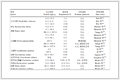
1 不同空间尺度下土壤微生物群落的空间分布及驱动因素土壤微生物多样性的空间分布有很强的尺度效应,目前土壤微生物研究的空间尺度可分为微小尺度(微米至厘米)、局域尺度(厘米至千米)、区域和全球尺度(数千米至数千千米)等3种尺度[15-16],不同尺度下微生物群落空间分布模式及驱动因素如表 1所示。
|
表 1 不同空间尺度下土壤微生物群落空间分布及驱动因素 Table 1 Distribution patterns and drivers of soil microbial communities at different spatial scales |
微小尺度上研究最多的是细菌、真菌群落在根际的分布特征,根系分泌物及信号分子从土壤库中招募特定种群定殖在根际,形成了特定的微生物种群,如硝酸盐还原菌和反硝化菌、菌根真菌和根瘤菌、土壤病原体的拮抗微生物等[17]。由于根系分泌物的富集作用,根际土壤细菌、真菌生物量比非根际土壤中高几倍至几十倍,但从非根际土壤到根际微生物群落α多样性反而较低,这与植物根系释放的酸性代谢物导致土壤酸化密切相关[18]。其中假单胞菌(Pseudomonas)和木霉菌(Trichoderma)富集于多种植物根际,这种分布特征与土壤质地、营养成分、土壤生物活动、根际效应等密切相关[19-20],因此形成了土壤微环境的多样性与空间异质性,且空间异质性与微生物多样性及生物量间存在显著正相关[21-22]。另外,土壤颗粒及孔隙结构中形成的水–土、气–土及水–气界面为微生物提供了多样化生境,通过调控温度、氧气、基质、水分等影响微生物群落的生长与扩散,因此,团聚体越多、孔隙度越高,微生物生物量和多样性越高[23-24]。总之,在微小尺度内,土壤质地和地上植被差异所导致的空间异质性是微生物多样性和群落结构空间分布的关键驱动因素。
1.2 局域尺度土壤微生物多样性和群落结构随海拔梯度分布是局域尺度上研究结论最多的,随着海拔升高,微生物多样性呈降低趋势,与植物多样性海拔分布格局有相似之处,其中细菌多样性总体呈现单峰或者下凹型的海拔分布格局;真菌海拔分布模式因种群而不同,其中菌根真菌多样性随海拔呈单峰下降分布,表现出与植物相似的海拔分布[25]。例如,日本富士山微生物多样性沿海拔梯度呈单峰变化趋势,在中等海拔(1 500 m)处最高[26];值得注意的是干旱地区贺兰山[27、热带地区武夷山[28]、亚马逊和安第斯山脉森林土壤[29]微生物多样性分布模式相似,均随海拔升高而降低,与地上植物多样性分布相似;高寒区青藏高原谢拉山土壤细菌表现出更明显的海拔分布差异和多样性下降趋势[30],贡嘎山森林土壤细菌多样性同样随海拔升高递减[31];寒冷地区长白山的细菌多样性仅在苔原土壤中随海拔升高呈下降趋势,其他类型土壤中并没有表现出规律性变化,只是细菌群落结构沿海拔高度有显著变化[32],这可能与该地区土壤有机碳含量较高有关。综上,不同地区土壤细菌、真菌多样性可能有不同的海拔分布模式,与地上植物的分布格局也不完全一致。
在局域尺度,由于微生物随机扩散、土壤质地差异及植被斑块化分布,导致微生物群落分布模式及驱动因素也互不相同,例如不同树种凋落物下形成了不同微生物区系,土壤质地、温度和含水量以及植被类型等随着海拔梯度上升均有明显差异[33-34]。目前研究显示土壤pH和年降雨量对细菌和真菌多样性的影响最为显著。最近,Song等[35]对黄山不同海拔梯度森林土壤研究显示活性有机碳是影响细菌群落结构的主要因素,该结论与其他研究者不同,或许能为区域尺度微生物分布格局及驱动因素研究提供新的借鉴。
1.3 区域和全球尺度在区域和全球尺度,土壤微生物多样性地理分布格局因种群而不同。2006年,Martiny等[36]提出生物丰度和多样性并非随机分布,具有明显的空间分布特征。例如,南半球土壤细菌多样性从赤道到南极多样性减少,似乎与动植物多样性沿赤道距离分布模式相似,有明显纬度地带分布特征[37-38]。然而,O'Malley[39]认为微生物群落的分布并无明显的地带性和区域分布特征,呈全球性的随机分布。更多研究结果显示北半球土壤细菌多样性并不符合随纬度升高而降低的变化趋势,微生物丰度沿纬度分布格局尚不明确,只是群落组成各不相同[40-42]。最近,Bahram等[43]和van den Hoogen等[44]先后在Nature上发表研究结果,一致认为:土壤细菌多样性在中纬度地区最高,真菌多样性则随着纬度升高而降低,表明在全球表层土壤真菌和细菌多样性沿纬度梯度呈现不同的分布格局,而且与地上动植物丰度在赤道热带地区最高、向两极逐渐下降的时空分布规律并不完全一致。因此,针对特定种群(细菌、真菌、古菌、放线菌等)探讨微生物群落全球分布可能更易于形成共识。
在区域和全球尺度,环境因子和区域差异是微生物群落构建的主要驱动因素,其中区域气候、地形、土壤类型等发挥着更为重要的作用。土壤真菌多样性的全球分布主要受气候条件的驱动,最近,Delgado-Baquerizo等[45]研究证实全球气候变暖导致土壤真菌中病原菌比例显著增加,而细菌、菌根真菌则受地域气候、土壤类型和植被条件的共同影响[46]。此外,地上–地下生物的互作也是微生物多样性大尺度空间分布模式的重要影响因素,表明在区域和全球尺度上,环境选择和生态位分化共同决定了土壤微生物多样性与群落组成。
综上,土壤细菌、真菌多样性及群落结构因土壤特性、植被类型、气候条件的差异在一定空间尺度表现出特定的分布格局,目前尚未形成普适性理论;且影响土壤微生物群落空间分布的关键因素不尽相同,即不同尺度下土壤微生物群落构建机制也不相同。因此,在比较不同研究结果时需要明确区分研究尺度与研究对象,讨论群落构建机制时也应充分考虑空间尺度效应,这对形成共识具有重要意义。
2 不同时间尺度下土壤微生物群落演变特征及驱动因素不同时间尺度下土壤微生物群落动态演变特征、驱动因素及研究对象各不相同(表 2)。常见的时间研究尺度可分4种[47]:①数小时至数天或数周的短期尺度;②气候和生物因素变化引起的季节尺度;③原生和次生植被演替及土壤形成初期长达几年至数十年;④气候变化和土壤发育过程所需的数百年至数千年的长期演变过程。
|
|
表 2 不同时间尺度下土壤微生物群落演变及驱动因素 Table 2 Evolution and drivers of soil microbial communities at different time scales |
土壤环境条件改变之后,微生物群落可在短期内快速响应,微生物代谢活动、生长强度及生长/休眠比例均有明显改变。在特定时间段内,形成一个高活性的“热点区域”,微生物呼吸、生长速率、矿化速率、酶活性或RNA/DNA比率显著增加(2倍~ 20倍) [48]。例如,在根系分泌物周围、碎屑层、有机质丰富的土壤孔隙,这些适宜的微环境诱发了微生物群落快速繁殖,形成“热点区域”[49]。模拟添加天然多糖(几丁质、纤维素) 后的第7 ~ 15天土壤微生物活性最高,21 d后微生物活性恢复到初始水平[50]。但森林土壤中这种“热点区域”会长期存在,主要是因为有机物的不断转化、输入。因此,短期内微生物群落演变的主要驱动力是营养物质的快速释放,如干旱之后的降雨[51-52]、土壤解冻[53]、凋落物输入和转化之后,引发微生物活性迅速恢复,多样性快速增加,特定种群富集,群落结构改变。
2.2 季节(数月)演变微生物群落季节演变表现出种属特异性,细菌群落结构和多样性的季节性差异显著,而真菌季节性变化较小,但在不同植被类型和土地利用方式间差异显著。不同季节微生物多样性和生物量变化幅度约为0.3倍~ 20倍,温带地区春夏季(3—9月) 较秋冬季(10—2月) 具有较高的多样性和生物量,表现出典型的温带夏冬季节演变及热带地区雨季旱季演变特征[54];但北极和高海拔地区微生物生物量在冬季末达到最大值,在融雪季节显著下降[55];赤道地区森林土壤微生物群落则无明显季节演替,主要原因可能与该地区土壤温度、湿度和群落活性几乎全年恒定相关[56]。群落活性的季节变化则因种群而不同,部分细菌、菌丝真菌和酵母菌在冬季活性更高,耐旱的放线菌种群在旱季生长更快[57]。
土壤温度、含水量和有机质是驱动土壤微生物群落季节变化的重要因素[58]。在干湿季明显的热带和亚热带地区,温度主要影响微生物群落的生理活性,土壤含水量才是驱动土壤微生物季节变化的关键因素[59]。这两者不仅直接改变微生物多样性,还可通过调节植物活性间接改变微生物多样性。另外,植物根系分泌的可溶性有机物含量通常在春夏季植物生长旺盛期间达到最大值,这和微生物丰度和活性在春夏季最高的结果高度一致,表明在特定的气候条件下,地上植被类型及其根系分泌物是微生物季节演替的重要驱动因素。因此,土壤微生物群落的季节演变是其响应土壤生境变化的结果,是由土壤环境因素所驱动的。
2.3 多年(数年至数十年)演变土壤发育、退化与恢复、植被演变等生态过程伴随着数年至数十年之久的微生物群落的演变。研究人员常选择冰川消退地区[60]、裸露岩石[61]、石质和砂质基质[62]以及海洋湖泊沉积物[63-64]等具有时间序列的土壤为研究对象,探究从最初裸露基质至发育不同阶段微生物群落演替特征。结果表明,光合藻类、固氮细菌(蓝藻)及产酸真菌是岩石表面定殖的关键种群,发育初期群落多样性和生物量通常很低,主要受植被稀少、土壤有机质和氮磷元素缺乏的限制[65];此后,生物量及α多样性逐年增加[66],β多样性在土壤形成初期较高,随着土壤逐渐发育,β多样性可能会降低[67-68]。此外,数十年尺度上的微生物群落演变可反映人为扰动对土壤生态过程的影响,例如森林砍伐后,微生物生物量减少,细菌群落结构显著变化、α多样性增加,而真菌多样性降低[69];森林或草原植被自然恢复30年或更长时间后,微生物多样性和群落结构与天然森林或草原土壤相似[70];喜马拉雅西北部冰川退缩地微生物群落丰度和多样性递减,主要受土壤温度和pH的影响[71]。综上,土壤发育、退化与恢复及植被演变过程中细菌和真菌多样性有不同的演替特征,群落结构也有显著变化。多年演变过程中,微生物生物量、土壤有机质的积累与植被丰度显著正相关[72]。多数研究表明土壤pH、植被类型和有机质含量是调控土壤微生物群落多年演变的主要因素[73]。
2.4 长期(数百年及以上)演变长期演替后微生物多样性降低,群落结构趋于单一,特有功能种群增加。深层土壤是研究微生物群落长期演变的主要对象,包括自然沉积物、古建筑土壤、永久冻土等。埋深超过100 m的土壤微生物DNA仍保存完整,群落垂直分布信息也得到了较好保存:自上而下细菌α多样性下降,群落结构差异明显,糖酵解细菌明显减少,寡营养和厌氧细菌增多,特别是疣微菌门(Verrucomicrobia) 相对丰度显著降低[74];真菌菌丝体变短、生物量降低,70% 以小孢子形式存在[75];长期演替过程中,细菌数量减少至表层土壤的1/3 ~ 1/8[76]。例如,青藏高原冻土岩芯中细菌群落α多样性随深度增加而降低,群落结构显著改变,其中氨氧化古菌是碳氮循环的优势种群[77]。
微生物群落长期演变主要与土壤有机质含量及土壤环境条件密切相关。通常,深埋土壤氧含量低,CO2含量高,温度和湿度基本恒定,新鲜有机质输入几乎为零。深埋土壤有机质含量逐渐下降,微生物生物量和多样性也相应降低。不同生态系统的研究也得出了相近结论:半干旱区深层土壤水分缺失和有机质降低导致细菌多样性降低,群落结构变化及功能损失[78];大兴安岭多年冻土区的研究显示土壤有机碳降低是导致微生物多样性降低和群落结构改变的主要因素[79]。
3 土壤微生物群落时空分布的理论基础微生物群落构建机制是解释不同尺度下微生物时空分布的核心科学问题,是土壤微生态学研究的重要挑战。目前,微生物群落构建的基础理论包括生态位理论和中性理论,前者认为确定性过程是决定性因素,后者则强调随机过程(成种、灭绝、定殖和扩散限制) 对群落建成的作用。最新研究表明,确定性过程和随机性过程在群落构建过程中是共同起作用的,但相对贡献大小不同,更多的研究倾向于将两种理论整合以解释群落构建过程[80-82]。褚海燕研究团队比较了自然生态系统(青藏高原) 与农田生态系统(华北平原) 土壤细菌的群落构建过程,结果显示,农田生态系统在空间距离大于900 km时以确定性过程为主,空间距离在150 ~ 900 km范围内以随机性过程为主;自然生态系统在130 ~ 1 200 km范围内以确定性过程为主[83-84]。表明不同生态系统土壤微生物群落构建机制不同,且有尺度效应,因此,应用生态位理论和中性理论解释微生物群落构建过程需要考虑尺度效应。显然,扩散过程在小尺度范围更容易发生,因此可认为小尺度范围内中性理论的贡献大于生态位理论,随机过程起主导作用;而大尺度下生态位理论的贡献大于中性理论,确定性过程起主导作用。在时间尺度上,演替早期主要受随机过程的影响;随着演替的进行,确定性过程重要性逐渐增加[85]。可见,不同研究尺度、植物种类和生境等都会影响确定性过程和随机过程对群落构建的影响。
另外,宏观生态学中的种–面积关系、距离–衰减关系以及广域种–稀有种的分化等时空演替规律在土壤微生物生态中都存在[86-87]。随着空间尺度增大,群落构建过程由匀质性扩散向异质性选择转变,构建机制的转变可以很好地解释土壤微生物的距离–衰减分布模式[88]。最新研究结果也表明古菌和真菌的多样性与地上生物分布表现出一致的分布趋势,特别是真菌的全球分布格局与植物群落分布密切相关,这和真菌与植物之间的共生关系一致[89],古菌和真菌群落分布格局的调控机制可能与地上植物类似[90]。尽管如此,不同种群也因研究尺度、土壤类型、气候因子和植被的不同而存在较大差异,目前对于土壤微生物群落分布格局及群落构建机制还未能形成统一认识[91]。
4 结论与展望土壤微生物多样性与群落结构的时空分布模式受生物因素和非生物因素的共同影响,表现出时空差异性,并非“everything is everywhere”[92]。目前,关于生物时空分布格局的相关理论基本都是基于地上植物的研究结果,土壤微生物时空分布研究起步较晚,至今尚未形成一致的理论体系。挑战一方面来自土壤随机扩散、空间异质性和植被斑块分布,导致空间分布的不连续性和不均匀性;另一方面由于长期演替无法模拟和重复,更多研究只关注了短期、季节或数年演替特征。目前常以空间代替时间,选择深层土壤、永久冻土、冰川消退土壤及海底沉积物为研究对象以揭示不同时间尺度下土壤微生物群落的演变规律[93]。群落分布模式、驱动因素和群落构建机制也因研究尺度、生物群落、考量指标不同而有差异,因此,得出结论时需要明确区分研究尺度、研究对象及考量指标,这对形成普适性理论具有重要意义。
空间和时间因素均能影响微生物群落分布模式,但两者相对重要性不同。例如季节性变化主要是由快速变化的土壤环境变化引起的,说明时间因素影响的本质是空间环境变化的结果,反映出地理空间比时间的相对重要性更高。同时,地理距离越远,空间异质性越高,因此,地理距离比环境因素的影响更大。因此在讨论微生物分布驱动因素时,须选择同一尺度范围的空间和时间因素。最新研究结果显示,区域及全球尺度下,年降雨量、气候因子、土壤有机碳含量、pH是驱动土壤细菌、真菌群落生态位分化、多样性和群落结构区域分布模式的关键环境因子[94-96]。结合前述微小尺度、局域尺度研究结果,发现土壤有机碳是影响群落空间分布的共同驱动因素,可以作为预测土壤微生物群落分布模式的主要环境因子[97]。
基于现有研究进展及存在的问题,未来研究中:①重点关注区域和全球尺度下土壤微生物群落分布模式,探究不同时空尺度下土壤微生物群落分布模式的决定性因素;②在更高分类水平上探讨不同微生物种群的时空分布模式;③微生物多样性及群落结构是空间异质性对相似群落选择的结果,因此,对群落功能基因的实时定量能更真实反映微生物群落演变与功能的相互关系。
| [1] |
曹鹏, 贺纪正. 微生物生态学理论框架[J]. 生态学报, 2015, 35(22): 7263-7273 (  0) 0) |
| [2] |
Wagg C, Schlaeppi K, Banerjee S, et al. Fungal-bacterial diversity and microbiome complexity predict ecosystem functioning[J]. Nature Communications, 2019, 10: 4841 DOI:10.1038/s41467-019-12798-y ( 0) |
| [3] |
Delgado-Baquerizo M, Reich P B, Trivedi C, et al. Multiple elements of soil biodiversity drive ecosystem functions across biomes[J]. Nature Ecology & Evolution, 2020, 4(2): 210-220 ( 0) |
| [4] |
贺纪正, 王军涛. 土壤微生物群落构建理论与时空演变特征[J]. 生态学报, 2015, 35(20): 1–2, 6575–6583 ( 0) |
| [5] |
van Plas F. Biodiversity and ecosystem functioning in naturally assembled communities[J]. Biological Reviews of the Cambridge Philosophical Society, 2019, 94(4): 1220-1245 DOI:10.1111/brv.12499 ( 0) |
| [6] |
黄艺, 黄木柯, 柴立伟, 等. 干旱半干旱区土壤微生物空间分布格局的成因[J]. 生态环境学报, 2018, 27(1): 191-198 ( 0) |
| [7] |
褚海燕, 王艳芬, 时玉, 等. 土壤微生物生物地理学研究现状与发展态势[J]. 中国科学院院刊, 2017, 32(6): 585-592 ( 0) |
| [8] |
褚海燕, 冯毛毛, 柳旭, 等. 土壤微生物生物地理学: 国内进展与国际前沿[J]. 土壤学报, 2020, 57(3): 515-529 ( 0) |
| [9] |
Copley J. Ecology goes underground[J]. Nature, 2000, 406(6795): 452-454 DOI:10.1038/35020131 ( 0) |
| [10] |
Chu H Y, Gao G F, Ma Y Y, et al. Soil microbial biogeography in a changing world: Recent advances and future perspectives[J]. mSystems, 2020, 5(2): e00803-e00819 ( 0) |
| [11] |
刘秉儒. 生物多样性的海拔分布格局研究及进展[J]. 生态环境学报, 2021, 30(2): 438-444 ( 0) |
| [12] |
Shen C C, Ni Y Y, Liang W J, et al. Distinct soil bacterial communities along a small-scale elevational gradient in alpine tundra[J]. Frontiers in Microbiology, 2015, 6: 582 ( 0) |
| [13] |
Duan Y L, Wang X Y, Wang L L, et al. Biogeographic patterns of soil microbe communities in the deserts of the Hexi Corridor, Northern China[J]. CATENA, 2022, 211: 106026 DOI:10.1016/j.catena.2022.106026 ( 0) |
| [14] |
Zhang K P, Delgado-Baquerizo M, Zhu Y G, et al. Space is more important than season when shaping soil microbial communities at a large spatial scale[J]. mSystems, 2020, 5(3): e00783-e00719 ( 0) |
| [15] |
贺纪正, 葛源. 土壤微生物生物地理学研究进展[J]. 生态学报, 2008, 28(11): 5571-5582 ( 0) |
| [16] |
Bardgett R D, van der Putten W H. Belowground biodiversity and ecosystem functioning[J]. Nature, 2014, 515: 505-511 DOI:10.1038/nature13855 ( 0) |
| [17] |
Broeckling C D, Broz A K, Bergelson J, et al. Root exudates regulate soil fungal community composition and diversity[J]. Applied and Environmental Microbiology, 2008, 74(3): 738-744 DOI:10.1128/AEM.02188-07 ( 0) |
| [18] |
Tian P, Razavi B S, Zhang X C, et al. Microbial growth and enzyme kinetics in rhizosphere hotspots are modulated by soil organics and nutrient availability[J]. Soil Biology and Biochemistry, 2020, 141: 107662 DOI:10.1016/j.soilbio.2019.107662 ( 0) |
| [19] |
刘京伟, 李香真, 姚敏杰. 植物根际微生物群落构建的研究进展[J]. 微生物学报, 2021, 61(2): 231-248 ( 0) |
| [20] |
Hu L F, Robert C A M, Cadot S, et al. Root exudate metabolites drive plant-soil feedbacks on growth and defense by shaping the rhizosphere microbiota[J]. Nature Communications, 2018, 9(1): 2738 DOI:10.1038/s41467-018-05122-7 ( 0) |
| [21] |
陈虹, 唐昊冶, 郭家欢, 等. 根系分泌物主要作用及解析技术进展[J]. 土壤, 2023, 55(2): 225-233 DOI:10.13758/j.cnki.tr.2023.02.001 ( 0) |
| [22] |
Dudenhöffer J H, Luecke N C, Crawford K M. Changes in precipitation patterns can destabilize plant species coexistence via changes in plant-soil feedback[J]. Nature Ecology & Evolution, 2022, 6(5): 546-554 ( 0) |
| [23] |
Kravchenko A N, Guber A K. Soil pores and their contributions to soil carbon processes[J]. Geoderma, 2017, 287: 31-39 DOI:10.1016/j.geoderma.2016.06.027 ( 0) |
| [24] |
Xu L, Naylor D, Dong Z B, et al. Drought delays development of the sorghum root microbiome and enriches for monoderm bacteria[J]. Proceedings of the National Academy of Sciences of the United States of America, 2018, 115(18): E4284-E4293 ( 0) |
| [25] |
厉桂香, 马克明. 土壤微生物多样性海拔格局研究进展[J]. 生态学报, 2018, 38(5): 1521-1529 ( 0) |
| [26] |
Singh D, Takahashi K, Kim M, et al. A hump-backed trend in bacterial diversity with elevation on Mount Fuji, Japan[J]. Microbial Ecology, 2012, 63(2): 429-437 DOI:10.1007/s00248-011-9900-1 ( 0) |
| [27] |
刘秉儒, 张秀珍, 胡天华, 等. 贺兰山不同海拔典型植被带土壤微生物多样性[J]. 生态学报, 2013, 33(22): 7211-7220 ( 0) |
| [28] |
吴则焰, 林文雄, 陈志芳, 等. 武夷山国家自然保护区不同植被类型土壤微生物群落特征[J]. 应用生态学报, 2013, 24(8): 2301-2309 ( 0) |
| [29] |
Nottingham A T, Fierer N, Turner B L, et al. Microbes follow Humboldt: Temperature drives plant and soil microbial diversity patterns from the Amazon to the Andes[J]. Ecology, 2018, 99(11): 2455-2466 DOI:10.1002/ecy.2482 ( 0) |
| [30] |
Wang J T, Cao P, Hu H W, et al. Altitudinal distribution patterns of soil bacterial and archaeal communities along Mt. shegyla on the Tibetan Plateau[J]. Microbial Ecology, 2015, 69(1): 135-145 DOI:10.1007/s00248-014-0465-7 ( 0) |
| [31] |
Li J B, Shen Z H, Li C N, et al. Stair-step pattern of soil bacterial diversity mainly driven by pH and vegetation types along the elevational gradients of Gongga Mountain, China[J]. Frontiers in Microbiology, 2018, 9: 569 DOI:10.3389/fmicb.2018.00569 ( 0) |
| [32] |
Shen C C, Xiong J B, Zhang H Y, et al. Soil pH drives the spatial distribution of bacterial communities along elevation on Changbai Mountain[J]. Soil Biology and Biochemistry, 2013, 57: 204-211 DOI:10.1016/j.soilbio.2012.07.013 ( 0) |
| [33] |
Liu D, Liu G H, Chen L, et al. Soil pH determines fungal diversity along an elevation gradient in Southwestern China[J]. Science China-Life Sciences, 2018, 61(6): 718-726 DOI:10.1007/s11427-017-9200-1 ( 0) |
| [34] |
Cui Y X, Bing H J, Fang L C, et al. Diversity patterns of the rhizosphere and bulk soil microbial communities along an altitudinal gradient in an alpine ecosystem of the eastern Tibetan Plateau[J]. Geoderma, 2019, 338: 118-127 DOI:10.1016/j.geoderma.2018.11.047 ( 0) |
| [35] |
Song L Y, Yang T, Xia S G, et al. Soil depth exerts stronger impact on bacterial community than elevation in subtropical forests of Huangshan Mountain[J]. Science of the Total Environment, 2022, 852: 158438 DOI:10.1016/j.scitotenv.2022.158438 ( 0) |
| [36] |
Martiny J B, Bohannan B J M, Brown J H, et al. Microbial biogeography: Putting microorganisms on the map[J]. Nature Reviews Microbiology, 2006, 4(2): 102-112 DOI:10.1038/nrmicro1341 ( 0) |
| [37] |
Fierer N, Lennon J T. The generation and maintenance of diversity in microbial communities[J]. American Journal of Botany, 2011, 98(3): 439-448 DOI:10.3732/ajb.1000498 ( 0) |
| [38] |
Delgado-Baquerizo M, Maestre F T, Reich P B, et al. Carbon content and climate variability drive global soil bacterial diversity patterns[J]. Ecological Monographs, 2016, 86(3): 373-390 DOI:10.1002/ecm.1216 ( 0) |
| [39] |
O'Malley M A. The nineteenth century roots of 'everything is everywhere'[J]. Nature Reviews Microbiology, 2007, 5(8): 647-651 DOI:10.1038/nrmicro1711 ( 0) |
| [40] |
Fierer N, Jackson R B. The diversity and biogeography of soil bacterial communities[J]. Proceedings of the National Academy of Sciences of the United States of America, 2006, 103(3): 626-631 ( 0) |
| [41] |
Chu H Y, Fierer N, Lauber C L, et al. Soil bacterial diversity in the Arctic is not fundamentally different from that found in other biomes[J]. Environmental Microbiology, 2010, 12(11): 2998-3006 DOI:10.1111/j.1462-2920.2010.02277.x ( 0) |
| [42] |
Wu T H, Ayres E, Bardgett R D, et al. Molecular study of worldwide distribution and diversity of soil animals[J]. Proceedings of the National Academy of Sciences of the United States of America, 2011, 108(43): 17720-17725 ( 0) |
| [43] |
Bahram M, Hildebrand F, Forslund S K, et al. Structure and function of the global topsoil microbiome[J]. Nature, 2018, 560(7717): 233-237 DOI:10.1038/s41586-018-0386-6 ( 0) |
| [44] |
van den Hoogen J, Geisen S, Routh D, et al. Soil nematode abundance and functional group composition at a global scale[J]. Nature, 2019, 572(7768): 194-198 DOI:10.1038/s41586-019-1418-6 ( 0) |
| [45] |
Delgado-Baquerizo M, Guerra C A, Cano-Díaz C, et al. The proportion of soil-borne pathogens increases with warming at the global scale[J]. Nature Climate Change, 2020, 10: 550-554 DOI:10.1038/s41558-020-0759-3 ( 0) |
| [46] |
Tedersoo L, Bahram M, Toots M, et al. Towards global patterns in the diversity and community structure of ectomycorrhizal fungi[J]. Molecular Ecology, 2012, 21(17): 4160-4170 DOI:10.1111/j.1365-294X.2012.05602.x ( 0) |
| [47] |
Chernov T I, Zhelezova A D. The dynamics of soil microbial communities on different timescales: A review[J]. Eurasian Soil Science, 2020, 53(5): 643-652 DOI:10.1134/S106422932005004X ( 0) |
| [48] |
Högberg M N, Briones M J I, Keel S G, et al. Quantification of effects of season and nitrogen supply on tree below-ground carbon transfer to ectomycorrhizal fungi and other soil organisms in a boreal pine forest[J]. The New Phytologist, 2010, 187(2): 485-493 DOI:10.1111/j.1469-8137.2010.03274.x ( 0) |
| [49] |
Kuzyakov Y, Blagodatskaya E. Microbial hotspots and hot moments in soil: Concept & review[J]. Soil Biology and Biochemistry, 2015, 83: 184-199 DOI:10.1016/j.soilbio.2015.01.025 ( 0) |
| [50] |
Yaroslavtsev A M, Manucharova N A, Stepanov A L, et al. Microbial destruction of chitin in soils under different moisture conditions[J]. Eurasian Soil Science, 2009, 42(7): 797-806 DOI:10.1134/S1064229309070114 ( 0) |
| [51] |
Placella S A, Brodie E L, Firestone M K. Rainfall-induced carbon dioxide pulses result from sequential resuscitation of phylogenetically clustered microbial groups[J]. Proceedings of the National Academy of Sciences of the United States of America, 2012, 109(27): 10931-10936 ( 0) |
| [52] |
Placella S A, Firestone M K. Transcriptional response of nitrifying communities to wetting of dry soil[J]. Applied and Environmental Microbiology, 2013, 79(10): 3294-3302 DOI:10.1128/AEM.00404-13 ( 0) |
| [53] |
Coolen M J L, van de Giessen J, Zhu E Y, et al. Bioavailability of soil organic matter and microbial community dynamics upon permafrost thaw[J]. Environmental Microbiology, 2011, 13(8): 2299-2314 DOI:10.1111/j.1462-2920.2011.02489.x ( 0) |
| [54] |
Moche M, Gutknecht J, Schulz E, et al. Monthly dynamics of microbial community structure and their controlling factors in three floodplain soils[J]. Soil Biology and Biochemistry, 2015, 90: 169-178 DOI:10.1016/j.soilbio.2015.07.006 ( 0) |
| [55] |
Xu B, Wang J N, Wu N, et al. Seasonal and interannual dynamics of soil microbial biomass and available nitrogen in an alpine meadow in the eastern part of Qinghai–Tibet Plateau, China[J]. Biogeosciences, 2018, 15(2): 567-579 DOI:10.5194/bg-15-567-2018 ( 0) |
| [56] |
Zhang X Y, Wang W, Chen W L, et al. Comparison of seasonal soil microbial process in snow-covered temperate ecosystems of Northern China[J]. PLoS One, 2014, 9(3): e92985 DOI:10.1371/journal.pone.0092985 ( 0) |
| [57] |
Lacerda-Júnior G V, Noronha M F, Cabral L, et al. Land use and seasonal effects on the soil microbiome of a Brazilian dry forest[J]. Frontiers in Microbiology, 2019, 10: 648 DOI:10.3389/fmicb.2019.00648 ( 0) |
| [58] |
Chernov T I, Tkhakakhova A K, Ivanova E A, et al. Seasonal dynamics of the microbiome of chernozems of the long-term agrochemical experiment in Kamennaya Steppe[J]. Eurasian Soil Science, 2015, 48(12): 1349-1353 DOI:10.1134/S1064229315120054 ( 0) |
| [59] |
Wu H, Xiong D H, Xiao L, et al. Effects of vegetation coverage and seasonal change on soil microbial biomass and community structure in the dry-hot valley region[J]. Journal of Mountain Science, 2018, 15(7): 1546-1558 DOI:10.1007/s11629-017-4650-2 ( 0) |
| [60] |
Sun H Y, Wu Y H, Zhou J, et al. Variations of bacterial and fungal communities along a primary successional chronosequence in the Hailuogou glacier retreat area (Gongga Mountain, SW China)[J]. Journal of Mountain Science, 2016, 13(9): 1621-1631 DOI:10.1007/s11629-015-3570-2 ( 0) |
| [61] |
Ciccazzo S, Esposito A, Borruso L, et al. Microbial communities and primary succession in high altitude mountain environments[J]. Annals of Microbiology, 2016, 66(1): 43-60 DOI:10.1007/s13213-015-1130-1 ( 0) |
| [62] |
Zhelezova A, Chernov T, Tkhakakhova A, et al. Prokaryotic community shifts during soil formation on sands in the tundra zone[J]. PLoS One, 2019, 14(4): e0206777 DOI:10.1371/journal.pone.0206777 ( 0) |
| [63] |
Uroz S, Tech J J, Sawaya N A, et al. Structure and function of bacterial communities in ageing soils: Insights from the Mendocino ecological staircase[J]. Soil Biology and Biochemistry, 2014, 69: 265-274 DOI:10.1016/j.soilbio.2013.11.002 ( 0) |
| [64] |
Shanmugam S G, Kingery W L. Changes in soil microbial community structure in relation to plant succession and soil properties during 4000 years of pedogenesis[J]. European Journal of Soil Biology, 2018, 88: 80-88 DOI:10.1016/j.ejsobi.2018.07.003 ( 0) |
| [65] |
Castle S C, Sullivan B W, Knelman J, et al. Nutrient limitation of soil microbial activity during the earliest stages of ecosystem development[J]. Oecologia, 2017, 185(3): 513-524 DOI:10.1007/s00442-017-3965-6 ( 0) |
| [66] |
Yarwood S A, Högberg M N. Soil bacteria and Archaea change rapidly in the first century of Fennoscandian boreal forest development[J]. Soil Biology and Biochemistry, 2017, 114: 160-167 ( 0) |
| [67] |
Ortiz-Álvarez R, Fierer N, de Los Ríos A, et al. Consistent changes in the taxonomic structure and functional attributes of bacterial communities during primary succession[J]. The ISME Journal, 2018, 12(7): 1658-1667 ( 0) |
| [68] |
Delgado-Baquerizo M, Bardgett R D, Vitousek P M, et al. Changes in belowground biodiversity during ecosystem development[J]. Proceedings of the National Academy of Sciences of the United States of America, 2019, 116(14): 6891-6896 ( 0) |
| [69] |
Navarrete A A, Tsai S M, Mendes L W, et al. Soil microbiome responses to the short-term effects of Amazonian deforestation[J]. Molecular Ecology, 2015, 24(10): 2433-2448 ( 0) |
| [70] |
Tripathi B M, Edwards D P, Mendes L W, et al. The impact of tropical forest logging and oil palm agriculture on the soil microbiome[J]. Molecular Ecology, 2016, 25(10): 2244-2257 DOI:10.1111/mec.13620 ( 0) |
| [71] |
Kumar A, Mukhia S, Kumar R. Microbial community dynamics from a fast-receding glacier of Western Himalayas highlight the importance of microbes in primary succession, nutrient recycling, and xenobiotics degradation[J]. Ecological Indicators, 2022, 144: 109565 DOI:10.1016/j.ecolind.2022.109565 ( 0) |
| [72] |
Liu Y P, Lu M X, Zhang X W, et al. Shift of the microbial communities from exposed sandstone rocks to forest soils during pedogenesis[J]. International Biodeterioration & Biodegradation, 2019, 140: 21-28 ( 0) |
| [73] |
Hendershot J N, Read Q D, Henning J A, et al. Consistently inconsistent drivers of microbial diversity and abundance at macroecological scales[J]. Ecology, 2017, 98(7): 1757-1763 DOI:10.1002/ecy.1829 ( 0) |
| [74] |
Makeev A, Aseyeva E, Rusakov A, et al. The environment of the Early Iron Age at the southern fringe of the forest zone of the Russian Plain[J]. Quaternary International, 2019, 502: 218-237 DOI:10.1016/j.quaint.2018.04.002 ( 0) |
| [75] |
Demkina T S, Khomutova T E, Kashirskaya N N, et al. Microbiological investigations of paleosols of archeological monuments in the steppe zone[J]. Eurasian Soil Science, 2010, 43(2): 194-201 DOI:10.1134/S1064229310020092 ( 0) |
| [76] |
Chernov T I, Zhelezova A D, Kutovaya O V, et al. Comparative analysis of the structure of buried and surface soils by analysis of microbial DNA[J]. Microbiology, 2018, 87(6): 833-841 DOI:10.1134/S0026261718060073 ( 0) |
| [77] |
胡维刚. 昆仑山垭口深层多年冻土微生物多样性及构建机制研究[D]. 兰州: 兰州大学, 2016.
( 0) |
| [78] |
Kong W B, Wei X R, Wu Y H, et al. Afforestation can lower microbial diversity and functionality in deep soil layers in a semiarid region[J]. Global Change Biology, 2022, 28(20): 6086-6101 DOI:10.1111/gcb.16334 ( 0) |
| [79] |
赵义. 大兴安岭多年冻土区土壤微生物多样性及其与环境因子相关性分析[D]. 哈尔滨: 哈尔滨师范大学, 2019.
( 0) |
| [80] |
Lim P P J, Newsham K K, Convey P, et al. Effects of field warming on a high Arctic soil bacterial community: A metagenomic analysis[J]. Current Science, 2018, 115(9): 1697 DOI:10.18520/cs/v115/i9/1697-1700 ( 0) |
| [81] |
Dini-Andreote F, Stegen J C, van Elsas J D, et al. Disentangling mechanisms that mediate the balance between stochastic and deterministic processes in microbial succession[J]. Proceedings of the National Academy of Sciences of the United States of America, 2015, 112(11): E1326-E1332 ( 0) |
| [82] |
陈鲜妮, 米倩, 徐晓峰. 局域尺度麦田土壤微生物群落构建过程及其驱动因素[J]. 土壤, 2023, 55(4): 812-820 DOI:10.13758/j.cnki.tr.2023.04.015 ( 0) |
| [83] |
Shi Y, Li Y T, Xiang X J, et al. Spatial scale affects the relative role of stochasticity versus determinism in soil bacterial communities in wheat fields across the North China Plain[J]. Microbiome, 2018, 6(1): 27 DOI:10.1186/s40168-018-0409-4 ( 0) |
| [84] |
Shi Y, Li Y T, Yuan M Q, et al. A biogeographic map of soil bacterial communities in wheats field of the North China Plain[J]. Soil Ecology Letters, 2019, 1(1): 50-58 ( 0) |
| [85] |
靳一丹, 陆雅海. 大数据时代土壤微生物地理学研究综述[J]. 生态学报, 2022, 42(13): 5152-5164 ( 0) |
| [86] |
Bell T, Ager D, Song J I, et al. Larger islands house more bacterial taxa[J]. Science, 2005, 308(5730): 1884 DOI:10.1126/science.1111318 ( 0) |
| [87] |
Green J, Bohannan B J M. Spatial scaling of microbial biodiversity[J]. Trends in Ecology & Evolution, 2006, 21(9): 501-507 ( 0) |
| [88] |
Feng M M, Tripathi B M, Shi Y, et al. Interpreting distance-decay pattern of soil bacteria via quantifying the assembly processes at multiple spatial scales[J]. MicrobiologyOpen, 2019, 8(9): e00851 DOI:10.1002/mbo3.851 ( 0) |
| [89] |
Tedersoo L, Bahram M, Põlme S, et al. Fungal biogeography. Global diversity and geography of soil fungi[J]. Science, 2014, 346(6213): 1256688 DOI:10.1126/science.1256688 ( 0) |
| [90] |
Wang X B, Lü X T, Yao J, et al. Habitat-specific patterns and drivers of bacterial β-diversity in China's drylands[J]. The ISME Journal, 2017, 11(6): 1345-1358 DOI:10.1038/ismej.2017.11 ( 0) |
| [91] |
朱永官, 陈保冬, 付伟. 土壤生态学研究前沿[J]. 科技导报, 2022, 40(3): 25-31 ( 0) |
| [92] |
Delgado-Baquerizo M, Oliverio A M, Brewer T E, et al. A global atlas of the dominant bacteria found in soil[J]. Science, 2018, 359(6373): 320-325 DOI:10.1126/science.aap9516 ( 0) |
| [93] |
Semenov M V, Nikitin D A, Stepanov A L, et al. The structure of bacterial and fungal communities in the rhizosphere and root-free loci of gray forest soil[J]. Eurasian Soil Science, 2019, 52(3): 319-332 DOI:10.1134/S1064229319010137 ( 0) |
| [94] |
Delgado-Baquerizo M, Eldridge D J. Cross-biome drivers of soil bacterial alpha diversity on a worldwide scale[J]. Ecosystems, 2019, 22(6): 1220-1231 DOI:10.1007/s10021-018-0333-2 ( 0) |
| [95] |
李善家, 王福祥, 从文倩, 等. 河西走廊荒漠土壤微生物群落结构及环境响应[J]. 土壤学报, 2022, 59(6): 1718-1728 ( 0) |
| [96] |
Ramirez K S, Snoek L B, Koorem K, et al. Range-expansion effects on the belowground plant microbiome[J]. Nature Ecology & Evolution, 2019, 3(4): 604-611 ( 0) |
| [97] |
陈新月, 姚晓东, 曾文静, 等. 北方农牧交错带草地土壤微生物量碳空间格局及驱动因素[J]. 北京大学学报(自然科学版), 2021, 57(2): 250-260 ( 0) |