 2024, Vol. 56


2. 四川省地质矿产勘查开发局成都水文地质工程地质中心, 成都 610081;
3. 四川省环境保护地下水污染防治工程技术中心, 成都 610081;
4. 成都工业学院材料与环境工程学院, 成都 611730
我国作为最大的农膜消费国,每年消耗塑料约100万t,并以每年30% 的速度增长[1-2]。农用薄膜厚度较小[3]、回收率低[4],导致破碎薄膜微塑料大量进入农田土壤[5],而微塑料中的许多添加剂成分如酞酸酯(PAEs)与微塑料聚合物分子的结合并不紧密,在微塑料的生命周期中极易浸出,二者在土壤环境中迁移并转移至植物、土壤动物体内,对土壤生态环境与农产品安全造成了严重的危害。因此,本文对农膜微塑料与(PAEs)在土壤中的赋存特征、迁移行为以及其向微生物、动物和植物等生物相转移的规律等研究进展进行了归纳、总结与评述,并提出了未来研究的建议,以为土壤农膜微塑料与(PAEs)的污染治理提供理论支撑。
1 农膜微塑料与酞酸酯在土壤中的赋存特征与影响因素 1.1 农膜微塑料与酞酸酯的赋存特征我国每年在农业上消耗的塑料其中用于农膜1 800万hm2,低洼坑道92万hm2,温室130万hm2 [1-2]。在生产使用过程中,部分农膜破碎残留在土壤中,在机械扰动等物理破碎、光或化学老化、生物降解的作用下,逐渐形成粒径小于5 mm的微塑料[6-7],其丰度相较于大塑料颗粒要高出几个数量级。与此同时,农膜在土壤中释放的以PAEs为主的添加剂会造成进一步的环境污染,其含量约为5 ~ 8 160 μg/g,占农膜总质量的60%[8-9]。农膜已经成为我国土壤中酞酸酯污染的主要来源[10]。
农膜微塑料大多聚集在土壤表层,小部分在耕种、降水、生物活动等作用下向下迁移,因此随着土壤深度的增加,微塑料的含量也随之降低,大部分微塑料通过降水、地表径流或土壤侵蚀等途径进入水体[11]。不易降解的特性使得微塑料随着耕作年限的增加而不断累积,例如,新疆表层0 ~ 30 cm的土壤中微塑料含量在农膜覆盖年限小于5年时为3.8 g/m2,5 ~ 10年时增长为10.1 g/m2,10 ~ 20年增长为12.4 g/m2,20年以上则为13.0 g/m2[12-13]。气候的差异使得农膜微塑料的赋存在空间上具有较高的异质性,热带湿润边远地区微塑料丰度最高,平均值为7 579 pieces/kg,亚热带北部湿润区、暖温带亚湿润区微塑料丰度平均值分别为4 165、3 731 pieces/kg,中温带半干旱区微塑料丰度平均值为2 268 pieces/kg,而高原温带半干旱区微塑料丰度平均值仅为45 pieces/kg,西南地区与中部部分地区呈现较高丰度的微塑料残留[14]。气候特征强烈影响微塑料的分布特征,其中年平均气温、年日照时数、海拔高度的增加均有利于微塑料的累积,而年平均降雨量、风速的增加却减少微塑料的累积。比如,四川盆地的紫外线辐射远低于青藏高原、云贵高原,土壤中微塑料粒径小于5 mm的占近90%,强烈的紫外线使农膜更易转化为微塑料留存在土壤中[14]。因此,我国农膜微塑料的赋存在地块尺度上与土壤深度呈负相关、与时间呈正相关,而在全国尺度上则受气候的强烈影响。
邻苯二甲酸二丁酯(DBP)和邻苯二甲酸二酯(DEHP)是PAEs中占比最为丰富的化合物。研究显示,PAEs在土壤剖面(0 ~ 5、0 ~ 20 cm)上其含量通常随土壤深度的增加而降低[15-16]。在华北平原的一个废水灌溉区,由于持续灌溉导致PAEs吸附与迁移,PAEs同源物(包括DBP和DEHP)的含量随着土壤深度(0 ~ 100 cm)的增加而逐渐降低[17]。土地利用类型同样影响PAEs的赋存特征[18]。在天津的一项调查结果表明,PAEs含量呈现出蔬菜土壤 > 荒地土壤 > 农田土壤 > 果园土壤的递减顺序[19],而在湖北省汉江平原的调查结果表明,蔬菜和果园土壤的PAEs含量高于水稻和棉田土壤[20],不同土地利用类型的PAEs分布可能受到农膜类型、覆盖时间、季节等影响。
1.2 农膜微塑料与酞酸酯在土壤中残留的影响因素人类活动引起的外源性输入是影响土壤中污染分布的重要因素。通常土壤中的微塑料丰度随着种植时间的增加而增大[21],如在新疆石河子长期覆膜棉田中,5、15、24年覆膜棉田土壤中微塑料平均丰度呈递增趋势。但也有研究发现,滇池湖畔农田种植10年与种植25年土壤中微塑料的丰度并没有显著差异[16, 22]。因此,种植年限可能会影响局部土壤微塑料丰度。由于微塑料的迁移受控于土壤孔隙,土壤质地与结构将直接影响微塑料的迁移[23],高比例的砂粒更有利于形成大孔隙,为微塑料迁移提供有利的通道,而对于粉质壤土,小颗粒和孔径则不利于微塑料的迁移。但对于PAEs残留影响程度较大的因素,土壤理化性质如有效氮、有效磷、阳离子交换量以及总有机碳等则与微塑料丰度相关性较低[24]。
土壤中的PAEs水平因土地利用类型而异。在广西桂林,农田土壤、蔬菜土壤、果园土壤中PAEs含量依次减少[25],而在江汉平原,蔬菜和果园土壤中PAEs含量高于水稻和棉田土壤[26]。不同土地利用类型的PAEs分布差异可能是由于工业活动或使用塑料薄膜、肥料和杀虫剂提高作物产量的农业过程引起的[19, 27]。土壤中PAEs水平也受农膜的使用模式、颜色、厚度、回收率和时长等的影响。如,在蔬菜农场中,使用双层地膜耕种8 ~ 12年的土壤其PAEs含量高于使用单层地膜耕种10年以上的土壤;各种颜色的塑料薄膜中PAEs含量也存在显著差异,白色地膜中PAEs含量约是黑色地膜的2倍;种植时间的增加会导致PAEs含量的累积[10, 28]。此外,生产过程中的施肥、废水灌溉、污泥回用等也会引起大量的PAEs进入土壤环境[29]。
Wang等[30]研究土壤性质对PAEs在土壤中积累的影响,结果表明,总有机碳、pH和PAEs之间没有明显的相关关系,Zeng等[31]与Niu等[32]的研究得到了类似的结果,但后者发现土壤的黏粒含量与PAEs中的邻苯二甲酸二乙酯(DEP)、邻苯二甲酸丁苄酯(BBP)、DEHP等含量均存在显著负相关关系。在山东和广州的农业土壤中,土壤有机质(总有机碳)与PAEs、pH与PAEs、黏粒与PAEs呈正相关,这可能归因于城市与农业土壤的差异[33]。综上所述,农膜源污染物在土壤中的赋存受到农膜使用频率、耕作方式等人为因素,土壤类型、土壤性质、气候因素等自然条件,以及微塑料与酞酸酯等化合物的物理化学特征的耦合影响。
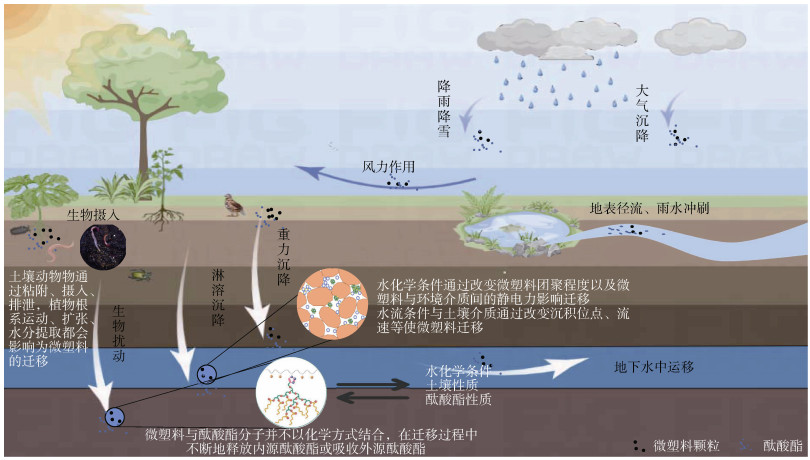
2 农膜微塑料与酞酸酯在土壤中的迁移行为 2.1 土壤中农膜微塑料与酞酸酯的迁移行为微塑料在风力、土壤侵蚀、地表径流、淋溶和重力的非生物作用或动物植物微生物的生物作用下发生横向或纵向的迁移[34-35],其在水平方向的迁移大多是远距离迁移,风力可以携带表层土壤的微塑料甚至到达世界最偏远的角落[36],而进入地下水或水体的微塑料也在径流作用下遍布各地,最终进入海洋环境。以伦敦泰晤士河流域微塑料为例,通过模拟污泥还田,发现残留在土壤中的污泥源微塑料比例为16% ~ 38%,其余大部分微塑料最终会从土壤迁移进入水体,成为水环境中微塑料污染的来源[37]。降雨淋溶和重力是使微塑料进行垂直迁移的重要动力,小颗粒可以通过淋溶沿着土壤孔隙运输。Grayling等[38]的研究发现,直径为0.1 ~ 0.6 μm的颗粒可以在土柱中垂直移动,而较大的微塑料颗粒则可能会保留在土壤中并充当汇。雨水冲刷促进微塑料向更深层土壤迁移。Zhang等[39]在我国东北农田中取样并模拟土壤侵蚀试验,结果表明,土壤样品中仅检测出聚乙烯(PE),并在表层土中的丰度最低,这归因于土壤表层的地表径流会促进微塑料向下移动,而在较深层土壤中渗透作用降低,导致微塑料迁移能力降低[40]。
内源PAEs可从农膜微塑料中解吸释放到土壤环境,相比于微塑料迁移受限于土壤孔隙结构,溶解性的PAEs更易迁移。Gulizia等[41]和Yan等[42]研究了微塑料中PAEs在土壤环境相关的水溶液中的浸出行为,试验将含有一定量邻苯二甲酸二丁酯(DnBP)、DEP等PAEs类化合物的微塑料置于不同的环境中观测PAEs的释放量,结果发现,50 mg微塑料(24.2% DnBP)与200 mL水溶液的混合液经48 h振荡后,DnBP的释放量达到0.8 mg/L,并且几乎在24 h内达到最大释放量,而微塑料(2.6% DEP、14.9% DnBP)经振荡后DnBP的释放量几乎不变,而DEP的释放量高达12 mg/L,不同PAEs的释放与微塑料性质、环境条件有紧密联系。由于酞酸盐是非离子化合物,PAEs类聚合物耐酸碱盐溶液,因此pH对酞酸酯释放量影响是有限的,但pH的变化对微塑料的团聚行为产生较大影响。当土壤地下水环境的pH升高时,微塑料表面的质子就会进入环境中,从而使表面电负性增加,颗粒间静电斥力增加,不易形成团聚体,更容易通过环境介质孔隙进行迁移[43-44];当pH降低时,微塑料颗粒团聚体的平均粒径增大,迁移能力随之下降[43]。具有代表性的天然可溶性有机质组分黄腐酸对微塑料中DnBP的释放有显著影响,既有可能是通过增加疏水有机化合物的溶解度,使邻苯二甲酸盐更容易溶解在水中;也有可能是黄腐酸比纯水具有更强的亲和力,可以更好地提取邻苯二甲酸盐,在多种增塑剂类化合物存在的情况下依然表现良好的促进作用。可溶性有机质中的腐殖酸可以直接占据微塑料上的吸附位点,进而直接影响有机污染物在微塑料上的吸附行为,因此当土壤中可溶性有机质含量较高时,PAEs更容易从微塑料中解吸而进入土壤迁移[45-46]。
另外,土壤中残留的外源PAEs亦可通过吸附作用与微塑料发生共迁移。Liu等[47]研究了DEP与DBP两种PAEs在3种微塑料聚苯乙烯(PS)、聚乙烯(PE)、聚氯乙烯(PVC)上的吸附行为,发现其均呈现高度线性,表明微塑料对PAEs的吸附受分配机理控制。其中,3种微塑料对DEP和DBP的吸附遵循PS > PE > PVC的顺序,与3种微塑料表面积的顺序不一致,因此吸附过程不受微塑料的物理性质影响。受pH、天然有机物腐殖酸影响较小,PAEs在酸性条件下较为稳定,在碱性条件下则会发生分解,因此在pH 2 ~ 7的环境下,微塑料吸附PAEs的情况未发生较大变化,而天然有机物腐殖酸对微塑料孔隙阻塞与微孔填充效应影响也较小,因此微塑料对PAEs的吸附不受而二者影响。而离子强度对吸附过程有显著影响,一方面可以通过改变微塑料的聚集状态改变吸附情况,另一方面通过盐析效应使PAEs更容易溶解而释放。例如,在氯化钠浓度从0 ~ 600 mol/L时,3种微塑料对DBP的吸附容量增加了约10%;氯化钙浓度从0 ~ 300 mol/L时,吸附容量增加了20%,钙离子的盐析作用强于钠离子,随着溶液盐度的增加,PAEs在微塑料上的吸附量也增加,因此高盐度土壤中PAEs具有更大的环境风险[47]。
此外,水流条件、土壤性质、生物作用等均对微塑料与PAEs共迁移造成影响。水流条件与土壤介质成分通过物理作用驱动团聚体迁移或停留,如当环境介质中孔隙水流速增加时,颗粒所受剪切应力增强,导致团聚体很难在介质表面沉积,从而迁移能力提高,而这种流速带来的影响要比水化学条件带来的影响更为显著[48]。与此同时,土壤中的植物、动物与微生物的活动同样驱动了微塑料的迁移。土壤中的蚯蚓、螨虫会通过粘附、摄入、排泄,促进土壤中微塑料的移动。植物根系的生物扰动如根系运动、根系扩张、根系水分提取对土壤中颗粒运输也有重要影响。但这些外力因素对微塑料的迁移运输通常仅是有限的辅助作用[49-50]。
综上所述,一方面,不同土壤环境影响微塑料对PAEs的释放,而PAEs一旦释放至土壤环境,将通过水文过程发生迁移;另一方面,微塑料在迁移过程中,会进一步通过吸附作用富集已存在的PAEs,形成协同运输。因此,PAEs的迁移行为与农膜微塑料具有高度的协同性(图 1)。微塑料与PAEs迁移的影响因素与影响机制详见表 1及表 2。
|
图 1 微塑料与PAEs在土壤中的迁移行为与影响因素 Fig. 1 Migration behavior and influencing factors of microplastics and PAEs in soil |

|
表 1 微塑料迁移的影响因素及机制 Table 1 Influencing factors and mechanisms of microplastic migration |
|
|
表 2 PAEs迁移的影响因素及机制 Table 2 Influencing factors and mechanisms of PAEs migration |
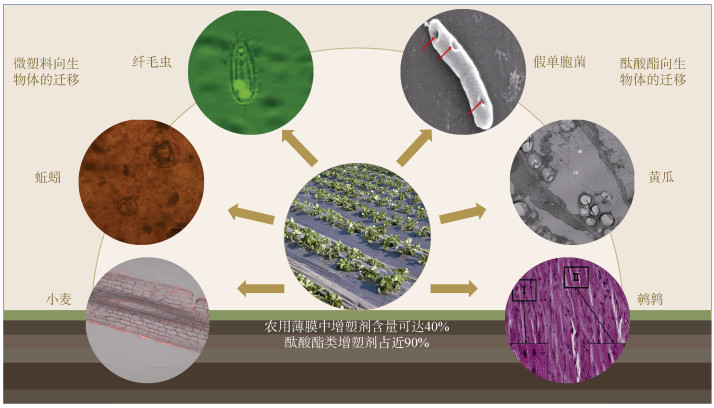
农膜微塑料不仅在土壤中大量检出,在土壤植物、动物以及微生物中检出的报道也在日益增加[74-80],这说明农膜微塑料已经出现由土壤向生物相转移的趋势。微塑料向土壤生物体迁移的情况详见表 3。微纳级微塑料颗粒可通过植物根系随水分或养分进入植物体,植物可变的细胞壁有利于其进入植物体内[81-82]。但这种迁移因植物种类而异,例如,微塑料可以干扰根毛的生长,影响水分与养分的输送与吸收,从而限制植物生长[83]。动物则往往通过进食摄取环境中的微塑料,并通过肠道消化形成粒径更小的微塑料,因微塑料较高的生物蓄积性和营养转移潜力,一方面微塑料可突破肠道屏障,在各器官内积累,从而导致病理生理反应,在此过程中,微塑料还会增加持久性有机污染物如多氯联苯的生物积累,部分多氯联苯会随着微塑料浓度的增加而增加[74]。另一方面,微塑料可以通过食物链进行转移,如微塑料在土壤–蚯蚓–鸡食物链内的转移,从土壤到蚯蚓粪便的富集系数为12.7,从土壤到鸡粪的富集系数为105[41]。与动植物不同,微塑料则影响传代周期较短的微生物功能基因表达[78, 84]。
|
|
表 3 微塑料向土壤生物体的迁移 Table 3 Migration of microplastics to soil organisms |
作为溶解性有机污染物,PAEs向生物体迁移的研究相比微塑料更加侧重于生物体吸收PAEs的限量以及所带来的急性或慢性毒性作用等。PAEs向土壤生物体迁移的情况详见表 4。如,DEHP对完整生物体具有雌激素内分泌干扰作用,在白菜、番茄、空心菜等多种植物体内也发现了累积含量少于10 mg/kg的DEHP,其多种同系物对微生物的生长代谢也有一定程度的影响[85]。PAEs的可穿透性与溶解性增加了微塑料向生物体迁移过程中不可避免的风险。
|
|
表 4 PAEs向土壤生物体的迁移 Table 4 Migration of PAEs to soil organisms |
土壤环境中广泛存在着微塑料,土壤生物等误食后会造成累积效应,由于微塑料与PAEs很难降解,富集了PAEs的微塑料一旦被生物摄入体内,一般难以排出,延长了有害物质在生物体内的停留时间,这一方面会影响生物自身生长,另一方面可经过食物链的放大作用逐级在生物体内富集,最终进入人体产生威胁。虽然目前研究者已关注到微塑料与PAEs向生物相的转移(图 2),但多数研究均针对单一污染物开展,忽略了农膜源新污染物的协同效应,其二者在迁移过程中的影响机制以及相互作用尚不明确,微塑料与PAEs对生物体的协同影响仍有待进一步研究。
|
图 2 微塑料与PAEs向土壤动物、植物、微生物迁移的证据[79, 87, 89-91] Fig. 2 Evidence for migration of microplastics and PAEs to soil animals, plants and microorganisms |
研究微塑料与PAEs等新污染物环境行为是农业污染防控的基础。PAEs与农膜微塑料的赋存特征具有显著相关性,在部分土壤中具有相似的时空分布特征;二者的赋存均受到农膜使用频率、耕作方式等人为因素,土壤类型、土壤性质、气候因素等自然条件,和污染物物理化学性质的耦合影响。农膜微塑料在土壤中的迁移行为受到生物与非生物因子的驱动,并在迁移过程中释放内源PAEs,同时会通过吸附作用富集外源性PAEs,形成协同运输,二者的迁移行为具有高度的协同性。土壤动物、植物、微生物可以通过进食、皮肤吸收等方式摄取微塑料与PAEs,并在体内富集,通过食物链对人类造成潜在的威胁。但目前对于微塑料与PAEs的研究更多集中于单一污染物的环境行为或与重金属、农药等的复合污染研究,相对缺乏农膜微塑料及其与内源PAEs相互作用及迁移行为的研究,这导致了对农膜微塑料与PAEs协同迁移机制认识不清,污染物理化性质、农田土壤环境条件、生物作用等因素对二者协同迁移的影响不明。因此,关于农膜源微塑料与PAEs迁移行为的研究,建议加强以下方面:
1) 发展微塑料与PAEs的快速、稳定的联合检测技术。目前土壤微塑料与PAEs各自的分离与检测方法有多种,但对两者共迁移的研究需要联合检测技术,这可为微塑料与PAEs协同迁移研究提供有效支撑。
2) 对微塑料与PAEs协同迁移行为开展研究。目前虽有少数文章研究PAEs从微塑料中的浸出行为,但只代表了初步调查,在真实的水生或土壤环境中,甚至动物消化系统中塑料降解剂的释放值得进一步研究,以准确评估与微塑料相关的风险。因此,不仅需要考虑不同环境因素对内源PAEs释放的影响,还需要考虑其对土壤中外源PAEs吸附–解吸过程的影响,并需要加强对迁移模型的研究,尤其是解决颗粒物(微塑料)与溶质(PAEs)迁移模型理论假设不一致的问题。
3) 生态环境风险的评估应更具有系统性。现有的研究大多在实验室开展,与实际环境与条件相差较远,代表性较差,应进一步开展长期田间观测试验,评估微塑料与PAEs对生物的生态毒性,跟踪其对土壤生态的长期影响,探究微塑料与PAEs在大时空尺度下的归趋。
| [1] |
Brown R. Polymers in agriculture and horticulture[M].
Rapra Technology Ltd., Shawbury, UK, 2004
(  0) 0) |
| [2] |
Garnaud J C. Agricultural and horticultural applications of polymers; Proceedings of the Rapra Technology Ltd, Oxford, Shawbury, UK, F, 1989 [C]. Pergamon Press.
( 0) |
| [3] |
王建伟. 日本工业标准JIS K6732~1967聚氯乙烯农膜[J]. 塑料, 1978, 7(2): 76-80 ( 0) |
| [4] |
本报讯. 农业部《农膜回收行动方案》提出: 到2020年全国农膜回收利用率达到80%以上[J]. 中国农资, 2017(19): 1 ( 0) |
| [5] |
Arkatkar A, Arutchelvi J, Bhaduri S, et al. Degradation of unpretreated and thermally pretreated polypropylene by soil consortia[J]. International Biodeterioration & Biodegradation, 2009, 63(1): 106-111 ( 0) |
| [6] |
Hayes D G, Wadsworth L C, Sintim H Y, et al. Effect of diverse weathering conditions on the physicochemical properties of biodegradable plastic mulches[J]. Polymer Testing, 2017, 62: 454-467 DOI:10.1016/j.polymertesting.2017.07.027 ( 0) |
| [7] |
Kumar M, Xiong X N, He M J, et al. Microplastics as pollutants in agricultural soils[J]. Environmental Pollution, 2020, 265(Pt A): 114980 ( 0) |
| [8] |
He L Z, Gielen G, Bolan N S, et al. Contamination and remediation of phthalic acid esters in agricultural soils in China: A review[J]. Agronomy for Sustainable Development, 2015, 35(2): 519-534 DOI:10.1007/s13593-014-0270-1 ( 0) |
| [9] |
Sun J Q, Wu X Q, Gan J. Uptake and metabolism of phthalate esters by edible plants[J]. Environmental Science & Technology, 2015, 49(14): 8471-8478 ( 0) |
| [10] |
Wang J, Luo Y M, Teng Y, et al. Soil contamination by phthalate esters in Chinese intensive vegetable production systems with different modes of use of plastic film[J]. Environmental Pollution, 2013, 180: 265-273 DOI:10.1016/j.envpol.2013.05.036 ( 0) |
| [11] |
Nizzetto L, Bussi G, Futter M N, et al. A theoretical assessment of microplastic transport in river catchments and their retention by soils and river sediments[J]. Environmental Science Processes & Impacts, 2016, 18(8): 1050-1059 ( 0) |
| [12] |
Zhang D, Liu H B, Hu W L, et al. The status and distribution characteristics of residual mulching film in Xinjiang, China[J]. Journal of Integrative Agriculture, 2016, 15(11): 2639-2646 DOI:10.1016/S2095-3119(15)61240-0 ( 0) |
| [13] |
He H J, Wang Z H, Guo L, et al. Distribution characteristics of residual film over a cotton field under long-term film mulching and drip irrigation in an oasis agroecosystem[J]. Soil and Tillage Research, 2018, 180: 194-203 DOI:10.1016/j.still.2018.03.013 ( 0) |
| [14] |
Cai L, Zhao X L, Liu Z H, et al. The abundance, characteristics and distribution of microplastics (MPs) in farmland soil-Based on research in China[J]. The Science of the Total Environment, 2023, 876: 162782 DOI:10.1016/j.scitotenv.2023.162782 ( 0) |
| [15] |
Li J, Song Y, Cai Y B. Focus topics on microplastics in soil: Analytical methods, occurrence, transport, and ecological risks[J]. Environmental Pollution, 2020, 257: 113570 DOI:10.1016/j.envpol.2019.113570 ( 0) |
| [16] |
Liu M T, Lu S B, Song Y, et al. Microplastic and mesoplastic pollution in farmland soils in suburbs of Shanghai, China[J]. Environmental Pollution, 2018, 242(Pt A): 855-862 ( 0) |
| [17] |
Tan W B, Zhang Y, He X S, et al. Distribution patterns of phthalic acid esters in soil particle-size fractions determine biouptake in soil-cereal crop systems[J]. Scientific Reports, 2016, 6: 31987 DOI:10.1038/srep31987 ( 0) |
| [18] |
Vikelsøe J, Thomsen M, Carlsen L. Phthalates and nonylphenols in profiles of differently dressed soils[J]. The Science of the Total Environment, 2002, 296(1/2/3): 105-116 ( 0) |
| [19] |
Kong S F, Ji Y Q, Liu L L, et al. Diversities of phthalate esters in suburban agricultural soils and wasteland soil appeared with urbanization in China[J]. Environmental Pollution, 2012, 170: 161-168 DOI:10.1016/j.envpol.2012.06.017 ( 0) |
| [20] |
Wang H, Liang H, Gao D W. Occurrence and risk assessment of phthalate esters (PAEs) in agricultural soils of the Sanjiang Plain, Northeast China[J]. Environmental Science and Pollution Research International, 2017, 24(24): 19723-19732 DOI:10.1007/s11356-017-9646-5 ( 0) |
| [21] |
Bläsing M, Amelung W. Plastics in soil: Analytical methods and possible sources[J]. The Science of the Total Environment, 2018, 612: 422-435 DOI:10.1016/j.scitotenv.2017.08.086 ( 0) |
| [22] |
郭冬梅, 吴瑛. 南疆棉田土壤中邻苯二甲酸酯(PAEs)的测定[J]. 干旱环境监测, 2011, 25(2): 76-79 ( 0) |
| [23] |
Rahmatpour S, Mosaddeghi M R, Shirvani M, et al. Transport of silver nanoparticles in intact columns of calcareous soils: The role of flow conditions and soil texture[J]. Geoderma, 2018, 322: 89-100 DOI:10.1016/j.geoderma.2018.02.016 ( 0) |
| [24] |
Feng S S, Lu H W, Yao T C, et al. Analysis of microplastics in soils on the high-altitude area of the Tibetan Plateau: Multiple environmental factors[J]. The Science of the Total Environment, 2023, 857(Pt 1): 159399 ( 0) |
| [25] |
刘三长, 蒋翔, 陈发挺. 桂林市农村土壤中酞酸酯类污染抽样分析[J]. 广西科学院学报, 2013, 29(4): 243-246 ( 0) |
| [26] |
Liu H, Liang H C, Liang Y, et al. Distribution of phthalate esters in alluvial sediment: A case study at JiangHan Plain, Central China[J]. Chemosphere, 2010, 78(4): 382-388 DOI:10.1016/j.chemosphere.2009.11.009 ( 0) |
| [27] |
Wu W, Hu J, Wang J Q, et al. Analysis of phthalate esters in soils near an electronics manufacturing facility and from a non-industrialized area by gas purge microsyringe extraction and gas chromatography[J]. The Science of the Total Environment, 2015, 508: 445-451 DOI:10.1016/j.scitotenv.2014.11.081 ( 0) |
| [28] |
Chai C, Cheng H Z, Ge W, et al. Phthalic acid esters in soils from vegetable greenhouses in Shandong Peninsula, East China[J]. PLoS One, 2014, 9(4): e95701 DOI:10.1371/journal.pone.0095701 ( 0) |
| [29] |
Lü H X, Mo C H, Zhao H M, et al. Soil contamination and sources of phthalates and its health risk in China: A review[J]. Environmental Research, 2018, 164: 417-429 DOI:10.1016/j.envres.2018.03.013 ( 0) |
| [30] |
Wang L J, Liu M M, Tao W D, et al. Pollution characteristics and health risk assessment of phthalate esters in urban soil in the typical semi-arid city of Xi'an, Northwest China[J]. Chemosphere, 2018, 191: 467-476 DOI:10.1016/j.chemosphere.2017.10.066 ( 0) |
| [31] |
Zeng F, Cui K Y, Xie Z Y, et al. Distribution of phthalate esters in urban soils of subtropical city, Guangzhou, China[J]. Journal of Hazardous Materials, 2009, 164(2/3): 1171-1178 ( 0) |
| [32] |
Niu L L, Xu Y, Xu C, et al. Status of phthalate esters contamination in agricultural soils across China and associated health risks[J]. Environmental Pollution, 2014, 195: 16-23 DOI:10.1016/j.envpol.2014.08.014 ( 0) |
| [33] |
Zeng F, Cui K Y, Xie Z Y, et al. Phthalate esters (PAEs): Emerging organic contaminants in agricultural soils in peri-urban areas around Guangzhou, China[J]. Environmental Pollution, 2008, 156(2): 425-434 DOI:10.1016/j.envpol.2008.01.045 ( 0) |
| [34] |
Bi M H, He Q, Chen Y. What roles are terrestrial plants playing in global microplastic cycling?[J]. Environmental Science & Technology, 2020, 54(9): 5325-5327 ( 0) |
| [35] |
Ren X W, Tang J C, Liu X M, et al. Effects of microplastics on greenhouse gas emissions and the microbial community in fertilized soil[J]. Environmental Pollution, 2020, 256: 113347 DOI:10.1016/j.envpol.2019.113347 ( 0) |
| [36] |
Kole P J, Löhr A J, Van Belleghem F G A J, et al. Wear and tear of tyres: A stealthy source of microplastics in the environment[J]. International Journal of Environmental Research and Public Health, 2017, 14(10): 1265 DOI:10.3390/ijerph14101265 ( 0) |
| [37] |
骆永明, 周倩, 章海波, 等. 重视土壤中微塑料污染研究防范生态与食物链风险[J]. 中国科学院院刊, 2018, 33(10): 1021-1030 ( 0) |
| [38] |
Grayling K M, Young S D, Roberts C J, et al. The application of X-ray micro Computed Tomography imaging for tracing particle movement in soil[J]. Geoderma, 2018, 321: 8-14 DOI:10.1016/j.geoderma.2018.01.038 ( 0) |
| [39] |
Zhang S W, Han B, Sun Y H, et al. Microplastics influence the adsorption and desorption characteristics of Cd in an agricultural soil[J]. Journal of Hazardous Materials, 2020, 388: 121775 DOI:10.1016/j.jhazmat.2019.121775 ( 0) |
| [40] |
杨扬, 何文清. 农田土壤微塑料污染现状与进展[J]. 环境工程, 2021, 39(5): 156–164, 15 ( 0) |
| [41] |
Gulizia A M, Patel K, Philippa B, et al. Understanding plasticiser leaching from polystyrene microplastics[J]. The Science of the Total Environment, 2023, 857(Pt 1): 159099 ( 0) |
| [42] |
Yan Y Y, Zhu F X, Zhu C Y, et al. Dibutyl phthalate release from polyvinyl chloride microplastics: Influence of plastic properties and environmental factors[J]. Water Research, 2021, 204: 117597 DOI:10.1016/j.watres.2021.117597 ( 0) |
| [43] |
Sadri B, Pernitsky D, Sadrzadeh M. Aggregation and deposition of colloidal particles: Effect of surface properties of collector beads[J]. Colloids and Surfaces A: Physicochemical and Engineering Aspects, 2017, 530: 46-52 ( 0) |
| [44] |
Xu P C, Ge W, Chai C, et al. Sorption of polybrominated diphenyl ethers by microplastics[J]. Marine Pollution Bulletin, 2019, 145: 260-269 DOI:10.1016/j.marpolbul.2019.05.050 ( 0) |
| [45] |
Dong S N, Sun Y Y, Gao B, et al. Retention and transport of graphene oxide in water-saturated limestone media[J]. Chemosphere, 2017, 180: 506-512 DOI:10.1016/j.chemosphere.2017.04.052 ( 0) |
| [46] |
Liu X M, Shi H H, Xie B, et al. Microplastics as both a sink and a source of bisphenol A in the marine environment[J]. Environmental Science & Technology, 2019, 53(17): 10188-10196 ( 0) |
| [47] |
Liu F F, Liu G Z, Zhu Z L, et al. Interactions between microplastics and phthalate esters as affected by microplastics characteristics and solution chemistry[J]. Chemosphere, 2019, 214: 688-694 DOI:10.1016/j.chemosphere.2018.09.174 ( 0) |
| [48] |
Zhang Q L, Raoof A, Hassanizadeh S M. Pore-scale study of flow rate on colloid attachment and remobilization in a saturated micromodel[J]. Journal of Environmental Quality, 2015, 44(5): 1376-1383 DOI:10.2134/jeq2015.01.0058 ( 0) |
| [49] |
刘沙沙, 付建平, 郭楚玲, 等. 微塑料的环境行为及其生态毒性研究进展[J]. 农业环境科学学报, 2019, 38(5): 957-969 ( 0) |
| [50] |
Zhu D, Chen Q L, An X L, et al. Exposure of soil collembolans to microplastics perturbs their gut microbiota and alters their isotopic composition[J]. Soil Biology and Biochemistry, 2018, 116: 302-310 DOI:10.1016/j.soilbio.2017.10.027 ( 0) |
| [51] |
Wang M, Gao B, Tang D S. Review of key factors controlling engineered nanoparticle transport in porous media[J]. Journal of Hazardous Materials, 2016, 318: 233-246 DOI:10.1016/j.jhazmat.2016.06.065 ( 0) |
| [52] |
Quevedo I R, Tufenkji N. Mobility of functionalized quantum dots and a model polystyrene nanoparticle in saturated quartz sand and loamy sand[J]. Environmental Science & Technology, 2012, 46(8): 4449-4457 ( 0) |
| [53] |
Franchi A, O'Melia C R. Effects of natural organic matter and solution chemistry on the deposition and reentrainment of colloids in porous media[J]. Environmental Science & Technology, 2003, 37(6): 1122-1129 ( 0) |
| [54] |
Alimi O S, Farner Budarz J, Hernandez L M, et al. Microplastics and nanoplastics in aquatic environments: Aggregation, deposition, and enhanced contaminant transport[J]. Environmental Science & Technology, 2018, 52(4): 1704-1724 ( 0) |
| [55] |
Chu X X, Li T T, Li Z, et al. Transport of microplastic particles in saturated porous media[J]. Water, 2019, 11(12): 2474 DOI:10.3390/w11122474 ( 0) |
| [56] |
Wu X L, Lyu X Y, Li Z Y, et al. Transport of polystyrene nanoplastics in natural soils: Effect of soil properties, ionic strength and cation type[J]. The Science of the Total Environment, 2020, 707: 136065 DOI:10.1016/j.scitotenv.2019.136065 ( 0) |
| [57] |
Pelley A J, Tufenkji N. Effect of particle size and natural organic matter on the migration of nano- and microscale latex particles in saturated porous media[J]. Journal of Colloid and Interface Science, 2008, 321(1): 74-83 DOI:10.1016/j.jcis.2008.01.046 ( 0) |
| [58] |
Wu L, Gao B, Muñoz-Carpena R, et al. Single collector attachment efficiency of colloid capture by a cylindrical collector in laminar overland flow[J]. Environmental Science & Technology, 2012, 46(16): 8878-8886 ( 0) |
| [59] |
Hoggan J L, Sabatini D A, Kibbey T C G. Transport and retention of TiO2 and polystyrene nanoparticles during drainage from tall heterogeneous layered columns[J]. Journal of Contaminant Hydrology, 2016, 194: 30-35 DOI:10.1016/j.jconhyd.2016.10.003 ( 0) |
| [60] |
Morales V L, Parlange J Y, Steenhuis T S. Are preferential flow paths perpetuated by microbial activity in the soil matrix? A review[J]. Journal of Hydrology, 2010, 393(1/2): 29-36 ( 0) |
| [61] |
任欣伟, 唐景春, 于宸, 等. 土壤微塑料污染及生态效应研究进展[J]. 农业环境科学学报, 2018, 37(6): 1045-1058 ( 0) |
| [62] |
Huerta Lwanga E, Gertsen H, Gooren H, et al. Incorporation of microplastics from litter into burrows of Lumbricus terrestris[J]. Environmental Pollution, 2017, 220(Pt A): 523-531 ( 0) |
| [63] |
Maaß S, Daphi D, Lehmann A, et al. Transport of microplastics by two collembolan species[J]. Environmental Pollution, 2017, 225: 456-459 DOI:10.1016/j.envpol.2017.03.009 ( 0) |
| [64] |
Zhu D, Bi Q F, Xiang Q, et al. Trophic predator-prey relationships promote transport of microplastics compared with the single Hypoaspis aculeifer and Folsomia candida[J]. Environmental Pollution, 2018, 235: 150-154 DOI:10.1016/j.envpol.2017.12.058 ( 0) |
| [65] |
Mitzel M R, Sand S, Whalen J K, et al. Hydrophobicity of biofilm coatings influences the transport dynamics of polystyrene nanoparticles in biofilm-coated sand[J]. Water Research, 2016, 92: 113-120 DOI:10.1016/j.watres.2016.01.026 ( 0) |
| [66] |
Tripathi S, Champagne D, Tufenkji N. Transport behavior of selected nanoparticles with different surface coatings in granular porous media coated with Pseudomonas aeruginosa biofilm[J]. Environmental Science & Technology, 2012, 46(13): 6942-6949 ( 0) |
| [67] |
Wilson A. Plasticizers: Principles and practice[M].
The University Press, The Institute of Materials, 1995
( 0) |
| [68] |
Štĕpek J, Daoust H. Additives for plastics[M].
Springer New York, NY, 1983
( 0) |
| [69] |
Orem J H, Sears J K. Flexible poly (vinyl chloride) for long outdoor life[J]. Journal of Vinyl Technology, 1979, 1(2): 79-83 DOI:10.1002/vnl.730010207 ( 0) |
| [70] |
Krauskopf L G. Plasticizer structure/performance relationships[J]. Journal of Vinyl Technology, 1993, 15(3): 140-147 DOI:10.1002/vnl.730150306 ( 0) |
| [71] |
Stark T D, Choi H, Diebel P W. Influence of plasticizer molecular weight on plasticizer retention in PVC geomembranes[J]. Geosynthetics International, 2005, 12(2): 99-110 DOI:10.1680/gein.2005.12.2.99 ( 0) |
| [72] |
安琼, 靳伟, 李勇, 等. 酞酸酯类增塑剂对土壤─作物系统的影响[J]. 土壤学报, 1999, 36(1): 118-126 ( 0) |
| [73] |
黄怡雯, 任文杰, 滕应. 农艺措施对土壤中酞酸酯消减的调控作用研究进展[J]. 土壤, 2022, 54(1): 9-17 ( 0) |
| [74] |
Besseling E, Wegner A, Foekema E M, et al. Effects of microplastic on fitness and PCB bioaccumulation by the lugworm Arenicola marina (L.)[J]. Environmental Science & Technology, 2013, 47(1): 593-600 ( 0) |
| [75] |
Urbina M A, Correa F, Aburto F, et al. Adsorption of polyethylene microbeads and physiological effects on hydroponic maize[J]. The Science of the Total Environment, 2020, 741: 140216 DOI:10.1016/j.scitotenv.2020.140216 ( 0) |
| [76] |
Lei L L, Liu M T, Song Y, et al. Polystyrene (nano) microplastics cause size-dependent neurotoxicity, oxidative damage and other adverse effects in Caenorhabditis elegans[J]. Environmental Science: Nano, 2018, 5(8): 2009-2020 ( 0) |
| [77] |
Dong Y M, Gao M L, Qiu W W, et al. Uptake of microplastics by carrots in presence of As (Ⅲ): Combined toxic effects[J]. Journal of Hazardous Materials, 2021, 411: 125055 ( 0) |
| [78] |
Wang J, Coffin S, Sun C L, et al. Negligible effects of microplastics on animal fitness and HOC bioaccumulation in earthworm Eisenia fetida in soil[J]. Environmental Pollution, 2019, 249: 776-784 ( 0) |
| [79] |
Li L Z, Luo Y M, Li R J, et al. Effective uptake of submicrometre plastics by crop plants via a crack-entry mode[J]. Nature Sustainability, 2020, 3: 929-937 ( 0) |
| [80] |
刘鑫蓓, 董旭晟, 解志红, 等. 土壤中微塑料的生态效应与生物降解[J]. 土壤学报, 2022, 59(2): 349-363 ( 0) |
| [81] |
Su Y M, Ashworth V, Kim C, et al. Delivery, uptake, fate, and transport of engineered nanoparticles in plants: A critical review and data analysis[J]. Environmental Science: Nano, 2019, 6(8): 2311-2331 ( 0) |
| [82] |
李连祯, 周倩, 尹娜, 等. 食用蔬菜能吸收和积累微塑料[J]. 科学通报, 2019, 64(9): 928-934 ( 0) |
| [83] |
Ullah R, Tsui M T K, Chen H, et al. Microplastics interaction with terrestrial plants and their impacts on agriculture[J]. Journal of Environmental Quality, 2021, 50(5): 1024-1041 ( 0) |
| [84] |
黄萌, 程思, 李嘉琪, 等. 聚苯乙烯微塑料对秀丽隐杆线虫取食偏好的影响[J]. 土壤, 2022, 54(1): 47-54 ( 0) |
| [85] |
Chen X P, Xu S S, Tan T F, et al. Toxicity and estrogenic endocrine disrupting activity of phthalates and their mixtures[J]. International Journal of Environmental Research and Public Health, 2014, 11(3): 3156-3168 ( 0) |
| [86] |
Li X X, Li M A, Jiang N, et al. Evaluation of soil ecological health after exposure to environmentally relevant doses of Di (2-ethylhexyl) phthalate: Insights from toxicological studies of earthworms at different ecological niches[J]. Environmental Pollution, 2023, 322: 121204 ( 0) |
| [87] |
Zhang Y, Tao Y, Zhang H, et al. Effect of di-n-butyl phthalate on root physiology and rhizosphere microbial community of cucumber seedlings[J]. Journal of Hazardous Materials, 2015, 289: 9-17 ( 0) |
| [88] |
Wu Z Y, Zhang X L, Wu X L, et al. Uptake of di(2-ethylhexyl) phthalate (DEHP) by the plant Benincasa hispida and its use for lowering DEHP content of intercropped vegetables[J]. Journal of Agricultural and Food Chemistry, 2013, 61(22): 5220-5225 ( 0) |
| [89] |
Wang Z G, Wang C L, You Y M, et al. Response of Pseudomonas fluorescens to dimethyl phthalate[J]. Ecotoxicology and Environmental Safety, 2019, 167: 36-43 ( 0) |
| [90] |
Rodriguez-Seijo A, Lourenço J, Rocha-Santos T A P, et al. Histopathological and molecular effects of microplastics in Eisenia andrei Bouché[J]. Environmental Pollution, 2017, 220(Pt A): 495-503 ( 0) |
| [91] |
Wang H, Li X N, Li P C, et al. Modulation of heat-shock response is associated with Di (2-ethylhexyl) phthalate (DEHP)-induced cardiotoxicity in quail (Coturnix japonica)[J]. Chemosphere, 2019, 214: 812-820 ( 0) |
2. Chengdu Center of Hydrogeology and Engineering Geology, Sichuan Bureau of Geology & Mineral Resources, Chengdu 610081, China;
3. Engineering and Technology Center of Groundwater Pollution Control for Environmental Protection in Sichuan, Chengdu 610081, China;
4. School of Materials and Environmental Engineering, Chengdu Technological University, Chengdu 611730, China