 2026, Vol. 58


2. 土壤与农业可持续发展全国重点实验室(中国科学院南京土壤研究所), 南京 211135;
3. 中国科学院大学, 北京 100049
全氟辛烷磺酸及其盐类(Perfluorooctane sulfonic acid,PFOS),作为一类传统的全氟和多氟烷基化合物(Per- and polyfluoroalkyl compounds,PFAS),最早由美国3M公司于1950年开始商业化生产。由于其具有优异的耐高温性、疏水性和防污性而被广泛应用于纺织品、化妆品、消防泡沫、食品包装和防污涂料等领域[1-4]。PFOS的广泛使用及其在环境中的持久性,使其在土壤、水体、空气、食物、动物甚至人体内均被广泛检出[5-7]。研究表明,PFAS对人体健康具有多方面的负面影响,包括免疫毒性、肝毒性、致癌性,以及对发育和生殖具有潜在危害[8-10]。目前,国际癌症研究机构(IARC)已将PFOS列为2B类致癌物[11],并于2009年将其列入《斯德哥尔摩公约》[12]。在中国,针对饮用水中的PFOS,建议限值不超过40 ng/L [13]。然而,在实际地下水中,PFOS浓度常常超出这一限值,尤其在工业区、机场和军事设施等特定区域的地下水中,PFOS污染问题尤为严重[14]。因此,有效去除水体中的PFOS,是亟待解决的环境治理难题之一。
现有的水体中PFOS污染的去处方法包括吸附[15]、生物降解[16]和化学氧化[17]。其中,吸附具有操作简单、适用范围广、高效、经济的优点。先前的研究表明,使用各种吸附剂(如活性炭、树脂、胺化生物质和黏土)进行吸附是去除水中PFAS的有效方法[18-21]。蒙脱土(Montmorillonite,MMT)作为一种天然黏土矿物,成本低,天然储量丰富,具有较大的比表面积和发达的传质通道,且不会造成二次污染,因而在水污染修复领域得到了广泛的应用研究[22-23]。此外,MMT具有特殊的层状结构以及特有的表面和层间插层化学性质,这使得其具有良好的改性潜力[24]。然而,MMT的亲水性和表面带永久性负电荷的特点限制了其对于某些疏水性有机污染物的去除。因此,针对PFOS中碳氟链的疏水性和官能团的亲水性,及其能与多种官能团发生不同相互作用的性质,对MMT进行特定改性,有望实现对PFOS的有效去除[25-26]。
MMT的改性手段主要包括酸活化、热处理和插层。其中,插层可以有效改变蒙脱土的结构和性能,尤其在提升吸附能力、增强稳定性、改善与有机物质相互作用等方面具有显著效果。纳米零价铁(Zero- valent iron nanoparticle,nZVI)是一种成本低、易制备、具有高比表面积和强大还原能力的环境友好型材料[27],被广泛用于氯化有机物、重金属和硝酸盐等污染修复[28-30]。近年来,随着对PFAS污染问题的关注不断增加,nZVI也开始被应用于PFAS的降解和去除研究[31-32]。然而,nZVI的实际应用仍然面临重重阻碍,如在水溶液中,不同的溶液化学参数可能使裸露的nZVI迅速失活,从而缩短其寿命[33-35]。此外,nZVI颗粒的聚集会影响其稳定性,从而降低其反应效率[36]。综合考虑MMT和nZVI的性能及优缺点,将nZVI插层到MMT中,可提高nZVI分散性[37],并在一定程度上降低MMT的亲水性和表面负电荷密度,提高MMT对PFOS的去除性能。然而,目前尚无使用MMT负载nZVI(MMT/nZVI)去除PFOS的研究。
因此,本研究拟合成MMT/nZVI复合材料,分析其理化特性,探究其对PFOS的去除性能,并解析溶液pH、共存离子及离子强度的变化对MMT/nZVI去除PFOS的影响,以揭示MMT/nZVI去除PFOS的吸附机理。
1 材料与方法 1.1 供试化学试剂全氟辛烷磺酸盐(C8F17KO3S)和六水合氯化铁(FeCl3·6H2O)由国药集团化学试剂有限公司提供。硼氢化钠(NaBH4)购自上海凌峰化学试剂有限公司。蒙脱土(MMT,纯度85%)由古丈县山麟石语矿产品有限公司提供。乙酸铵(CH3COONH4)和甲醇(CH3OH,色谱纯)分别购自上海西陇化工有限公司和德国默克化工技术(上海)有限公司。除MMT和甲醇外,其余所有药剂均为分析纯。
1.2 MMT/nZVI制备将50.0 g MMT与1 L浓度为0.1 mol/L的FeCl3·6H2O混合搅拌6 h,反应后,固液分离。为了确保MMT的阳离子交换位点被Fe3+完全饱和,重复上述步骤6次。接着,用去离子水多次洗涤离心后的固体,直到Cl–被完全去除。然后,将固体与除氧去离子水混合,并转移至500 mL三颈烧瓶中。烧瓶中间口连接滴液漏斗,两侧口分别作为氮气入口和排气口,接口处均用保鲜膜密封。再称取4 g NaBH4溶于50 mL除氧去离子水中,转入滴液漏斗,以1 mL/min的速率缓慢滴入烧瓶;同时,在400 r/min的磁力搅拌下进行反应。在滴加完成后,关闭滴液漏斗活塞,防止空气进入烧瓶,并继续搅拌1 h,确保反应充分进行。整个过程中,需持续通入氮气,保证溶液中无溶解氧,以防止合成过程中Fe0的氧化钝化。最后,用除氧去离子水和甲醇洗涤悬浮液3次,通过离心分离得到固体,并将其真空干燥48 h,最终得到MMT/nZVI复合材料。
1.3 材料表征采用扫描电子显微镜–能谱仪(SEM-EDS,Thermo Scientific Apreo 2S,美国)观察MMT和MMT/nZVI的表面形貌和结构。为探究改性对MMT晶体结构的影响,以铜靶(40 kV/40 mA,Kα λ=0.154 053 8 nm)作为辐射源,采用X射线衍射仪(XRD,Bruker D8 ADVANCE,德国)对MMT和MMT/nZVI分别在3°~10°和10°~85°的2θ范围内进行测定。通过X射线光电子能谱(XPS,Thermo Scientific Nexsa,美国),在Al-Kα光源下对吸附反应前后的MMT和MMT/nZVI表面元素组成和价态进行分析。采用傅里叶红外光谱仪(FTIR,Thermo Fisher -Nicolet is20,美国)在波段为400~4 000 cm–1的范围内对吸附反应前后的MMT和MMT/nZVI进行扫描,扫描次数32次,分辨率为4 cm–1。使用接触角/表面张力测量仪(Dataphysics DCAT21,德国)测试材料的水接触角。使用Zeta电位仪(BeNano 180 Zeta Pro,中国)测量材料的表面电荷。
1.4 批试验在50.0 mL聚丙烯离心管中加入20.0 mL的PFOS溶液,并向其中加入20.0 mg的吸附剂(用量为1.0 g/L),进行吸附去除批试验。将PFOS的储备溶液引入上述反应体系中,使最终浓度为1.0 mg/L(该浓度用于动力学试验及环境因素影响试验;等温吸附试验的初始浓度另行配制)。根据试验设计,使用0.1 mol/L HCl或NaOH调节溶液的初始pH,使用NaCl、Na2CO3、Na2SO4试剂调节溶液中的共存离子和离子强度。随后,将离心管置于MQL-61R型轨道摇床(中国上海民权仪器有限公司)上反应6 h,设定摇床温度为25℃,振荡速度为200 r/min。待反应结束后,取样分析,分析前用0.02 μm滤器过滤上清液。所有试验均重复3次,除非另有说明,所有试验步骤保持不变。
为了研究MMT和MMT/nZVI对PFOS的吸附行为,分别对两种材料进行了吸附动力学和吸附等温线试验。吸附动力学试验的取样时间分别设定为0、2、5、10、20、30、60 min;吸附等温线试验中PFOS的初始浓度分别设置为0.01、0.02、0.04、0.08、0.12、0.16、0. 60和1.0 mg/L。为了探究不同环境因素对MMT和MMT/nZVI吸附效果的影响,分别在不同的初始pH、共存离子及其强度条件下进行吸附试验。初始pH分别设置为3.0、5.0、7.0、9.0、11.0,共存离子分别设置为Cl–、CO32–、SO42–,离子强度分别设置为1、5、10、20、50 mmol/L。
1.5 PFOS测定方法使用配备AB SCIEX API3200质谱的Shimadzu LC-20A高效液相色谱–串联质谱(HPLC-MS/MS)系统检测溶液中的PFOS浓度,该系统采用多反应监测(MRM)的负电喷雾离子化(ESI)模式。色谱分离采用Agilent YMC-Triart C18色谱柱(150.0 mm × 4.6 mm,5.0 μm粒径),分离温度为40 ℃。流动相为10 mmol/L的乙酸铵溶液(A)和色谱甲醇(B),进样量为10.0 μL,流速为0.8 mL/min。HPLC-MS/MS的定量限为0.2 μg/L。
1.6 数据处理与分析分别采用准一级动力学方程(式(1))和准二级动力学方程(式(2))对MMT和MMT/nZVI去除PFOS的试验数据进行拟合,研究材料对PFOS的吸附过程并探究动力学特征[38]。
| $ {Q_t}{\text{ = }}{Q_{\text{e}}}{\text{(1}} - {{\text{e}}^{ - {k_{\text{1}}}t}}{\text{)}} $ | (1) |
| $ {Q_t}{\text{ = }}{K_{\text{2}}}Q_{\text{e}}^{\text{2}}t{\text{/(1 + }}{K_{\text{2}}}{Q_{\text{e}}}t{\text{)}} $ | (2) |
式中:t为吸附时间,min;Qt为t时刻材料对PFOS的吸附量,mg/g;Qe为吸附平衡时材料中PFOS的吸附量,mg/g;k1为准一级反应速率常数,min–1;k2为准二级反应速率常数,g/(mg·min)。
吸附等温线采用Langmuir(式(3))和Freundlich (式(4))模型进行拟合[38],方程如下:
| $ Q_{\mathrm{e}}=\left(Q_{\max } b C_{\mathrm{e}}\right) /\left(1+b C_{\mathrm{e}}\right) $ | (3) |
| $ {Q_{\text{e}}}{\text{ = (}}{Q_{{\text{max}}}}b{C_{\text{e}}}{\text{)/(1 + }}b{C_{\text{e}}}{\text{)}} $ | (4) |
式中:Ce为吸附平衡时溶液中剩余的未被吸附的吸附质浓度,mg/L;Qmax为最大吸附容量,mg/g;b为吸附强度,L/mg;KF为吸附容量,(mg1–1/nL1/n)/g;n为吸附指数,当n > 1时,表明吸附过程是有利的,n值越大,吸附过程越有利。
使用Excel 2021进行数据计算与处理,采用Origin 2025进行相关分析和绘图。
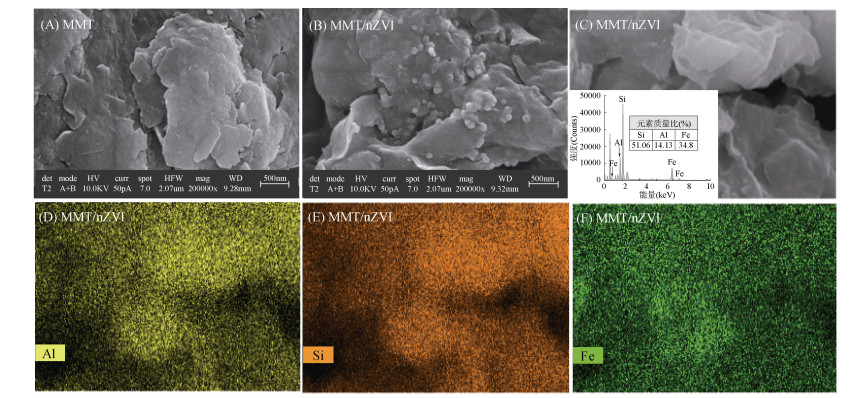
2 结果与讨论 2.1 MMT和MMT/nZVI理化性质表征从图 1A可观察到,MMT呈典型的层状结构,且各层之间紧密结合;而从图 1B可以看出,MMT/nZVI的层间和表面出现了大量的均匀球形颗粒物,这表明nZVI被成功负载到MMT上。与以往研究中nZVI以成簇的球形链状结构出现不同,MMT/nZVI中的nZVI颗粒分散性较好,表明MMT的负载有效防止了nZVI颗粒的聚集。此外,从图 1F中可以看出,Fe元素在MMT/nZVI的表面分布均匀。对比Al和Si元素(图 1D~1E)发现,Fe元素含量在MMT/nZVI中较高,质量占比为34.8%。这一结果进一步证实MMT成功负载了nZVI,并提高了nZVI的分散性,且MMT作为载体具有优异的负载能力,能够为nZVI提供丰富的负载位点。
|
图 1 MMT(A)和MMT/nZVI(B)的500 nm SEM图像及MMT/nZVI的EDS元素映射图(C~F) Fig. 1 500 nm SEM images of MMT(A)and MMT/nZVI(B), and EDS elemental mappings of MMT/nZVI(C–F) |
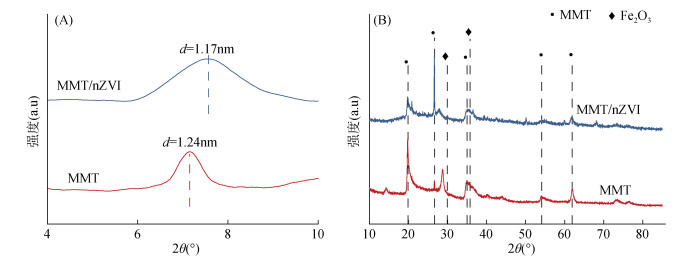
为进一步研究改性对MMT层间距和晶体结构的影响,采用XRD技术对MMT和MMT/nZVI进行了检测分析。从图 2A中可以看到,未改性的MMT的层间距为1.24 nm,而当nZVI被负载到MMT上后,MMT的层间距缩小至1.17 nm。这一变化与Xu等[39]的研究结果相一致,他们同样发现,与MMT相比,MMT/nZVI的层间距有减小的趋势。从图 2B中可观察到,MMT/nZVI的XRD图谱分别在2θ为19.9°、26.7°、35.1°、54.1°和62.0°时显示出与MMT典型衍射峰一致的特征峰[37, 40]。这些结果表明,负载nZVI并未改变MMT的晶体结构,说明MMT的结构具有良好的稳定性。此外,在30.1°和35.68°处还观察到与α-Fe2O3相关的微弱衍射峰[41-42],表明Fe0的表面可能发生了钝化,形成了以Fe0为中心的核壳结构,从而可以防止Fe0的快速氧化[43-45]。值得注意的是,在MMT/nZVI的XRD谱图中并未检测到Fe0的特征衍射峰,这表明复合材料中不存在聚集的Fe0[46],nZVI在MMT上的分散较好。
|
图 2 MMT和MMT/nZVI的X射线衍射图谱(A:2θ范围为4°~10°;B:2θ范围为10°~85°) Fig. 2 XRD spectra of MMT and MMT/nZVI: (A) 2θ range of 4°–10°; (B) 2θ range of 10°–85° |
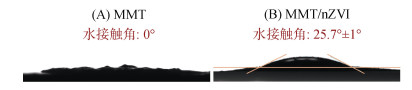
材料的润湿性是影响其与环境相互作用的关键特性之一,也是其与污染物之间反应的重要影响因素。本研究通过测量水接触角来表征材料的润湿性,测试结果如图 3所示。从图 3中可以看到,MMT的水接触角几乎为0°,表明其具有较强的亲水性。然而,负载了nZVI后,MMT/nZVI的水接触角明显上升,达到了25.7°,表明材料的疏水性得到增强。这种变化可能会使MMT/nZVI对疏水性污染物的吸附亲和力得到提高。
|
图 3 MMT(A)和MMT/nZVI(B)的水接触角 Fig. 3 Water contact angles of MMT(A) and MMT/nZVI(B) |
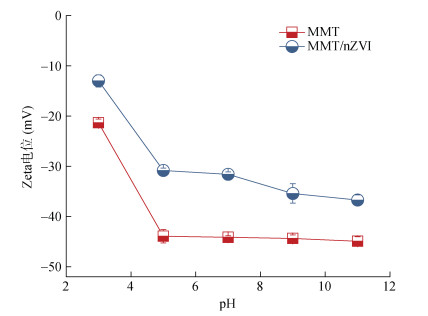
在不同pH环境下,材料的表面电荷可能会受pH的影响而发生变化,从而影响其对污染物的吸附[47]。因此在室温、0.01 mol/L硝酸钾恒定离子强度背景下,使用Zeta电位分析仪在pH为3.0~11.0的范围内分别测试了MMT和MMT/nZVI表面的Zeta电位变化情况,结果如图 4所示。在pH为3.0~11.0的范围内,MMT和MMT/nZVI的Zeta电位值始终为负,表明材料表面带负电荷,这些负电荷主要来自于MMT的边缘电荷和结构电荷位点。边缘电荷是由于羟基的去质子化,而结构电荷是由于四面体层(Si4+被Al3+取代)和八面体层(Al3+被Mg2+或其他低价阳离子取代)发生了异价类质同象置换,从而产生的永久性负电荷[48-49]。此外,随着pH的增加,两种材料的Zeta电位值均呈降低趋势,且在整个pH范围内,MMT/nZVI的Zeta电位始终高于MMT。这是因为在低pH条件下,溶液中的H+与MMT表面上的羟基会发生质子化(M–OH2+),使其表面正电荷增加,而随着pH逐渐升高,MMT表面的羟基会失去一个H+,发生去质子化(M–O–),从而留下带负电荷的氧原子,导致Zeta电位下降[50]。然而负载nZVI后,nZVI颗粒可以与MMT表面的官能团(如羟基、硅氧基等)发生相互作用,从而中和部分负电荷,使MMT/nZVI整体的负电荷密度降低。负电荷密度的降低可以削弱材料与阴离子污染物之间的静电排斥作用,对于阴离子污染物的吸附是有利的。
|
图 4 MMT和MMT/nZVI的Zeta电位变化图 Fig. 4 Zeta potential changes of MMT and MMT/nZVI |
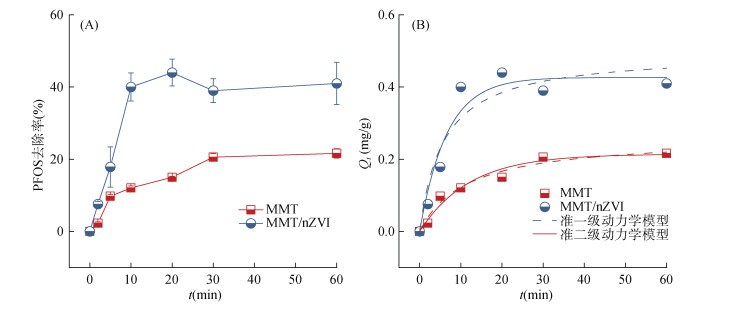
图 5显示了不同反应时间下,MMT和MMT/nZVI对PFOS的去除率以及动力学拟合结果。从图 5A中可以看出,MMT对PFOS的去除率最高仅为21.6%,并在反应30 min后达到吸附平衡,去除效果较差。这是由于MMT表面带负电荷,而PFOS在水溶液中也以阴离子的形式存在,两者之间存在静电排斥,从而导致吸附效果较差。而负载nZVI后,MMT/nZVI对PFOS的去除呈先上升后下降的趋势,最后在反应30 min后达到吸附平衡,且最大去除率为41.0%。MMT/nZVI较MMT的去除效果得到了提升。
|
图 5 MMT和MMT/nZVI对PFOS的去除率随时间的变化曲线(A)和吸附动力学拟合曲线(B) Fig. 5 Removal rates versus time (A) and adsorption kinetics fitting curves (B) of MMT and MMT/nZVI for PFOS |
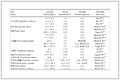
采用准一级和准二级动力学模型对MMT和MMT/nZVI吸附PFOS的动力学曲线进行拟合,拟合结果及参数见图 5B和表 1。其中,MMT的准一级和准二级动力学模型拟合相关系数R2分别为0.960 6和0.967 3,两模型的拟合参数差异不大,表明物理吸附和化学吸附在MMT去除PFOS的反应过程中均发挥了重要作用。而MMT/nZVI对PFOS的去除则更偏向符合准一级动力学模型,表明反应过程中物理吸附占主导地位。根据准一级动力学反应速率常数k1可知,MMT/nZVI去除PFOS的速率是MMT的1.8倍;根据平衡吸附量Qe可知,MMT/nZVI吸附PFOS的量是MMT的2倍。综上可见,MMT/nZVI更有利于PFOS的吸附去除。
|
表 1 MMT和MMT/nZVI对PFOS吸附的准一级和准二级动力学模型拟合参数 Table 1 Pseudo-first-order and pseudo-second-order kinetics parameters for PFOS adsorption by MMT and MMT/nZVI |
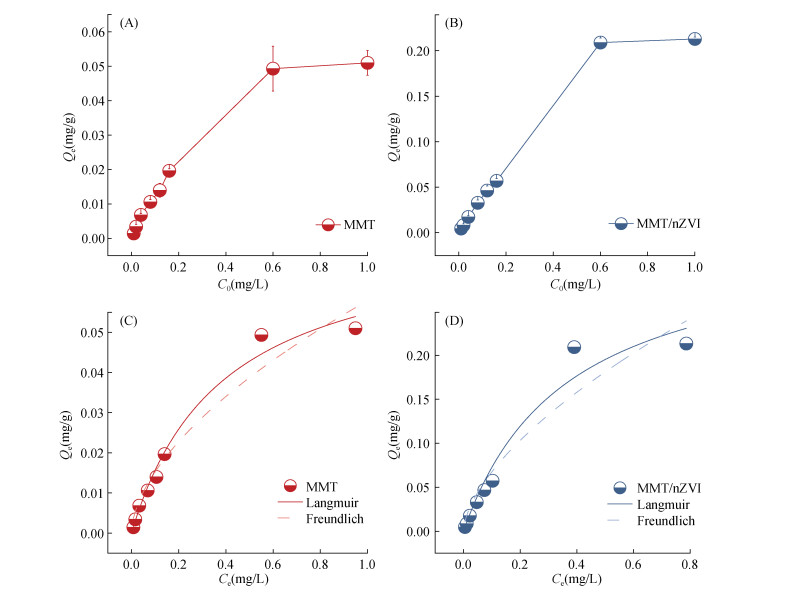
图 6展示了不同PFOS初始浓度下,MMT和MMT/nZVI对PFOS吸附的影响及吸附等温线拟合结果。由图 6A和6B可知,当PFOS初始浓度从0.01 mg/L增加至0.60 mg/L时,MMT和MMT/nZVI对PFOS的吸附量也随之增加。这是因为PFOS初始浓度的升高,会使分布于吸附材料周围的PFOS分子数量相应增加,浓度梯度的增大使得传质推动力提高,从而使吸附进行得更彻底[51]。而当PFOS浓度从0.6 mg/L增加至1.0 mg/L时,MMT和MMT/nZVI对PFOS的吸附量不再增加,此时MMT和MMT/nZVI对PFOS的吸附量分别为0.05 mg/g和0.21 mg/g。这是由于吸附材料的投加量一定时,其只能提供固定数量的吸附位点,随着PFOS浓度的增加,吸附位点逐渐饱和,难以继续吸附溶液中的PFOS,从而导致吸附量不再增加[52]。值得注意的是,PFOS在自然环境中通常以纳克级(ng/L)的浓度存在,因此即使MMT/nZVI对PFOS的吸附量只有0.21 mg/g,但对于环境中的PFOS,该吸附量是有效的,且MMT/nZVI价格低廉、易于制备,这使得其有可能成为一种具有良好经济效益的PFOS吸附剂。
|
图 6 MMT和MMT/nZVI对PFOS的吸附等温线(A、B)及模型拟合曲线(C、D) Fig. 6 Adsorption isotherms (A, B) of PFOS on MMT and MMT/nZVI, and model fittings (C, D) |
分别采用Langmuir模型与Freundlich模型对MMT和MMT/nZVI去除PFOS的吸附曲线进行拟合(图 6C、6D),拟合参数如表 2所示。从表 2中的拟合相关系数R2可以看出,MMT和MMT/nZVI对PFOS的吸附去除更加符合Langmuir模型,R2分别为0.98和0.96,这说明吸附过程以均匀的单分子层吸附为主[53]。由Langmuir模型的拟合参数可知,MMT/ nZVI对PFOS的理论最大吸附容量为0.34 mg/g,而MMT的最大吸附容量仅为0.08 mg/g,MMT/nZVI的吸附量是MMT的4.25倍。这表明nZVI的负载,在MMT/nZVI吸附PFOS的过程中发挥了重要作用。Langmuir吸附平衡常数b的大小直接与吸附过程的强度和效率相关,b值越大,表明吸附剂对吸附质的亲和力越强,吸附越容易发生。拟合得出的MMT和MMT/nZVI吸附PFOS的b值分别为2.59和2.73,表明MMT/nZVI对PFOS具有更强的吸附能力[54]。
|
|
表 2 MMT和MMT/nZVI吸附PFOS的等温吸附模型拟合参数 Table 2 Isotherm model fitting parameters of PFOS adsorption by MMT and MMT/nZVI |
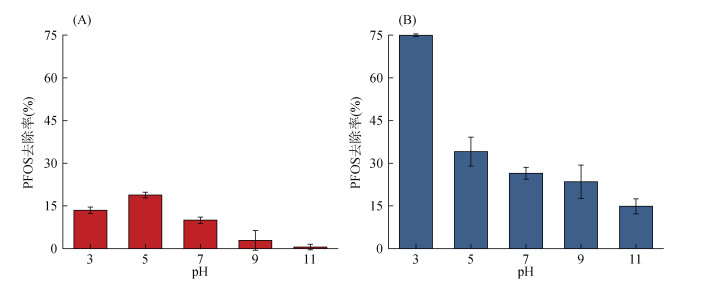
溶液pH是影响吸附材料吸附过程的因素之一。pH的变化会影响吸附材料表面基团的电离情况,从而改变其表面电荷分布。图 7展示了在pH 3~11范围内MMT和MMT/nZVI对PFOS的去除率变化情况。其中,由图 7A可知,MMT在酸性条件下对PFOS的去除率要高于碱性条件下,在pH 5时,PFOS去除率最高为18.83%,而在pH 11时,去除率仅为0.57%。由于在酸性条件下,MMT表面的羟基会质子化,形成带有更多正电荷的羟基(–OH2+),这种正电荷使MMT表面能够更有效地吸附带负电的PFOS阴离子,从而提升吸附效果。随着pH的升高,表面羟基开始去质子化,留下带负电的氧原子。由于静电排斥作用,带负电的氧原子与PFOS的阴离子产生相互排斥,导致MMT对PFOS的吸附能力下降[50]。负载nZVI后,MMT/nZVI对pH显示出更高的依赖性,但整体PFOS去除率均高于未改性MMT(图 7B)。MMT/nZVI对PFOS的吸附随pH的增加而显著降低,在pH 3的强酸条件下,PFOS去除率达到最高(74.97%),而在pH 11时,PFOS去除率仅14.83%。由于在酸性条件下,Fe0与溶液中H+反应,使MMT表面产生大量Fe离子,而阴离子PFOS与铁阳离子之间存在静电吸引,这使得MMT/nZVI可以吸附更多的PFOS。但在碱性条件下,溶液中的OH–以及MMT表面去质子化产生的负电荷与PFOS之间存在静电排斥,这阻碍了MMT/nZVI对PFOS的吸附,从而导致吸附效果下降。
|
图 7 不同pH对MMT(A)和MMT/nZVI(B)去除PFOS的影响 Fig. 7 Effects of different pH on PFOS removal by MMT (A) andMMT/nZVI (B) |
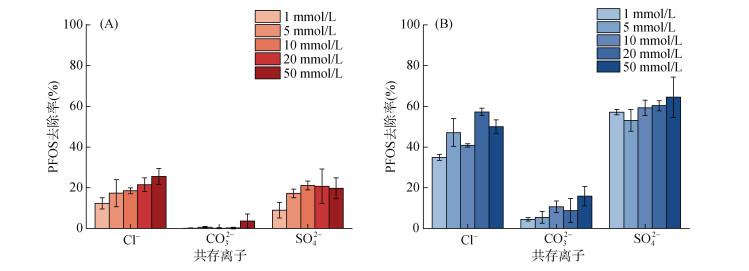
在自然环境的水体介质中,通常共存着多种溶解性组分,例如无机盐离子。为了评估MMT/nZVI在自然环境中的适应能力,对水体介质中常见的3种阴离子(Cl–、SO42–和CO32–)以及其离子强度(1、5、10、20、50 mmol/L)影响下MMT和MMT/nZVI对PFOS的去除性能进行了研究(图 8)。结果表明,Cl–和SO42–的存在以及其浓度的增加,对MMT和MMT/nZVI吸附PFOS的影响并不明显。然而当溶液中存在CO32–时,两种材料对PFOS的去除效果均明显降低,其中MMT的去除效果几乎为0,MMT/nZVI在1~50 mmol/L的CO32–浓度范围内对PFOS最大去除率仅15.87%。与Cl–和SO42–离子相比,CO32–的影响更大[55]。这可能是因为CO32–具有较强的碱性,其在水溶液中能够与水分子反应,生成OH–和HCO3–,从而提高溶液的pH,影响材料表面电荷分布。在2.1节的Zeta电位分析中,溶液pH越高,MMT和MMT/nZVI表面所带负电荷越多。因此,由于静电排斥以及离子竞争作用,吸附材料对PFOS的吸附效果明显下降。
|
图 8 不同离子及离子强度对MMT(A)和MMT/nZVI(B)去除PFOS的影响 Fig. 8 Effects of different ions and ionic strengths on removal of PFOS by MMT(A) and MMT/nZVI(B) |
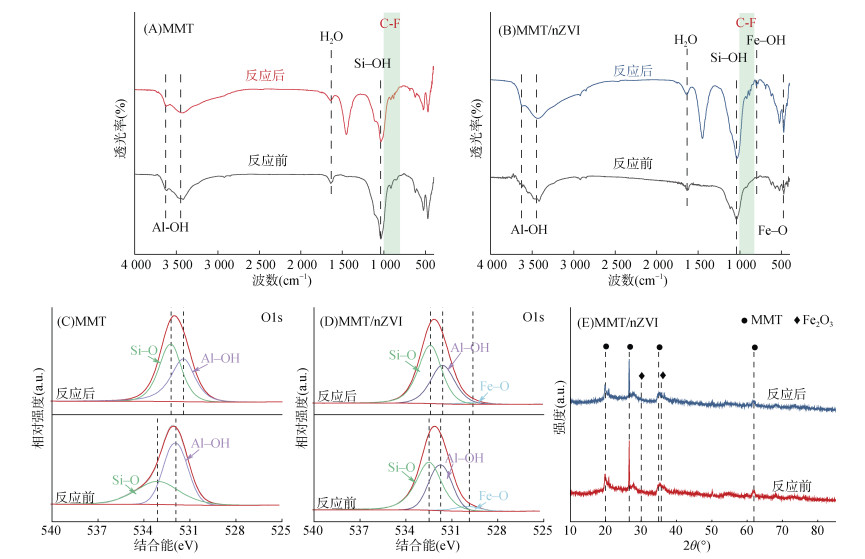
图 9A和9B展示了MMT和MMT/nZVI吸附PFOS反应前后的FTIR图谱,结合表 3可知,反应后的MMT/nZVI显示出了与MMT相关的基本结构特征,包括Al–OH、Si–OH以及层间水分子等官能团[56-61]。通过对比反应前后的FTIR图谱,发现反应后的MMT和MMT/nZVI在800~1 000 cm–1的范围内均出现了与C–F键相关的弯曲振动峰[62],表明两种材料均具备吸附PFOS的能力。进一步分析发现,两种材料的Al–OH和Si–OH弯曲振动峰在反应后均发生了明显变化,表明MMT上的铝氧化物和硅氧化物均参与了PFOS的吸附过程。以往的研究表明,PFOS可能通过配体交换取代铝氧化物上的羟基[63],或通过静电作用以及与MMT表面的羟基形成氢键来实现对PFOS的吸附[50, 64]。此外,还有研究发现,PFOS的磺酸盐基团能够与矿物表面的金属原子反应,形成络合物[65]。值得注意的是,MMT/nZVI上C–F键的弯曲振动峰较MMT更强,表明MMT/nZVI吸附的PFOS量更多。除利用MMT上的氧化物和羟基外,MMT/nZVI可能与PFOS还发生了其他的反应。这一点可以从图 9B中观察到,即位于795和473 cm–1处的Fe–OH和Fe–O弯曲振动峰在吸附PFOS后发生了明显变化[66],这表明铁氧化物在PFOS的吸附过程中也发挥了积极作用。据以往研究,PFOS的磺酸盐基团可以与α-Fe2O3表面形成外球复合物[67],进而提高MMT/nZVI对PFOS的吸附量。
|
图 9 MMT和MMT/nZVI吸附PFOS反应前后的红外光谱图(A、B)、O1s精细谱图(C、D)和X射线衍射图谱(E) Fig. 9 FTIR spectra(A, B), O1s orbital scan spectra (C, D), and X-ray diffraction patterns(E) of MMT and MMT/nZVI before and after reaction of adsorbed PFOS |
|
|
表 3 FTIR特征峰波数对应的官能团 Table 3 FTIR wavenumbers and their assignments |
MMT和MMT/nZVI在吸附PFOS反应前后的O1s结合能变化如图 9C和9D及表 4所示。反应前MMT的O1s峰被分成了两个小峰,分别是结合能为531.92、533.12 eV的与Al–OH、Si–O键相关的峰 [68]。吸附PFOS后,Al–OH和Si–O键的O1s峰结合能降低。结合能的降低是由于原子或分子的电子云密度增加,而电子云密度的增加与新化学键以及氢键的形成有关[69]。因此,根据XPS表征结果,铝氧化物和硅氧化物与PFOS反应形成了氢键和络合物。MMT/nZVI由于负载了nZVI,除出现与Al–OH和Si–O键相关的峰外,还在529.87 eV处出现与Fe–O键相关的峰[70]。与MMT一致,MMT/nZVI在吸附PFOS后,所有峰的结合能均下降。但值得注意的是,MMT/ nZVI的Al–OH、Si–O和Fe–O键结合能下降得并不多,说明络合和氢键并非MMT/nZVI吸附PFOS的唯一方式。据2.1节中MMT/nZVI水接触角表征分析,推测疏水相互作用也参与了PFOS的吸附过程。
|
|
表 4 根据XPS数据计算的O1s结合能(eV) Table 4 O1s binding energies calculated from XPS data |
图 9E为MMT/nZVI在反应前后2θ为10°~85°范围内的XRD谱图,从中可观察到,吸附PFOS后的MMT/nZVI出现了与MMT典型衍射峰一致的特征峰。这表明MMT的结构具有良好的稳定性。与反应前的MMT/nZVI相比,原本在2θ为30.1°和35.68°处出现的α-Fe2O3衍射峰未被观察到。结合FTIR表征结果,XRD表征再次证明了Fe2O3与PFOS之间存在相互作用。
3 结论本研究通过液相还原法将nZVI负载到MMT上,制备了MMT/nZVI复合材料。这种改性不仅增加了MMT的疏水性,降低了其表面负电荷密度,还有效提高了nZVI的分散性,有利于吸附以阴离子形式存在的疏水性污染物。XRD、FTIR和XPS等表征结果表明,MMT/nZVI中的铁氧化物、硅氧化物和铝氧化物能够与PFOS反应,形成氢键和络合物,从而有效吸附PFOS。此外,MMT/nZVI还能通过疏水相互作用进一步增强对PFOS的吸附,提高PFOS吸附去除效率。本研究揭示了MMT/nZVI对PFOS的吸附机理,为MMT/nZVI的应用提供了理论基础和试验依据,也为MMT吸附PFOS提供了新的改性思路。
| [1] |
Paul A G, Jones K C, Sweetman A J. A first global production, emission, and environmental inventory for perfluorooctane sulfonate[J]. Environmental Science & Technology, 2009, 43(2): 386-392 (  0) 0) |
| [2] |
Barzen-Hanson K A, Roberts S C, Choyke S, et al. Discovery of 40 classes of per- and polyfluoroalkyl substances in historical aqueous film-forming foams (AFFFs) and AFFF-impacted groundwater[J]. Environmental Science & Technology, 2017, 51(4): 2047-2057 ( 0) |
| [3] |
Gebbink W A, van Asseldonk L, van Leeuwen S P J. Presence of emerging per- and polyfluoroalkyl substances (PFASs) in river and drinking water near a fluorochemical production plant in the Netherlands[J]. Environmental Science & Technology, 2017, 51(19): 11057-11065 ( 0) |
| [4] |
Chen W B, Yang F, Hu E, et al. Occurrence, fate and risk assessment of per- and polyfluoroalkyl substances in wastewater treatment plants in Shaanxi, China[J]. Environmental Pollution (Barking, Essex, 2022, 314: 120226 DOI:10.1016/j.envpol.2022.120226 ( 0) |
| [5] |
Evich M G, Davis M J B, McCord J P, et al. Per- and polyfluoroalkyl substances in the environment[J]. Science, 2022, 375(6580): eabg9065 DOI:10.1126/science.abg9065 ( 0) |
| [6] |
Savage N. How to take 'forever' out of forever chemicals[J]. Nature, 2023, 624(7991). DOI: 10.1038/d41586-023-03876-9.
( 0) |
| [7] |
Giesy J P, Kannan K. Global distribution of perfluorooctane sulfonate in wildlife[J]. Environmental Science & Technology, 2001, 35(7): 1339-1342 ( 0) |
| [8] |
Lau C, Anitole K, Hodes C, et al. Perfluoroalkyl acids: A review of monitoring and toxicological findings[J]. Toxicological Sciences, 2007, 99(2): 366-394 DOI:10.1093/toxsci/kfm128 ( 0) |
| [9] |
Wang F Q, Liu W, Jin Y H, et al. Transcriptional effects of prenatal and neonatal exposure to PFOS in developing rat brain[J]. Environmental Science & Technology, 2010, 44(5): 1847-1853 ( 0) |
| [10] |
Wang F Q, Liu W, Ma J S, et al. Prenatal and neonatal exposure to perfluorooctane sulfonic acid results in changes in miRNA expression profiles and synapse associated proteins in developing rat brains[J]. Environmental Science & Technology, 2012, 46(12): 6822-6829 ( 0) |
| [11] |
Zahm S, Bonde J P, Chiu W A, et al. Carcinogenicity of perfluorooctanoic acid and perfluorooctanesulfonic acid[J]. The Lancet Oncology, 2024, 25(1): 16-17 DOI:10.1016/S1470-2045(23)00622-8 ( 0) |
| [12] |
Chen Z H, Teng Y, Mi N, et al. Highly efficient hydrated electron utilization and reductive destruction of perfluoroalkyl substances induced by intermolecular interaction[J]. Environmental Science & Technology, 2021, 55(6): 3996-4006 ( 0) |
| [13] |
Xian A, Wei C L, Tang Z W, et al. Fluorinated LDHs for selective sorption of PFOS: Unveiling the roles of increased hydrophobicity and F-F interactions[J]. Separation and Purification Technology, 2025, 362: 131851 DOI:10.1016/j.seppur.2025.131851 ( 0) |
| [14] |
Ackerman Grunfeld D, Gilbert D, Hou J, et al. Underestimated burden of per- and polyfluoroalkyl substances in global surface waters and groundwaters[J]. Nature Geoscience, 2024, 17(4): 340-346 DOI:10.1038/s41561-024-01402-8 ( 0) |
| [15] |
Senevirathna S T M L D, Tanaka S, Fujii S, et al. A comparative study of adsorption of perfluorooctane sulfonate (PFOS) onto granular activated carbon, ion-exchange polymers and non-ion-exchange polymers[J]. Chemosphere, 2010, 80(6): 647-651 DOI:10.1016/j.chemosphere.2010.04.053 ( 0) |
| [16] |
Kwon B G, Lim H J, Na S H, et al. Biodegradation of perfluorooctanesulfonate (PFOS) as an emerging contaminant[J]. Chemosphere, 2014, 109: 221-225 DOI:10.1016/j.chemosphere.2014.01.072 ( 0) |
| [17] |
Trzcinski A P, Harada K. Adsorption of PFOS onto graphite intercalated compound and analysis of degradation by-products during electro-chemical oxidation[J]. Chemosphere, 2023, 323: 138268 DOI:10.1016/j.chemosphere.2023.138268 ( 0) |
| [18] |
Cantoni B, Turolla A, Wellmitz J, et al. Perfluoroalkyl substances (PFAS) adsorption in drinking water by granular activated carbon: Influence of activated carbon and PFAS characteristics[J]. Science of the Total Environment, 2021, 795: 148821 DOI:10.1016/j.scitotenv.2021.148821 ( 0) |
| [19] |
Karbassiyazdi E, Kasula M, Modak S, et al. A juxtaposed review on adsorptive removal of PFAS by metal-organic frameworks (MOFs) with carbon-based materials, ion exchange resins, and polymer adsorbents[J]. Chemosphere, 2023, 311: 136933 DOI:10.1016/j.chemosphere.2022.136933 ( 0) |
| [20] |
Mastropietro T F, Bruno R, Pardo E, et al. Reverse osmosis and nanofiltration membranes for highly efficient PFASs removal: Overview, challenges and future perspectives[J]. Dalton Transactions, 2021, 50(16): 5398-5410 DOI:10.1039/D1DT00360G ( 0) |
| [21] |
Gao Y X, Deng S B, Du Z W, et al. Adsorptive removal of emerging polyfluoroalky substances F-53B and PFOS by anion-exchange resin: A comparative study[J]. Journal of Hazardous Materials, 2017, 323(Pt A): 550-557 ( 0) |
| [22] |
Liu X L, Ma R, Wang X X, et al. Graphene oxide-based materials for efficient removal of heavy metal ions from aqueous solution: A review[J]. Environmental Pollution, 2019, 252: 62-73 DOI:10.1016/j.envpol.2019.05.050 ( 0) |
| [23] |
Pang H W, Wu Y H, Wang X X, et al. Recent advances in composites of graphene and layered double hydroxides for water remediation: A review[J]. Chemistry – An Asian Journal, 2019, 14(15): 2542-2552 DOI:10.1002/asia.201900493 ( 0) |
| [24] |
Huang W J, Liu J H, She Q M, et al. Recent advances in engineering montmorillonite into catalysts and related catalysis[J]. Catalysis Reviews, 2023, 65(3): 929-985 DOI:10.1080/01614940.2021.1995163 ( 0) |
| [25] |
Yadav S, Ibrar I, Al-Juboori R A, et al. Updated review on emerging technologies for PFAS contaminated water treatment[J]. Chemical Engineering Research and Design, 2022, 182: 667-700 DOI:10.1016/j.cherd.2022.04.009 ( 0) |
| [26] |
Maimaiti A, Deng S B, Meng P P, et al. Competitive adsorption of perfluoroalkyl substances on anion exchange resins in simulated AFFF-impacted groundwater[J]. Chemical Engineering Journal, 2018, 348: 494-502 DOI:10.1016/j.cej.2018.05.006 ( 0) |
| [27] |
Cao Z, Li H, Xu X H, et al. Correlating surface chemistry and hydrophobicity of sulfidized nanoscale zerovalent iron with its reactivity and selectivity for denitration and dechlorination[J]. Chemical Engineering Journal, 2020, 394: 124876 DOI:10.1016/j.cej.2020.124876 ( 0) |
| [28] |
Wang C B, Zhang W X. Synthesizing nanoscale iron particles for rapid and complete dechlorination of TCE and PCBs[J]. Environmental Science & Technology, 1997, 31(7): 2154-2156 ( 0) |
| [29] |
Alazaiza M Y D, Albahnasawi A, Copty N K, et al. Nanoscale zero-valent iron application for the treatment of soil, wastewater and groundwater contaminated with heavy metals: A review[J]. Desalination and Water Treatment, 2022, 253: 194-210 DOI:10.5004/dwt.2022.28302 ( 0) |
| [30] |
Zhang Y, Li Y M, Li J F, et al. Enhanced removal of nitrate by a novel composite: Nanoscale zero valent iron supported on pillared clay[J]. Chemical Engineering Journal, 2011, 171(2): 526-531 DOI:10.1016/j.cej.2011.04.022 ( 0) |
| [31] |
Liu Y Y, Ptacek C J, Baldwin R J, et al. Application of zero-valent iron coupled with biochar for removal of perfluoroalkyl carboxylic and sulfonic acids from water under ambient environmental conditions[J]. Science of the Total Environment, 2020, 719: 137372 DOI:10.1016/j.scitotenv.2020.137372 ( 0) |
| [32] |
Xiao J, Huang J, Chen Y C, et al. The introduction of nano zero-valent iron in constructed wetlands simultaneously enhanced the removal of perfluorooctanoic acid (PFOA) and nutrients[J]. Journal of Environmental Management, 2025, 376: 124285 DOI:10.1016/j.jenvman.2025.124285 ( 0) |
| [33] |
Liu Y Q, Lowry G V. Effect of particle age (Fe0 content) and solution pH on NZVI reactivity: H2 evolution and TCE dechlorination[J]. Environmental Science & Technology, 2006, 40(19): 6085-6090 ( 0) |
| [34] |
Tratnyek P G, Salter-Blanc A J, Nurmi J T, et al. Reactivity of zerovalent metals in aquatic media: Effects of organic surface coatings[M]//Aquatic Redox Chemistry. Washington, DC: American Chemical Society, 2011: 381–406.
( 0) |
| [35] |
Sun Y K, Li J X, Huang T L, et al. The influences of iron characteristics, operating conditions and solution chemistry on contaminants removal by zero-valent iron: A review[J]. Water Research, 2016, 100: 277-295 DOI:10.1016/j.watres.2016.05.031 ( 0) |
| [36] |
Stefaniuk M, Oleszczuk P, Ok Y S. Review on nano zerovalent iron (nZVI): From synthesis to environmental applications[J]. Chemical Engineering Journal, 2016, 287: 618-632 DOI:10.1016/j.cej.2015.11.046 ( 0) |
| [37] |
Zhang Y Y, Jiang H, Zhang Y, et al. The dispersity- dependent interaction between montmorillonite supported nZVI and Cr(VI) in aqueous solution[J]. Chemical Engineering Journal, 2013, 229: 412-419 DOI:10.1016/j.cej.2013.06.031 ( 0) |
| [38] |
Zheng M M, Wang J, Fu D, et al. Anchored growth of highly dispersed LDHs nanosheets on expanded graphite for fluoride adsorption properties and mechanism[J]. Journal of Hazardous Materials, 2023, 442: 130068 DOI:10.1016/j.jhazmat.2022.130068 ( 0) |
| [39] |
Xu B D, Li D C, Qian T T, et al. Boosting the activity and environmental stability of nanoscale zero-valent iron by montmorillonite supporting and sulfidation treatment[J]. Chemical Engineering Journal, 2020, 387: 124063 DOI:10.1016/j.cej.2020.124063 ( 0) |
| [40] |
Bhowmick S, Chakraborty S, Mondal P, et al. Montmorillonite-supported nanoscale zero-valent iron for removal of arsenic from aqueous solution: Kinetics and mechanism[J]. Chemical Engineering Journal, 2014, 243: 14-23 DOI:10.1016/j.cej.2013.12.049 ( 0) |
| [41] |
Sun Y M, Feng L, Yang L. Degradation of PCB67 in soil using the heterogenous Fenton process induced by montmorillonite supported nanoscale zero-valent iron[J]. Journal of Hazardous Materials, 2021, 406: 124305 DOI:10.1016/j.jhazmat.2020.124305 ( 0) |
| [42] |
Nogueira F G E, Lopes J H, Silva A C, et al. Catalysts based on clay and iron oxide for oxidation of toluene[J]. Applied Clay Science, 2011, 51(3): 385-389 DOI:10.1016/j.clay.2010.12.007 ( 0) |
| [43] |
Sun Y P, Li X Q, Cao J S, et al. Characterization of zero-valent iron nanoparticles[J]. Advances in Colloid and Interface Science, 2006, 120(1/2/3): 47-56 ( 0) |
| [44] |
Martin J E, Herzing A A, Yan W L, et al. Determination of the oxide layer thickness in core-shell zerovalent iron nanoparticles[J]. Langmuir, 2008, 24(8): 4329-4334 DOI:10.1021/la703689k ( 0) |
| [45] |
Li X Q, Zhang W X. Sequestration of metal cations with zerovalent iron Nanoparticles—A study with high resolution X-ray photoelectron spectroscopy (HR-XPS)[J]. The Journal of Physical Chemistry C, 2007, 111(19): 6939-6946 DOI:10.1021/jp0702189 ( 0) |
| [46] |
Gu C, Jia H Z, Li H, et al. Synthesis of highly reactive subnano-sized zero-valent iron using smectite clay templates[J]. Environmental Science & Technology, 2010, 44(11): 4258-4263 ( 0) |
| [47] |
Zhang Y X, Lin Y H, Li Y J, et al. Study of stability and aggregation kinetics of coated zero-valent iron nanoparticles[J]. Desalination and Water Treatment, 2022, 262: 298-311 DOI:10.5004/dwt.2022.28502 ( 0) |
| [48] |
Long H, Wu P X, Zhu N W. Evaluation of Cs+ removal from aqueous solution by adsorption on ethylamine- modified montmorillonite[J]. Chemical Engineering Journal, 2013, 225: 237-244 DOI:10.1016/j.cej.2013.03.088 ( 0) |
| [49] |
Wang T H, Liu T Y, Wu D C, et al. Performance of phosphoric acid activated montmorillonite as buffer materials for radioactive waste repository[J]. Journal of Hazardous Materials, 2010, 173(1/2/3): 335-342 ( 0) |
| [50] |
Lu X Y, Deng S B, Wang B, et al. Adsorption behavior and mechanism of perfluorooctane sulfonate on nanosized inorganic oxides[J]. Journal of Colloid and Interface Science, 2016, 474: 199-205 DOI:10.1016/j.jcis.2016.04.032 ( 0) |
| [51] |
刘真贞, 向紫杨, 胡思萌, 等. 改性生物炭对罗丹明B的吸附性能及机理研究[J]. 环境科学与技术, 2024, 47(S2): 168-177 ( 0) |
| [52] |
Somsiripan T, Sangwichien C. Enhancement of adsorption capacity of Methylene blue, Malachite green, and Rhodamine B onto KOH activated carbon derived from oil palm empty fruit bunches[J]. Arabian Journal of Chemistry, 2023, 16(12): 105270 DOI:10.1016/j.arabjc.2023.105270 ( 0) |
| [53] |
Wang Z H, Shen D K, Shen F, et al. Kinetics, equilibrium and thermodynamics studies on biosorption of Rhodamine B from aqueous solution by earthworm manure derived biochar[J]. International Biodeterioration & Biodegradation, 2017, 120: 104-114 ( 0) |
| [54] |
Zhi F K, Zhou W J, Chen J R, et al. Adsorption properties of active biochar: Overlooked role of the structure of biomass[J]. Bioresource Technology, 2023, 387: 129695 DOI:10.1016/j.biortech.2023.129695 ( 0) |
| [55] |
Akbour R A, El Gaayda J, Titchou F E, et al. Adsorption of anionic dyes from aqueous solution using polyelectrolyte PDADMAC-modified-montmorillonite clay[J]. Desalination and Water Treatment, 2020, 208: 407-422 DOI:10.5004/dwt.2020.26446 ( 0) |
| [56] |
Shi Y, Wang X, Zhong S T, et al. Nano zero-valent iron/montmorillonite composite for the removal of Cr(VI) from aqueous solutions: Characterization, performance, and mechanistic insights[J]. Applied Clay Science, 2024, 253: 107345 DOI:10.1016/j.clay.2024.107345 ( 0) |
| [57] |
Liu B X, Chen C, Li W, et al. Effective removal of Cr(VI) from aqueous solution through adsorption and reduction by magnetic S-doped Fe-Cu-La trimetallic oxides[J]. Journal of Environmental Chemical Engineering, 2022, 10(3): 107433 DOI:10.1016/j.jece.2022.107433 ( 0) |
| [58] |
Duan Z H, Zhang W H, Lu M W, et al. Magnetic Fe3O4/activated carbon for combined adsorption and Fenton oxidation of 4-chlorophenol[J]. Carbon, 2020, 167: 351-363 DOI:10.1016/j.carbon.2020.05.106 ( 0) |
| [59] |
Zhou C J, Ren G L, Fan X Q, et al. Probing the effect of thickener microstructure on rheological and tribological properties of grease[J]. Journal of Industrial and Engineering Chemistry, 2022, 111: 51-63 DOI:10.1016/j.jiec.2022.03.010 ( 0) |
| [60] |
Zhang R M, Yan W, Jing C Y. Mechanistic study of PFOS adsorption on kaolinite and montmorillonite[J]. Colloids and Surfaces A: Physicochemical and Engineering Aspects, 2014, 462: 252-258 ( 0) |
| [61] |
Zviagina B B, McCarty D K, Środoń J, et al. Interpretation of infrared spectra of dioctahedral smectites in the region of OH-stretching vibrations[J]. Clays and Clay Minerals, 2004, 52(4): 399-410 DOI:10.1346/CCMN.2004.0520401 ( 0) |
| [62] |
Alonso-de-Linaje V, Mangayayam M C, Tobler D J, et al. Enhanced sorption of perfluorooctane sulfonate and perfluorooctanoate by hydrotalcites[J]. Environmental Technology and Innovation, 2021, 21: 101231 DOI:10.1016/j.eti.2020.101231 ( 0) |
| [63] |
Wang F, Liu C S, Shih K. Adsorption behavior of perfluorooctanesulfonate (PFOS) and perfluorooctanoate (PFOA) on boehmite[J]. Chemosphere, 2012, 89(8): 1009-1014 DOI:10.1016/j.chemosphere.2012.06.071 ( 0) |
| [64] |
Zhao L X, Bian J N, Zhang Y H, et al. Comparison of the sorption behaviors and mechanisms of perfluorosulfonates and perfluorocarboxylic acids on three kinds of clay minerals[J]. Chemosphere, 2014, 114: 51-58 DOI:10.1016/j.chemosphere.2014.03.098 ( 0) |
| [65] |
Kasprzyk-Hordern B. Chemistry of alumina, reactions in aqueous solution and its application in water treatment[J]. Advances in Colloid and Interface Science, 2004, 110(1/2): 19-48 ( 0) |
| [66] |
Wang H, Zhu J, Fu Q L, et al. Phosphate adsorption on uncoated and humic acid-coated iron oxides[J]. Journal of Soils and Sediments, 2016, 16(7): 1911-1920 DOI:10.1007/s11368-016-1383-8 ( 0) |
| [67] |
Gao X D, Chorover J. Adsorption of perfluorooctanoic acid and perfluorooctanesulfonic acid to iron oxide surfaces as studied by flow-through ATR-FTIR spectroscopy[J]. Environmental Chemistry, 2012, 9(2): 148-157 DOI:10.1071/EN11119 ( 0) |
| [68] |
Zhang N N, Ejtemaei M, Nguyen A V, et al. XPS analysis of the surface chemistry of sulfuric acid-treated kaolinite and diaspore minerals with flotation reagents[J]. Minerals Engineering, 2019, 136: 1-7 ( 0) |
| [69] |
Guo F Y, Li D B, Fein J B, et al. Roles of hydrogen bond and ion bridge in adsorption of two bisphenols onto montmorillonite: An experimental and DFT study[J]. Applied Clay Science, 2022, 217: 106406 DOI:10.1016/j.clay.2022.106406 ( 0) |
| [70] |
Zhang Y L, Li Y T, Dai C M, et al. Sequestration of Cd(II) with nanoscale zero-valent iron (nZVI): Characterization and test in a two-stage system[J]. Chemical Engineering Journal, 2014, 244: 218-226 DOI:10.1016/j.cej.2014.01.061 ( 0) |
2. State Key Laboratory of Soil and Sustainable Agriculture, Institute of Soil Science, Chinese Academy of Sciences, Nanjing 211135, China;
3. University of Chinese Academy of Sciences, Beijing 100049, China