 2026, Vol. 58


2. 湖南省农业科学院湖南省耕地与农业环境生态研究所, 农田土壤重金属污染防控与修复湖南省重点实验室, 长沙 410125;
3. 农业农村部长江中游平原农业环境重点实验室, 长沙 410125;
4. 中国科学院大学, 北京 100049
土壤重金属污染是制约农业可持续发展、威胁生态系统健康的重大环境问题[1]。重金属元素具有持久性、生物累积性和高毒性等特征,在土壤–植物系统中形成复杂的污染链[2]。准确预测重金属在特定环境条件下的迁移路径、形态转化规律及其在植物体内的富集水平,已成为开展有效风险评估、实施精准污染修复以及制定安全农产品生产标准的核心科学问题[3]。
然而,土壤–植物系统是一个典型的开放、非均质、多相耦合的复杂生命–非生命复合体系[4]。重金属在其中的行为由物理输运(如水分运移与溶质迁移)、地球化学反应(如吸附–解吸、沉淀–溶解)以及生物生理过程(如根系吸收、跨膜转运和组织分配)在多时空尺度上动态耦合所驱动[5-6]。
数学模型已成为整合碎片化知识、揭示系统内在机制、实现定量化预测不可或缺的工具。然而,当前该领域模型的发展呈现出显著的“非对称格局”:在土壤端,基于“水动力–溶质迁移–地球化学”耦合框架的机理模型及相关软件(如HYDRUS、PHREEQC)已相当成熟[7];而在植物端,模型发展则相对滞后,仍普遍依赖生物富集系数(BCF)、转移因子(TF)等经验性参数[8],导致在土壤与植物系统之间形成了一道明显的“机制鸿沟”。
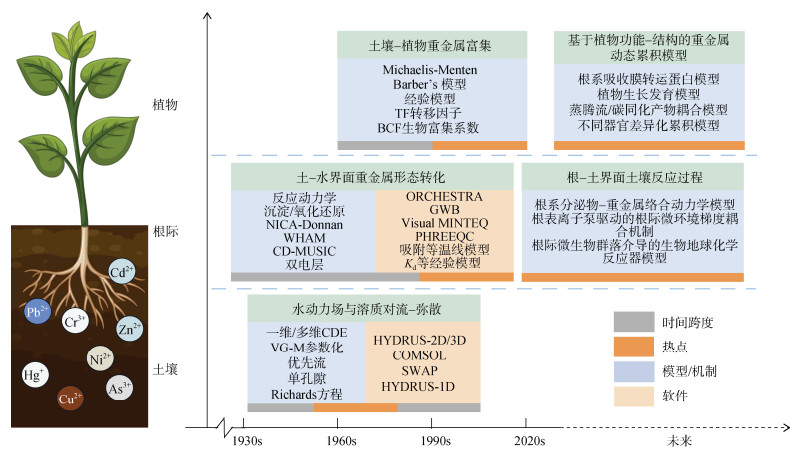
本文围绕重金属从土壤向植物迁移的过程,依次关注土壤重金属迁移模型、土壤中重金属形态转化模型以及植物富集模型3个核心环节(图 1),旨在呈现当前研究的发展脉络,识别在连接“土壤”与“植物”过程中存在的主要建模瓶颈与理论断点。
|
图 1 土壤–植物系统中重金属迁移转化过程模型关系示意图 Fig. 1 Schematic illustration of model relationships for heavy metal migration and transformation processes in the soil-plant system |
重金属在土壤中的时空分布由“物理输运–化学反应–界面过程”三重耦合机制共同控制。现有研究普遍采用“水动力–溶质迁移–地球化学”多物理场耦合模型,该模型包括描述水分运动的Richards方程、描述溶质迁移的对流–弥散方程,以及耦合地球化学反应的吸附/解吸、沉淀/溶解等项。相关理论体系已较为成熟,系统性的研究成果可参考相关专著[9-10]及论文[11]。
1.1 控制方程体系 1.1.1 Richards方程——非饱和水动力场设土壤孔隙度φ(无量纲)已知,含水量θ与压力水头h由水保持曲线
| $ \frac{{\partial \theta }}{{\partial t}} = \nabla \cdot\left[ {{K_{\text{s}}}{K_{\text{r}}}\left( h \right)\nabla \left( {h + z} \right)} \right] + {S_{\text{w}}} $ | (1) |
式中:
将重金属总浓度
| $ {C_{\text{T}}} = \theta C + {\rho _b}S $ | (2) |
式中:ρb为干密度(kg/m3);θ为体积含水量(m3/m3)。
一维垂直方向CDE可写为[13]:
| $ \frac{{\partial \theta C}}{{\partial t}} + {\rho _b}\frac{{\partial S}}{{\partial t}} = \frac{\partial }{{\partial z}}\left[ {\theta D\frac{{\partial C}}{{\partial z}}} \right] - \frac{\partial }{{\partial z}}\left( {qC} \right) + {R_{{\text{che}}}} $ | (3) |
式中:弥散系数D(m2/s)=
吸附/解吸动力学可采用线性可逆模型:
| $ S = {K_{\text{d}}}C $ | (4) |
式中:Kd为分配系数。
可以采用非线性表面络合模型(如CD-MUSIC或Langmuir-Freundlich)替代线性
| $ S = \left( {{q_{{\text{max}}}}{K_{\text{L}}}C} \right)/\left( {1 + {K_{\text{L}}}C} \right) $ | (5) |
式中:
沉淀/溶解反应遵循质量作用定律,可利用PHREEQC或ORCHESTRA等软件求解多组分化学平衡,实时更新
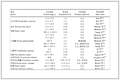
基于上述理论框架,研究者开发了多种数值模拟工具,用于描述非饱和带中水分运移、溶质传输及其生物地球化学行为。这些软件依据空间维度和应用尺度的不同,可分为一维、二维/三维专用模型(表 1)。
|
表 1 土壤重金属迁移模型对比 Table 1 Comparison of heavy metal transport models in soil |
一维模拟软件包括HYDRUS-1D[14-15]及SWAP[16]。HYDRUS-1D基于Richards方程和对流–弥散方程模拟水分运动和溶质迁移,用户界面友好、参数数据库完善,支持多种化学过程模块。SWAP在植物–土壤相互作用方面具有更强的生态生理模块,包括动态根系分布及作物蒸腾响应等。
二维/三维模拟软件包括HYDRUS-2D/3D[17]、COMSOL Multiphysics[18]及OpenGeoSys[19]。HYDRUS-2D/3D支持复杂几何边界、多层土壤结构及根系空间分布,但计算成本高、参数空间大。COMSOL是一款通用多物理场耦合仿真平台,允许高度定制化和深度耦合的多物理场模拟。OpenGeoSys(OGS)是一款专注于地质环境过程的开源有限元模拟平台,在热–水–力–化学多场耦合方面具有独特优势,但要求用户具备较强的数学建模与编程能力。
2 土壤重金属形态转化模型重金属在土壤固–液–气多相体系中的形态转化,是一个从长程静电作用、中程配位交换到短程化学键生成的连续能量梯度过程[20-21]。
重金属在土壤多相体系中的形态转化可从吸附机制的分类框架入手加以理解[22]。固液分配系数(Kd)的概念为描述这一过程提供了定量化的基础工具[23]。矿物与有机或生物组分间的界面反应在固定重金属方面具有不可忽视的作用[24]。吸附等温线的多种变体被用于拟合不同条件下的平衡吸附行为[25-26]。同时,竞争吸附的平衡与动力学模型拓展了对多离子共存体系的认识[27]。吸附与解吸的动力学反应则通过系统建模得到进一步验证和参数化[28-29]。
2.1 电性吸附:长程静电主导的弱可逆过程在低离子强度条件下,重金属离子通过长程静电作用被吸附到带电表面的过程,主要发生在双电层的扩散层中,形成外层吸附态。该过程高度可逆,强烈依赖于溶液pH和离子强度。常用模型见表 2。
|
|
表 2 土壤重金属电性吸附模型对比 Table 2 Comparison of electrical adsorption models for heavy metals in soil |
当重金属离子内层水化壳与表面羟基或羧基发生配体交换,形成共价键或强极性键时,发生专性吸附。该过程具有高稳定性、低可逆性与强选择性,吸附行为受表面位点密度、pH、离子强度及竞争阳离子的联合控制。
机制模型包括CD-MUSIC模型、WHAM模型和NICA-Donnan模型。CD-MUSIC模型将吸附离子的电荷分配到表面平面和扩散层平面;WHAM模型专注于腐殖酸/富里酸与重金属的络合;NICA-Donnan模型基于非理想竞争吸附理论。
2.3 界面化学转化:短程化学键重组驱动的准不可逆过程当局部离子活度积超过溶度积,或氧化还原电位(Eh)触发价态转变时,吸附态重金属离子可发生不可逆或准不可逆的化学转化,形成热力学更稳定的次生矿物相或变价固相产物[30-31]。该过程主要通过沉淀成矿与氧化还原转化两类机制实现。
2.4 经验/半机理模型在缺乏完整矿物组成、表面电荷参数或动力学数据的情况下,常借助经验模型或半机理模型快速预测土壤重金属溶解态浓度,包括线性回归模型、分配系数模型(Kd模型)、基于土壤性质的经验修正模型以及基于吸附等温线的非线性模型(如Freundlich和Langmuir模型)。
2.5 相关方法与软件目前已有专业地球化学软件基于已有研究构建了较完善的模拟框架,为重金属多形态转化的定量模拟提供可行路径[32]。表 3总结了主流软件的总体特征。
|
|
表 3 土壤重金属形态转化软件对比 Table 3 Comparison of software for heavy metal speciation transformation in soil |
PHREEQC支持酸碱、溶解–沉淀、氧化还原、络合等反应,基于质量作用定律和活度积原理建模,支持自定义动力学速率方程。Visual MINTEQ提供丰富的表面吸附模型和有机质吸附专用模型,但化学反应数据库较小,无动力学模块。Geochemist’s Workbench (GWB) 功能与PHREEQC类似,具有更友好界面和更多插件,但为商业软件,源码不开放,自定义功能受限。ORCHESTRA采用“模型–求解器”分离架构,支持高度自定义,但需用户自行维护热力学数据。
3 植物富集重金属模型土壤–植物系统中重金属的迁移与富集是一个高度复杂的多尺度、多过程耦合体系,涉及从根际微环境到地上部器官的跨膜运输、组织分配与生理调控[33]。典型迁移路径包括:根际溶解–吸附–解吸→根表被动吸附或主动转运→共质体与质外体双通道运输→凯氏带选择性屏障→木质部装载及蒸腾流驱动运输→韧皮部再分配→叶肉细胞内螯合与液泡区隔化→果实或种子中最终卸载与积累。
由于上述过程在时间与空间上具有高度异质性,且关键生理参数难以原位同步测定,当前对植物重金属富集能力的预测仍主要依赖于经验或半经验模型。早期研究系统梳理了镉吸收经验模型与机制模型的核心框架及模拟瓶颈[34]。在此基础上,耦合水分运动与根系响应的动态模型,实现了对根际重金属时空变化的数值刻画[35]。考虑重金属胁迫对生物量反馈的平衡模型,则揭示了浓度–生长抑制之间的非线性关系[36]。进一步引入有机配体络合反应动力学,提升了模型对外源调控措施(如强化植物提取)的模拟能力[37-38]。面向植物修复需求,模型架构已扩展至耦合生物地球化学、水文与物候等多元过程[39]。农药吸收模型中涵盖块茎、叶面等不同植物类型的模拟方法,可为重金属转运建模提供借鉴[40-44]。而超累积植物模型系统的构建,则为解析高富集种的特殊转运机制提供了结构参考[45]。上述研究共同表明,仅依赖生物富集系数(BCF)和转移因子(TF)等经验性指标难以捕捉全路径动态,亟需发展机理驱动的跨尺度模型。
3.1 生物富集系数(BCF)、转移因子(TF)与统计回归模型生物富集系数(BCF)定义为植物体内重金属浓度与对应土壤有效态浓度的比值,用于表征植物对土壤中重金属的吸收能力。转移因子(TF)定义为地上部与根中重金属浓度之比,用于衡量重金属从根向地上部的转运效率。
| $ {\text{BCF}} = \frac{{{C_{{\text{plant}}}}}}{{{C_{{\text{soil}}}}}} $ | (6) |
式中:
线性与多元回归模型通过统计学方法建立重金属积累量与影响因子之间的经验关系,在区域尺度风险评估中具有实用价值,但存在外推局限性,难以揭示内在生理机制。
| $ \begin{aligned} {C_{{\text{plant}}}} = &{\beta _0} + {\beta _1}{C_{{\text{soil}}}} + {\beta _2}{\text{pH}} + {\beta _3}{\text{SOM}} + {\beta _4}{\text{CEC}} + \hfill \\ &{\beta _5}{\text{EC}} + \varepsilon \hfill \\ \end{aligned} $ | (7) |
式中:SOM为土壤有机质含量(g/kg);CEC为阳离子交换量(cmol/kg);EC为电导率(dS/m);
Barber-Cushman模型是根际养分动态模拟的里程碑模型,基于扩散–质流–根系吸收耦合机制,通过求解偏微分方程描述土壤溶液中离子向根表迁移的过程[46]。模型采用Michaelis-Menten型动力学方程描述根系吸收速率。
3.3 FIAM与BLM模型游离离子活度模型(FIAM)认为只有溶解态的自由金属离子具有生物活性,能够与生物体表面的结合位点发生作用[47-48]。生物配体模型(BLM)在其基础上引入了生物配体的概念,认为金属的生物效应取决于其在生物配体上的占据分数[49-50]。BLM可形式化为:
| $ f = \frac{{{K_{{\text{M-BL}}}} \cdot \left[ {{{\text{M}}^{n + }}} \right]}}{{1 + {K_{{\text{M-BL}}}} \cdot \left[ {{{\text{M}}^{n + }}} \right] + \sum {{K_{i{\text{-BL}}}} \cdot [{C_i}]} }} $ | (8) |
式中:f为生物配体占据分数;
BLM聚焦于根表界面的化学竞争机制,适用于溶液化学主导的系统;Barber-Cushman模型则强调根际微域中离子的物理迁移过程,适用于真实土壤环境。两者可结合使用,可将BLM计算的f作为Barber模型中吸收项的驱动力,实现从“土壤传输”到“根表响应”的多尺度整合。简言之,BLM回答“哪些离子能结合并产生效应”,而Barber-Cushman回答“有多少离子能到达根表”。
3.4 相关方法软件当前植物中重金属的机理模型仍较为缺乏,多数研究依赖经验性回归或静态分配系数。农药模型中对化学物质迁移转化的动态描述,以及作物生长模型中对养分吸收、生物量分配和物候阶段的机制性模拟,为构建更科学的重金属累积模型提供了重要参考。表 4整理了主流的软件和模型。
|
|
表 4 作物生长模拟软件与农药模型 Table 4 Crop growth simulation software and pesticide models |
本文系统梳理了土壤–植物系统中重金属迁移转化模型的研究,通过对土壤迁移物理场、界面地球化学和植物富集生理学三大核心模块的深入剖析,揭示了该领域研究呈现显著的非对称发展格局。
1) 土壤端模型已进入机制化和精细化阶段。土壤中重金属的物理迁移与化学转化模型已构建起相对成熟的理论框架,能够从分子尺度解析“电性吸附–专性吸附–界面沉淀/氧化还原”这一连续能量梯度上的形态演变。
2) 植物端模型存在显著的“机制鸿沟”,仍以经验描述为主。当前对植物富集重金属的模拟严重滞后,主流方法仍停留在生物富集系数、转移因子和多元统计回归等模型,未能有效整合从跨膜转运、木质部长距离运输到组织区隔化的完整生理过程。
3) 系统耦合层面存在“断点”,未能形成闭环反馈回路。现有模型多为单向连接,忽略了植物根系对土壤微环境的主动调控作用,切断了系统内部至关重要的物质和信息反馈回路,本质上是“土壤驱动植物”的线性过程。
4.2 展望针对上述结论中揭示的非对称性与耦合断点,未来土壤–植物系统中重金属模型研究应聚焦于“填补机制鸿沟、实现系统整合”,在以下方向寻求突破。
1) 攻克“根–土界面”微域耦合建模难题。亟待开发能够动态耦合根系生理活动与土壤地球化学过程的“根际模块”,显式模拟根系分泌物的释放、扩散及其与重金属的络合–解离反应动力学,耦合根表离子泵活动导致的根际pH和氧化还原电位梯度,并整合根际微生物群落的生物地球化学功能。
2) 构建基于功能–结构植物模型的重金属动态累积模型。借鉴作物生长模型以及其他污染物植物富集模型的先进理念,开发能够预测重金属在植物体内“源–库–流”动态分配的机理模型,包括基于Michaelis-Menten动力学的膜转运蛋白模型、与蒸腾流和碳同化产物分配相关的长距离运输模块,以及植物体内螯合与液泡区隔化的平衡及动力学方程。
3) 发展多源数据融合与模型–数据同化新范式。结合同位素示踪、同步辐射微区成像等技术原位获取关键过程参数,利用机器学习算法从高通量基因组/转录组数据中挖掘调控吸收与转运的关键基因,并发展模型–数据同化技术将实时监测数据动态融入模型运算,实现从“模拟”到“智能预测与模拟”的跨越。
| [1] |
Hou D Y, Jia X Y, Wang L W, et al. Global soil pollution by toxic metals threatens agriculture and human health[J]. Science, 2025, 388(6744): 316-321 DOI:10.1126/science.adr5214 (  0) 0) |
| [2] |
Zhang Z, Wu H F, Zhang A Y, et al. Transfer of heavy metals along the food chain: A review on the pest control performance of insect natural enemies under heavy metal stress[J]. Journal of Hazardous Materials, 2024, 478: 135587 DOI:10.1016/j.jhazmat.2024.135587 ( 0) |
| [3] |
Zhuang F, Huang J Y, Li H G, et al. Biogeochemical behavior and pollution control of arsenic in mining areas: A review[J]. Frontiers in Microbiology, 2023, 14: 1043024 DOI:10.3389/fmicb.2023.1043024 ( 0) |
| [4] |
Zeng Y J, Verhoef A, Vereecken H, et al. Monitoring and modeling the soil-plant system toward understanding soil health[J]. Reviews of Geophysics, 2025, 63(1): e2024RG000836 DOI:10.1029/2024RG000836 ( 0) |
| [5] |
Feng F S, Sun J, Ding L, et al. Migration patterns of heavy metals from solid waste stockpile soils by native plants for ecological restoration in arid and semi-arid regions of Northwest China[J]. Environmental Research, 2024, 251(Pt 1): 118607.
( 0) |
| [6] |
Chen T, Wen X C, Zhou J W, et al. A critical review on the migration and transformation processes of heavy metal contamination in lead-zinc tailings of China[J]. Environmental Pollution, 2023, 338: 122667 DOI:10.1016/j.envpol.2023.122667 ( 0) |
| [7] |
Luo X H, Xiang C, Wu C, et al. Geochemical fractionation and potential release behaviour of heavy metals in lead–zinc smelting soils[J]. Journal of Environmental Sciences, 2024, 139: 1-11 ( 0) |
| [8] |
Ahmad Z, Khan S M, Page S E, et al. Environmental sustainability and resilience in a polluted ecosystem via phytoremediation of heavy metals and plant physiological adaptations[J]. Journal of Cleaner Production, 2023, 385: 135733 DOI:10.1016/j.jclepro.2022.135733 ( 0) |
| [9] |
邵明安, 王全九, 黄明斌. 土壤物理学[M].
高等教育出版社, 北京, 2006
( 0) |
| [10] |
王全九. 土壤物理与作物生长模型[M].
中国水利水电出版社, 北京, 2016
( 0) |
| [11] |
林青. 土壤中重金属运移的数值模拟及不确定性分析[D]. 青岛: 青岛大学, 2011.
( 0) |
| [12] |
Richards L A. Capillary conduction of liquids through porous mediums[J]. Physics, 1931, 1(5): 318-333 DOI:10.1063/1.1745010 ( 0) |
| [13] |
Bear J. Dynamics of fluids in porous media[J]. Soil Science, 1975, 120(2): 162-163 DOI:10.1097/00010694-197508000-00022 ( 0) |
| [14] |
Šimůnek J, van Genuchten M T, Šejna M. Recent developments and applications of the HYDRUS computer software packages[J]. Vadose Zone Journal, 2016, 15(7): vzj2016.04.0033.
( 0) |
| [15] |
高震国, 钟瑞林, 杨帅, 等. Hydrus模型在中国的最新研究与应用进展[J]. 土壤, 2022, 54(2): 219-231 ( 0) |
| [16] |
Heinen M, Mulder M, van Dam J, et al. SWAP 50 years: Advances in modelling soil-water-atmosphere-plant interactions[J]. Agricultural Water Management, 2024, 298: 108883 DOI:10.1016/j.agwat.2024.108883 ( 0) |
| [17] |
Li J J, Ma H, Chen X W, et al. Integrating HYDRUS-2D and Bayesian Networks for simulating long-term sludge land application: Uncovering heavy metal mobility and pollution risk in the soil-groundwater environment[J]. Journal of Hazardous Materials, 2024, 474: 134803 DOI:10.1016/j.jhazmat.2024.134803 ( 0) |
| [18] |
Usoh G A, Ahaneku I E, Ugwu E C, et al. Mathematical modeling and numerical simulation technique for selected heavy metal transport in MSW dumpsite[J]. Scientific Reports, 2023, 13: 5674 DOI:10.1038/s41598-023-32984-9 ( 0) |
| [19] |
Kolditz O, Bauer S, Bilke L, et al. OpenGeoSys: An open-source initiative for numerical simulation of thermo-hydro-mechanical/chemical (THM/C) processes in porous media[J]. Environmental Earth Sciences, 2012, 67(2): 589-599 DOI:10.1007/s12665-012-1546-x ( 0) |
| [20] |
黄盘铭. 土壤化学[M].
科学出版社, 北京, 1991
( 0) |
| [21] |
刘新敏, 唐雨婷, 胡斐南, 等. 土壤固–液界面原子/离子轨道杂化效应及其环境意义[J]. 土壤学报, 2026, 63(1): 11-24 ( 0) |
| [22] |
Bradl H B. Adsorption of heavy metal ions on soils and soils constituents[J]. Journal of Colloid and Interface Science, 2004, 277(1): 1-18 ( 0) |
| [23] |
Degryse F, Smolders E, Parker D R. Partitioning of metals (Cd, Co, Cu, Ni, Pb, Zn) in soils: Concepts, methodologies, prediction and applications–a review[J]. European Journal of Soil Science, 2009, 60(4): 590-612 DOI:10.1111/j.1365-2389.2009.01142.x ( 0) |
| [24] |
Qu C C, Chen W L, Hu X P, et al. Heavy metal behaviour at mineral-organo interfaces: Mechanisms, modelling and influence factors[J]. Environment International, 2019, 131: 104995 DOI:10.1016/j.envint.2019.104995 ( 0) |
| [25] |
Chen X Y, Hossain M F, Duan C Y, et al. Isotherm models for adsorption of heavy metals from water - A review[J]. Chemosphere, 2022, 307: 135545 DOI:10.1016/j.chemosphere.2022.135545 ( 0) |
| [26] |
Ahmed H R, Kayani K F, Ealias A M, et al. A comprehensive review of forty adsorption isotherm models: An in-depth analysis of ten statistical error measures[J]. Water, Air, & Soil Pollution, 2025, 236(6): 346 ( 0) |
| [27] |
Selim H M, Zhang H. Modeling approaches of competitive sorption and transport of trace metals and metalloids in soils: A review[J]. Journal of Environmental Quality, 2013, 42(3): 640-653 DOI:10.2134/jeq2012.0323 ( 0) |
| [28] |
Peng L F, Liu P Y, Feng X H, et al. Kinetics of heavy metal adsorption and desorption in soil: Developing a unified model based on chemical speciation[J]. Geochimica et Cosmochimica Acta, 2018, 224: 282-300 DOI:10.1016/j.gca.2018.01.014 ( 0) |
| [29] |
彭兰芳. 土壤重金属吸附和解吸动力学反应预测模型的建立[D]. 广州: 华南理工大学, 2018.
( 0) |
| [30] |
曹锐, 王悦, 陈爽, 等. 镉砷复合污染水稻土原位钝化修复技术研究进展[J]. 土壤学报, 2023, 60(3): 657-672 ( 0) |
| [31] |
邓林, 戴青云, 周金泉, 等. 有色金属冶炼厂周边砷镉复合污染土壤的钝化材料研究[J]. 土壤, 2023, 55(3): 619-625 ( 0) |
| [32] |
赵晓鹏, 顾雪元. 地球化学模型在土壤重金属形态研究中的应用进展[J]. 环境化学, 2019, 38(1): 59-70 ( 0) |
| [33] |
Sytar O, Ghosh S, Malinska H, et al. Physiological and molecular mechanisms of metal accumulation in hyperaccumulator plants[J]. Physiologia Plantarum, 2020, ppl.13285 DOI:10.1111/ppl.13285 ( 0) |
| [34] |
Tudoreanu L, Phillips C J C. Modeling cadmium uptake and accumulation in plants[J]. Advances in Agronomy, 2004, 84: 121-157 ( 0) |
| [35] |
Verma P, George K V, Singh H V, et al. Modeling rhizofiltration: Heavy-metal uptake by plant roots[J]. Environmental Modeling & Assessment, 2006, 11(4): 387-394 ( 0) |
| [36] |
Guala S D, Vega F A, Covelo E F. Heavy metal concentrations in plants and different harvestable parts: A soil-plant equilibrium model[J]. Environmental Pollution, 2010, 158(8): 2659-2663 DOI:10.1016/j.envpol.2010.04.026 ( 0) |
| [37] |
Lin Z B, Schneider A, Sterckeman T, et al. Ranking of mechanisms governing the phytoavailability of cadmium in agricultural soils using a mechanistic model[J]. Plant and Soil, 2016, 399(1): 89-107 ( 0) |
| [38] |
Lin Z B, Sterckeman T, Nguyen C. How exogenous ligand enhances the efficiency of cadmium phytoextraction from soils[J]. Journal of Hazardous Materials, 2024, 465: 133188 DOI:10.1016/j.jhazmat.2023.133188 ( 0) |
| [39] |
Wang J Y, Aghajani Delavar M. Modelling phytoremediation: Concepts, methods, challenges and perspectives[J]. Soil & Environmental Health, 2024, 2(1): 100062 ( 0) |
| [40] |
Li Z J. Plant uptake models of pesticides: Advancing integrated pest management, food safety, and health risk assessment[J]. Reviews of Environmental Contamination and Toxicology, 2025, 263(1): 3 DOI:10.1007/s44169-024-00076-y ( 0) |
| [41] |
Trapp S. Fruit Tree model for uptake of organic compounds from soil and air[J]. SAR and QSAR in Environmental Research, 2007, 18(3/4): 367-387 ( 0) |
| [42] |
Rein A, Legind C N, Trapp S. New concepts for dynamic plant uptake models[J]. SAR and QSAR in Environmental Research, 2011, 22(1/2): 191-215 ( 0) |
| [43] |
Li Z J. Modeling plant uptake of organic contaminants by root vegetables: The role of diffusion, xylem, and phloem uptake routes[J]. Journal of Hazardous Materials, 2022, 434: 128911 DOI:10.1016/j.jhazmat.2022.128911 ( 0) |
| [44] |
Brunetti G, Kodešová R, Švecová H, et al. A novel multiscale biophysical model to predict the fate of ionizable compounds in the soil-plant continuum[J]. Journal of Hazardous Materials, 2022, 423: 127008 DOI:10.1016/j.jhazmat.2021.127008 ( 0) |
| [45] |
Milner M J, Kochian L V. Investigating heavy-metal hyperaccumulation using Thlaspi caerulescens as a model system[J]. Annals of Botany, 2008, 102(1): 3-13 DOI:10.1093/aob/mcn063 ( 0) |
| [46] |
Kuppe C W, Schnepf A, von Lieres E, et al. Rhizosphere models: Their concepts and application to plant-soil ecosystems[J]. Plant and Soil, 2022, 474(1): 17-55 ( 0) |
| [47] |
Morel F M M, Hering J G. Principles and applications of aquatic chemistry[M].
Wiley-Interscience, New York, 1993
( 0) |
| [48] |
Tessier A, Turner D R. Metal speciation and bioavailability in aquatic system[M].
John Wiley and Sons, New York, 1995
( 0) |
| [49] |
Thakali S, Allen H E, Di Toro D M, et al. A terrestrial biotic ligand model. 1. Development and application to Cu and Ni toxicities to barley root elongation in soils[J]. Environmental Science & Technology, 2006, 40(22): 7085-7093 ( 0) |
| [50] |
Chen B C, Wang P J, Ho P C, et al. Nonlinear biotic ligand model for assessing alleviation effects of Ca, Mg, and K on Cd toxicity to soybean roots[J]. Ecotoxicology, 2017, 26(7): 942-955 DOI:10.1007/s10646-017-1823-2 ( 0) |
| [51] |
Fantke P, Charles R, de Alencastro L F, et al. Plant uptake of pesticides and human health: Dynamic modeling of residues in wheat and ingestion intake[J]. Chemosphere, 2011, 85(10): 1639-1647 DOI:10.1016/j.chemosphere.2011.08.030 ( 0) |
2. Key Lab of Prevention, Control and Remediation of Soil Heavy Metal Pollution in Hunan Province, Hunan Institute of Agricultural Soil and Eco-Environment, Hunan Academy of Agricultural Sciences, Changsha 410125, China;
3. Key Laboratory of Agro-Environment in Midstream of Yangtze Plain, Ministry of Agriculture and Rural Affairs, Changsha 410125, China;
4. University of Chinese Academy of Sciences, Beijing 100049, China